The Basilica di Santa Croce in Gerusalemme stands as a monumental testament to the rich tapestry of history and spirituality in Rome. Situated in the heart of the city, this basilica is an integral part of the traditional pilgrimage route, famously promoted by Saint Philip Neri. Its origins trace back to the 4th century when it was constructed near the Palazzo del Sessorium, the residence of Saint Helena, mother of Emperor Constantine. Unlike other churches of its time, Santa Croce was not erected to commemorate martyrs but to safeguard the sacred relics of the Passion of Christ, brought to Rome by Saint Helena from the Holy Land.
Throughout the centuries, Santa Croce in Gerusalemme has undergone numerous transformations, reflecting the architectural and artistic evolutions of the ages. Its initial design, rooted in early Christian architecture, was later enhanced with Baroque elements, particularly during the 18th-century renovations under Pope Benedict XIV. The basilica’s significance is further underscored by its role as a repository of revered relics, including fragments of the True Cross. Today, it continues to attract pilgrims and visitors, offering a profound connection to the sacred history it embodies.
Description of Santa Croce in Gerusalemme
The Basilica of Santa Croce in Gerusalemme stands as a testament to the rich tapestry of history and spirituality that Rome offers. Visitors to the basilica are greeted by an architectural marvel that combines elements from various historical periods, each contributing to the overall grandeur of the site. The basilica is not only a place of worship but also a repository of sacred relics and art, attracting pilgrims and tourists alike. As one explores its halls, the blend of ancient and baroque styles becomes evident, offering a unique insight into the evolution of ecclesiastical architecture.
Upon entering, tourists are immediately drawn to the basilica’s Baroque façade, a creation of architects Pietro Passalacqua and Domenico Gregorini in the mid-18th century. This entrance sets the tone for the intricate artistry found within. Inside, the basilica’s layout is defined by its three naves, separated by ancient granite columns, which guide visitors through a journey of historical and religious significance. The basilica’s role as a reliquary is underscored by its collection of sacred artifacts, including fragments of the True Cross, which are displayed in a dedicated chapel, inviting contemplation and reverence.
The Atrium and Façade
The entrance to Santa Croce in Gerusalemme is marked by an atrium of elliptical design, a testament to the architectural ingenuity of the 18th century. This space, with its small dome supported by granite columns, serves as a prelude to the grandeur that lies beyond. The atrium’s design reflects the influence of the Baroque period, characterized by its dynamic forms and expressive use of light and space.
The façade itself, crafted from travertine, is a striking example of Baroque architecture. It features a concave design that is both inviting and imposing, with lesenes dividing the structure and large windows that allow natural light to flood the interior. The façade is crowned by statues, adding a sculptural dimension that enhances its visual impact. This architectural ensemble not only serves as a physical entrance but also as a symbolic gateway to the spiritual and historical journey within.
Interior and Artistic Highlights
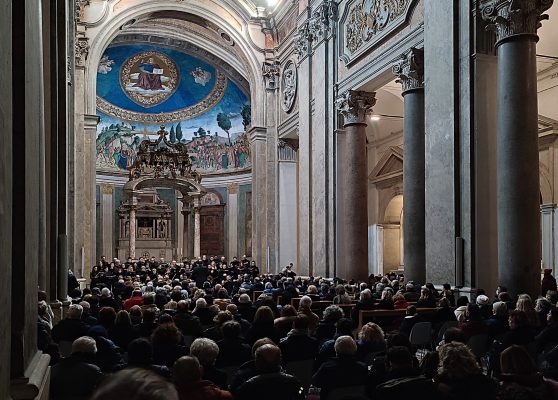
Inside the basilica, the interior space is defined by its three naves, which are separated by a series of ancient granite columns. These columns, along with the marble decorations, create a sense of continuity and historical depth. The central nave is adorned with a ceiling painting by Corrado Giaquinto, depicting Saint Helena in Glory, a masterpiece of 18th-century art that captures the viewer’s attention with its vibrant colors and dynamic composition.
Another significant artistic feature is the tomb of Cardinal Quiñones, designed by Jacopo Sansovino. This monument, located in the presbytery, showcases the skill and artistry of Renaissance sculpture, with intricate details and a harmonious composition that reflect the cardinal’s status and influence. The basilica’s artistic treasures extend to the frescoes of the apse, attributed to Antoniazzo Romano and Marco Palmezzano, which narrate the discovery of the True Cross, an event central to the basilica’s identity.
The Chapel of Saint Helena
The Chapel of Saint Helena, located in the basilica’s subterranean level, is a site of profound historical and spiritual significance. Originally constructed in the early Christian period, it was later renovated under the direction of Cardinal Bernardino López de Carvajal. The chapel’s mosaics, attributed to Baldassarre Peruzzi, depict scenes related to the True Cross, with figures of the Evangelists and Christ in a central medallion, all rendered in a vibrant palette that reflects the artistic sensibilities of the Renaissance.
Visitors to the chapel are also drawn to the statue of Saint Helena, originally a Roman statue of Juno, which was transformed with the addition of a cross and new features. This adaptation reflects the early Christian practice of repurposing pagan art for religious purposes, a testament to the syncretic nature of Roman Christianity. The chapel’s historical significance is further underscored by the presence of soil from the Holy Land, a symbolic gesture that connects the basilica to its Jerusalem namesake.
The Chapel of the Relics
The Chapel of the Relics, constructed in the 20th century, serves as the primary location for the basilica’s collection of sacred artifacts. Designed by architect Florestano Di Fausto, the chapel provides a fitting setting for the display of these relics, which include fragments of the True Cross, a nail from the Crucifixion, and a portion of the Titulus Crucis. These relics are housed in reliquaries crafted by Giuseppe Valadier, whose work in silver and gold reflects the importance of these sacred objects.
The chapel’s design emphasizes the spiritual significance of the relics, with a vestibule that features a cross-shaped door, symbolizing the centrality of the Cross in Christian theology. The arrangement of the relics invites reflection and veneration, offering visitors a tangible connection to the events of the Passion. This space, described by Pope John Paul II as a “sanctuary of the Cross,” continues to be a focal point for pilgrims seeking spiritual renewal and historical insight.
The Anfiteatro Castrense and Monastic Gardens
Adjacent to the basilica, the Anfiteatro Castrense offers a glimpse into the ancient Roman past. This structure, part of the larger Sessorian complex, was integrated into the Aurelian Walls and served as a bastion in later centuries. Its elliptical design and brick construction are characteristic of Roman engineering, providing a contrast to the basilica’s more recent architectural elements.
The monastic gardens, located within the amphitheater’s confines, were once a thriving part of the monastic life at Santa Croce. Though no longer cultivated, these gardens remain a point of interest for visitors, offering a peaceful retreat and a reminder of the site’s monastic heritage. Guided tours of the Anfiteatro Castrense are available, providing an opportunity to explore this lesser-known aspect of Rome’s archaeological landscape.
The History of Santa Croce in Gerusalemme
Santa Croce in Gerusalemme stands as a testament to the rich tapestry of history that envelops Rome. This basilica, known for its profound spiritual significance and historical depth, has undergone various transformations since its inception. Originally constructed in the 4th century, it was established not merely as a place of worship but as a reliquary to house sacred Christian relics. Over the centuries, it has been a focal point for pilgrims and a symbol of the Christian faith.
The basilica’s history is intertwined with the legacy of Saint Helena, mother of Emperor Constantine, who is credited with bringing the relics of the Passion to Rome. Throughout the ages, Santa Croce in Gerusalemme has been a site of significant architectural and religious evolution, reflecting the broader historical changes within the city of Rome and the Church itself.
Early Christian Era and Foundation (4th Century)
The origins of Santa Croce in Gerusalemme can be traced back to the early Christian period, when it was constructed under the auspices of Emperor Constantine. The basilica was built on the grounds of the Sessorian Palace, the residence of Constantine’s mother, Saint Helena. According to tradition, Saint Helena embarked on a pilgrimage to the Holy Land and returned with relics of the Passion, including fragments of the True Cross, which were enshrined in the basilica.
This period marked the transformation of the site from a Roman imperial residence to a Christian place of worship. The basilica was unique in its purpose, serving not as a memorial to martyrs but as a reliquary, housing sacred objects that were believed to hold immense spiritual power. This initiative by Saint Helena positioned Santa Croce in Gerusalemme as a pivotal location for Christian devotion and pilgrimage.
Medieval Transformations (10th – 14th Century)
During the medieval era, Santa Croce in Gerusalemme underwent significant architectural changes. In the 10th century, a monastery was established adjacent to the basilica, marking the beginning of a long monastic presence. The basilica itself was expanded and renovated, reflecting the Romanesque architectural style prevalent at the time. A notable transformation occurred under the guidance of Pope Lucius II in the 12th century, who initiated the construction of a Romanesque bell tower and the division of the basilica into three naves.
The medieval period also saw the basilica’s decline during the Avignon Papacy, when it was largely abandoned. However, it remained an important pilgrimage site, with its relics drawing visitors from across Christendom. The tradition of penitential pilgrimages, particularly during Lent, was established, with popes themselves participating in barefoot processions to venerate the relics.
Renaissance and Baroque Revival (15th – 18th Century)
The Renaissance brought renewed interest and investment in Santa Croce in Gerusalemme. In the late 15th century, the discovery of the Titulus Crucis, the inscription believed to have been affixed to the Cross of Jesus, sparked a wave of restoration efforts. The basilica’s interior was adorned with frescoes by renowned artists such as Antoniazzo Romano, depicting the stories of the True Cross.
In the 18th century, under the patronage of Pope Benedict XIV, the basilica underwent a significant Baroque transformation. Architects Pietro Passalacqua and Domenico Gregorini were commissioned to design a new facade, characterized by its elegant travertine and dynamic forms. This period marked a revival of the basilica’s religious and cultural significance, aligning it with the broader Baroque movement that swept through Rome.
Modern Era and Contemporary Developments (19th – 21st Century)
The modern era saw Santa Croce in Gerusalemme navigating the challenges of political and social change. Following the capture of Rome in 1870, the basilica’s property was largely confiscated by the Italian state, although the church itself remained under ecclesiastical control. The 20th century witnessed further restorations, as well as the establishment of a parish to serve the growing urban population surrounding the basilica.
In recent decades, the basilica has continued to adapt to contemporary needs while preserving its historical legacy. In 2009, the pastoral care of the basilica was transferred from the Cistercian monks to the diocesan clergy, marking the end of nearly a millennium of monastic presence. Today, Santa Croce in Gerusalemme remains a vital part of Rome’s religious and cultural landscape, attracting pilgrims and visitors from around the world.
Visiting Santa Croce in Gerusalemme
Approaching the Basilica
Visitors approaching the Basilica di Santa Croce in Gerusalemme are greeted by its impressive baroque facade, a testament to the architectural evolution the site has undergone over centuries. The basilica, located in the heart of Rome, is easily accessible via public transportation, with nearby metro stations such as San Giovanni and Lodi providing convenient access. As you walk towards the basilica, the historical significance of the area becomes palpable, with remnants of ancient structures like the Anfiteatro Castrense nearby, offering a glimpse into Rome’s imperial past.
The basilica stands as a prominent feature in the urban landscape, its travertine facade and towering campanile visible from a distance. The approach to Santa Croce in Gerusalemme is not only a journey through the streets of modern Rome but also a step back in time, allowing visitors to immerse themselves in the rich tapestry of history that characterizes this iconic site.
Exploring the Interior
Once inside, visitors can explore the basilica’s rich interior, which features a blend of architectural styles from different eras. The basilica’s three-aisled nave is adorned with cosmatesque flooring and houses numerous works of art, including the impressive frescoes by Corrado Giaquinto. These artworks, along with the monumental tomb of Cardinal Francisco Quiñones designed by Jacopo Sansovino, provide a visual narrative of the basilica’s historical and artistic significance.
The basilica also houses the Chapel of the Relics, where visitors can view sacred relics associated with the Passion of Christ, such as fragments of the True Cross and the Titulus Crucis. This chapel serves as a focal point for pilgrims and visitors alike, offering a space for reflection and spiritual connection. The interior of Santa Croce in Gerusalemme is a testament to the enduring legacy of religious devotion and artistic achievement.
Contextual Tips for Visitors
For those planning a visit to Santa Croce in Gerusalemme, it is advisable to consider incorporating the basilica into a broader itinerary that includes nearby attractions. The basilica is part of the traditional Giro delle Sette Chiese, a pilgrimage route that encompasses some of Rome’s most significant religious sites. This allows visitors to experience the spiritual and historical richness of Rome in a comprehensive manner.
While exploring the basilica, visitors should take time to appreciate the surrounding area, which includes the Anfiteatro Castrense and the Oratorio di Santa Maria del Buon Aiuto. These sites provide additional layers of historical context and enhance the overall experience of visiting Santa Croce in Gerusalemme. Whether you are a pilgrim seeking spiritual enlightenment or a history enthusiast eager to explore Rome’s past, the basilica offers a unique and enriching experience.