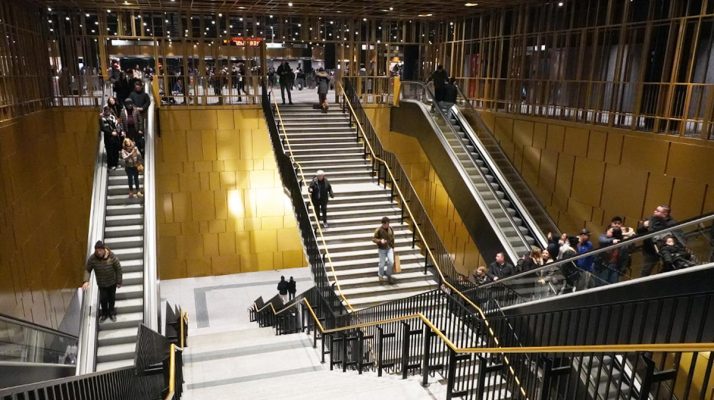
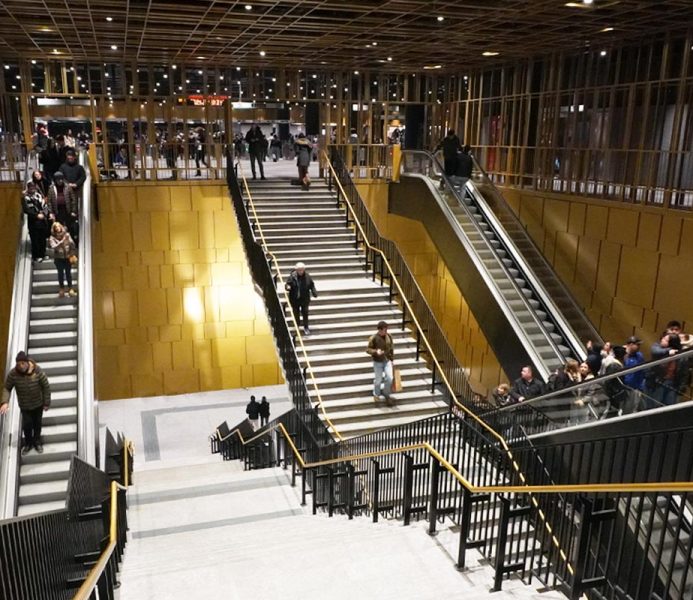
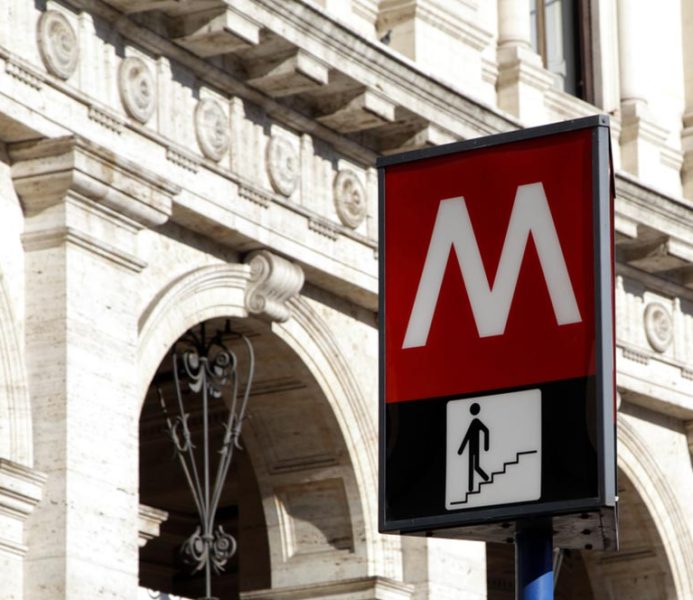
The opening of the Colosseo – Fori Imperiali station was accompanied by extensive and largely uniform media coverage, characterised by strongly celebratory tones. Newspapers, television reports, and institutional communication presented the intervention as an event of historic magnitude, capable of redefining the relationship between contemporary infrastructure and archaeological heritage.
This narrative had the merit of refocusing public attention on a project long awaited and realised under complex design conditions. At the same time, however, it contributed to simplifying a project that would require a more articulated reading, compressing objectives, design choices, and criticalities into a strongly symbolic account.
In a context such as that of the Imperial Fora, where every contemporary intervention confronts a stratification of exceptional historical density, this simplification risks shifting the debate away from the quality of spatial and museological experience toward the celebration of the work’s supposed exceptionalism.
The “most beautiful metro in the world”
The recurring expression used to describe the station — “the most beautiful metro in the world” — introduces an absolute aesthetic judgement that lends itself poorly to critical analysis. It is an effective communicative formula, but a problematic one when applied to a work that cannot be assessed independently of the context in which it is embedded.
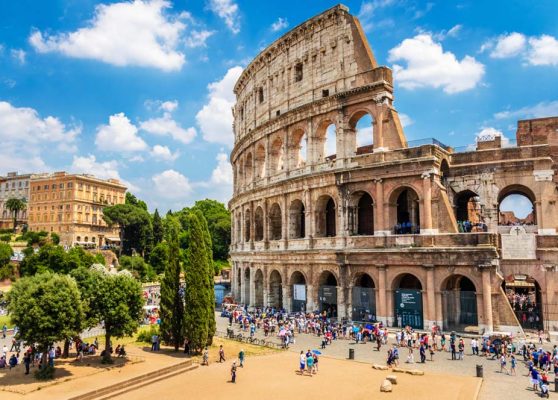
At the heart of the Imperial Fora, the perception of architecture is inevitably influenced by the symbolic force of the archaeological landscape: the Colosseum, the Palatine Hill, and the surrounding monumental remains amplify any contemporary intervention, making it difficult to distinguish the intrinsic quality of the project from the extraordinary nature of the place itself.
The risk lies in overlapping two distinct levels:
- on the one hand, the architectural and museological value of the station;
- on the other, the historical and iconic value of the urban context in which it is located.
Such an overlap does not encourage a conscious evaluation of the intervention, nor does it allow its limitations to be examined with serenity, without such scrutiny being perceived as a wholesale rejection of the project. A less hyperbolic narrative would likely have allowed the station to be addressed for what it is: a highly ambitious attempt to integrate infrastructure, archaeology, and cultural communication in one of the city’s most complex contexts.
During our visit, we identified two principal areas of criticality within the museological framework: the narrative choice and the exhibition experience.
Museum and Metro: Conceptual Integration
Integrating archaeological content within a metro station represents one of the most stimulating challenges of contemporary museology applied to public space. The case of the Colosseo – Fori Imperiali station therefore does not call into question the principle of integration itself, but rather its narrative and cultural translation within an infrastructure operating at the heart of one of the city’s most complex archaeological contexts.
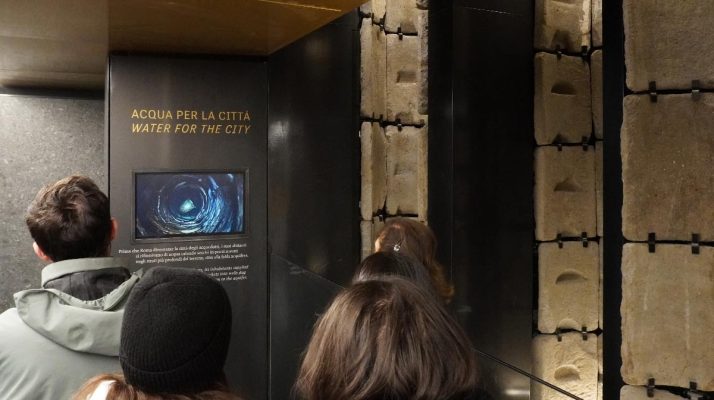
The project expresses a clear cultural ambition: to transform the descent into the underground into an experience of traversing history, allowing the vertical movement of the metro to dialogue with the site’s archaeological stratification. This ambition takes shape in a coherent museological framework, which adopts the theme of the “well” as the conceptual key to the entire route.
Exhibition and Narrative
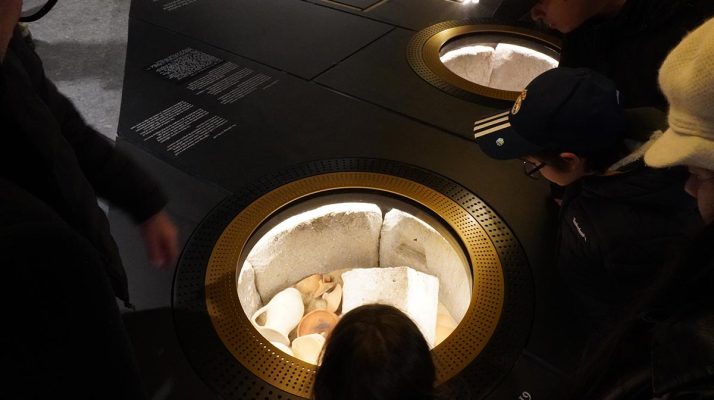
The reference to the well provides a clear and immediately recognisable guiding thread, organising artefacts and exhibition devices around the idea of descent, stratification, and the relationship between surface and subsoil. In this sense, the narrative is unitary and legible throughout the route, despite its physical fragmentation.
The theme is therefore neither obscure nor difficult to grasp. On the contrary, it is a conceptually solid choice that could have served as the basis for a broader archaeological narrative. The critical issue instead emerges in the very perimeter of the narrative, which tends to remain focused on the event of excavation and on the modalities of discovery.
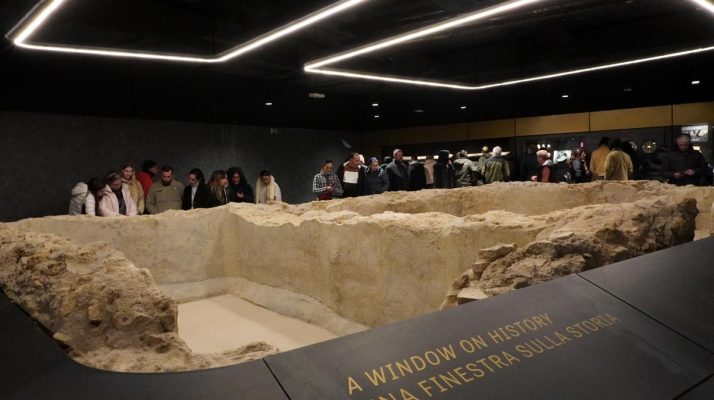
The well, as presented, primarily tells its own story: its emergence during archaeological investigations, its material restitution, the moment of discovery as it appeared to the archaeologists themselves. This approach — explicitly claimed at the institutional level — effectively conveys the viewpoint of the excavation, but risks assuming a self-referential character, oriented more toward the celebration of the discovery process than toward the construction of a shared narrative about the place.
Between the Story of Excavation and the Story of Place
From this perspective, the theme of the well functions as an internal narrative of the archaeological site, but struggles to become a tool of mediation toward the outside. The passenger is introduced to a story about the investigated subsoil, but not to one that prepares them to understand the archaeological landscape they will encounter upon returning to the surface.
The result is a significant gap between the underground narrative and the archaeological framework above ground. The 28 Republican-period wells, dating between the 5th and 2nd centuries BC and uncovered beneath the Velia and the slopes of the Oppian Hill, occupy a central role in the exhibition, yet their relationship to the Imperial Fora, the Colosseum, and the Palatine remains implicit, entrusted to the visitor’s prior knowledge rather than to an explicit narrative construction.
In this sense, the thematic choice appears poorly aligned with the immediately overlying context. Not because the well is a secondary or marginal element, but because its narrative is not directly connected to the monumental system that defines the identity of the place.
Exhibition Framework: Pause, Flows, and the Isolation of Experience
The issue becomes clearer when observing the exhibition experience as a whole. From an infrastructural standpoint, the placement of exhibition spaces in lateral areas, wide corridors, or dedicated environments does not significantly interfere with passenger flows. The pause required for archaeological engagement does not generate congestion nor compromise the station’s operation.
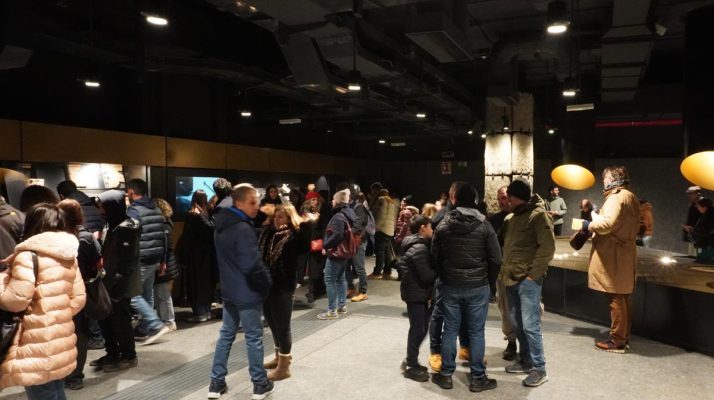
The issue instead lies on the experiential level. Engagement often takes place in spaces that remain external to the natural path of transit, transforming the encounter with archaeology into a separate, optional episode. This separation is particularly evident where the exhibition invites visitors into enclosed environments or dead-end corridors, requiring them to interrupt their movement and retrace their steps.
In such cases, museology does not come into conflict with infrastructure, but with the logic of movement: the cultural experience requires an intentional choice that isolates the narrative from everyday transit, rendering the exhibition less integrated than the project’s ambition would suggest.
The Station’s Museological Project
When compared with other models of integration between archaeology and infrastructure, the Colosseo – Fori Imperiali station occupies an intermediate position. Archaeology is integrated into the metro space, yet its experience does not always coincide with the passenger’s natural route. This ambiguity does not stem from a lack of design, but from the difficulty of reconciling, within the same space, movement, pause, and interpretation.
The overall impression is that of a musealisation constructed through successive additions, in which individual exhibition devices function effectively on a formal level but struggle to compose a continuous and progressive experience capable of accompanying the visitor throughout the entire route.
In this regard, it is useful and instructive to consider the exhibition framework of the San Giovanni station, also part of Line C. There, musealisation was conceived as a continuous stratigraphic narrative, legible during movement and integrated into obligatory paths.
The artefacts placed at the centre of corridors serve a dual function: exhibition and flow regulation. Graphics along the escalators guide passengers through a chronological journey that requires neither pauses nor detours, presenting itself as a progressive and intuitive experience.
This comparison does not aim to establish hierarchies of value, but highlights two profoundly different approaches: on the one hand, a museology integrated into movement; on the other, a museology that introduces points of friction between exhibition and transit.
Another exemplary case worth mentioning is the Syntagma metro station in Athens, one of the most successful examples of archaeological integration within a metropolitan context. Artefacts uncovered during excavation are displayed along obligatory routes, through continuous cases and glazed walls that accompany movement without requiring detours, forced stops, or intentional choices on the part of passengers.
In this model, archaeology becomes part of the traversed landscape: engagement occurs during transit, and the narrative relies on visual continuity, clarity of display, and simplicity of information. The result is a form of musealisation fully compatible with the nature of the infrastructure, in which historical narration does not interrupt flow but accompanies it.
Critical Issues of the Exhibition Framework: Fragmentation and Isolation
The main critical issues of the exhibition framework at the Colosseo – Fori Imperiali station do not concern the quality of individual displays nor the value of the artefacts presented, but rather the way in which the museological experience is articulated within the station’s space. Two closely connected nodes emerge in particular: fragmentation of the narrative and isolation of certain exhibition devices from the natural transit route.
Fragmentation of the Narrative
Within the station, archaeological content is distributed across corridors, transit nodes, and dedicated environments, predominantly in lateral positions. From an infrastructural standpoint, this choice is effective: displays do not interfere with primary flows nor compromise station functionality.
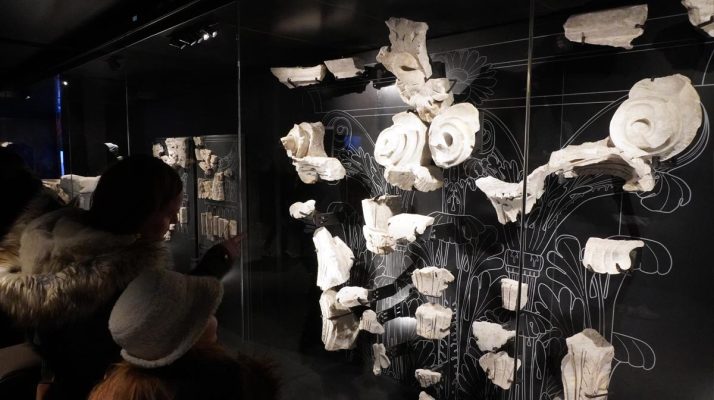
From a museological perspective, however, this distribution produces a discontinuous experience. Artefacts appear as autonomous episodes rather than as parts of a progressive interpretive sequence. The theme of the well provides a unitary conceptual reference, yet struggles to translate into a narrative that accompanies visitors along the entire route.
In the absence of a clearly perceptible narrative hierarchy, archaeology is received as a summation of presences rather than as a construction of meaning. For passengers crossing the station without an explicit intention to visit, the narrative often remains in the background, entrusted to the suggestive power of the artefact rather than to a structured reading.
Isolation of the Exhibition Experience
A second critical element concerns the isolation of certain exhibition spaces from the metro’s ordinary route. In several instances, archaeological engagement requires a deliberate choice: entering enclosed spaces, deviating from the main path, interrupting movement, and in one case in particular, retracing one’s steps.
This configuration does not generate infrastructural problems, but significantly affects the overall experience. Archaeology is perceived as a separate, optional episode that does not naturally embed itself within everyday transit. In this sense, integration between museum and metro remains partial.
If the intention was to isolate the museological experience, a more coherent solution would have been the model adopted at the Yenikapı metro in Istanbul, where archaeology is housed within autonomous museum spaces, clearly distinguished from transport infrastructure. There, separation is explicit and functional: visitors know when they are entering a museum and when they are using the metro.
The Street-Level Glazed Hall
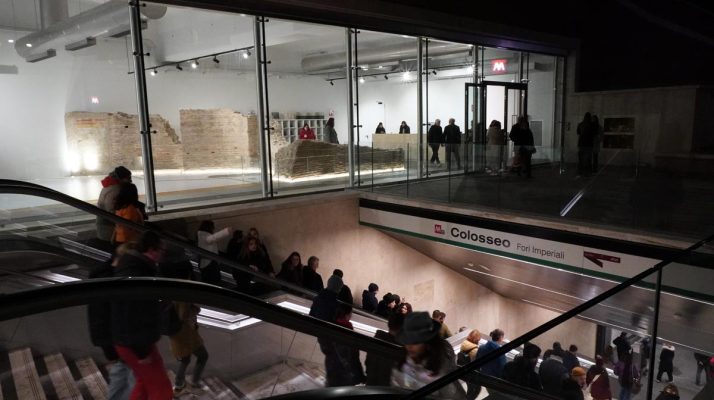
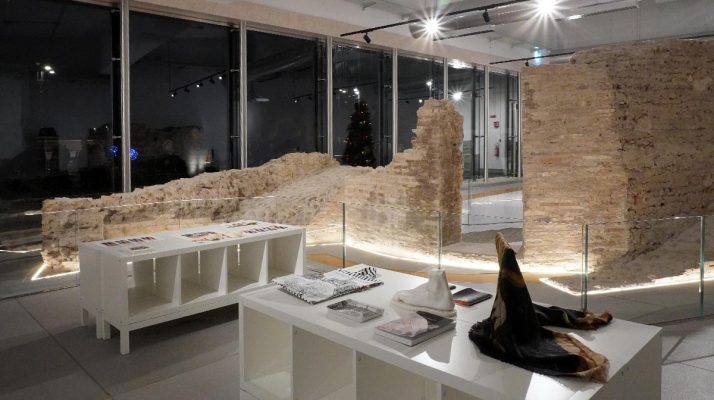
The large glazed hall facing Via dei Fori Imperiali exemplifies this ambiguity. Architecturally, the space is of high quality: at its centre lie the remains of a Roman-period structure, likely a domus, enhanced by grazing lighting that precisely defines the perimeter of its walls.
Placing the artefact at the centre of the hall produces an effect of strong formal legibility, while the expansive glazing ensures effective visual continuity between interior and exterior. However, the hall is not traversed by metro flows: accessing it requires exiting the station and walking around the escalator area.
The result is a hybrid condition. Visibility is high, but narrative continuity with the metro experience remains weak. The space does not fully assume the status of an autonomous museum nor that of an integral part of the transit route. The presence of an area designated for a shop and of deliberately neutral surfaces reinforces the perception of a representational environment — aesthetically controlled yet narratively indeterminate.
The Dead-End Corridor
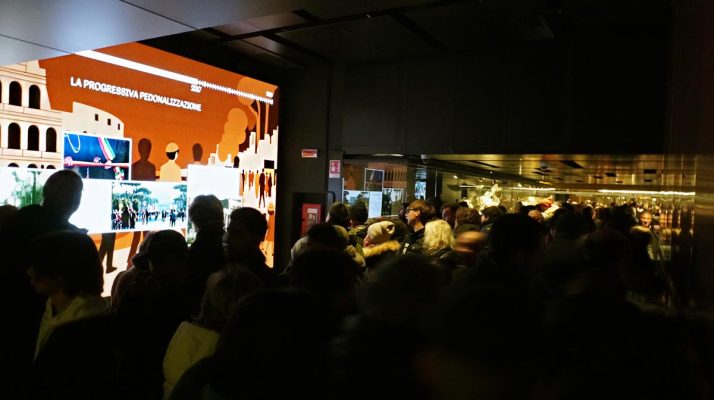
A more pronounced criticality is concentrated in the exhibition corridor near the ticket barriers, configured as a space without alternative exits. To view the displayed content, visitors are invited into an environment that leads nowhere else, necessitating a reversal of direction.
This device accentuates the separation of the museological experience from ordinary transit. Engagement takes on the character of a closed and intentional episode, requiring time, pause, and focused attention. During our visit, this configuration generated situations of crowding and congestion, highlighting the criticalities of an exhibition space that does not naturally absorb flows but interrupts them.
(img corridor DSC01224)
A Station as Cultural Threshold
When compared with the autonomous museum model (Yenikapı Metro, Istanbul) and the integrated and functional model (Syntagma Metro, Athens), the Colosseo – Fori Imperiali station appears positioned in an intermediate zone. Archaeology is present, enhanced, and made visible, yet its experience oscillates between integration and separation, without fully adhering to either logic.
In a context such as that of the Imperial Fora, this ambiguity carries particular weight. For a significant portion of visitors, the station represents the first point of contact with Rome’s central archaeological area. Emerging here, passengers find themselves suddenly immersed in one of the world’s most complex historical landscapes, often without immediate tools for orientation among epochs, functions, and transformations.
From this perspective, the station could have more decisively assumed the role of a cultural threshold: not so much a site of autonomous exhibition, but a space preparing visitors for engagement with the archaeological landscape above ground. A narrative more clearly oriented toward the Imperial Fora, the Palatine, and the Colosseum — supported by historical cartographies, simplified stratigraphic sections, and spatial interpretive keys — might have rendered the experience more immediately intelligible for passengers in transit.
The Colosseo – Fori Imperiali station remains an ambitious work, of high architectural quality and notable design complexity. The critical issues outlined here do not call its value into question, but rather invite broader reflection on how archaeology can be communicated within spaces of everyday movement, without sacrificing either narrative depth or infrastructural nature.
Ultimately, more than an additional underground museum, the context of the Imperial Fora calls for devices capable of orienting the gaze. It is on this capacity for mediation — between past and present, movement and understanding — that the cultural responsibility of a station located at the very heart of Rome’s history is played out.
ArcheoRoma was founded precisely with this objective: to promote a conscious reading of archaeology and the history of architecture through interpretive tools that are rigorous yet accessible. In this sense, the reflection on the Colosseo – Fori Imperiali station is not a critique of the work itself, but an invitation to clarify which model of cultural communication is intended when contemporary infrastructure settles into the most delicate point of Rome’s urban palimpsest.