Rome hosts an exhibition dedicated to one of the most influential and revolutionary artists of the twentieth century explores the artistic and theoretical journey of Vasily Kandinsky, the painter widely regarded as one of the founders of abstract art. More than a stylistic innovator, Kandinsky transformed the very meaning of painting, freeing it from the obligation to represent the visible world and opening it to the realm of spiritual and emotional experience.
Through paintings, studies, and thematic sections, the exhibition traces the progressive development of a language in which color, form, and composition become autonomous forces. Kandinsky’s work emerges not merely as an aesthetic revolution, but as a profound reflection on perception, harmony, music, and the inner dimension of human experience.
Vasily Kandinsky and the origins of abstract art
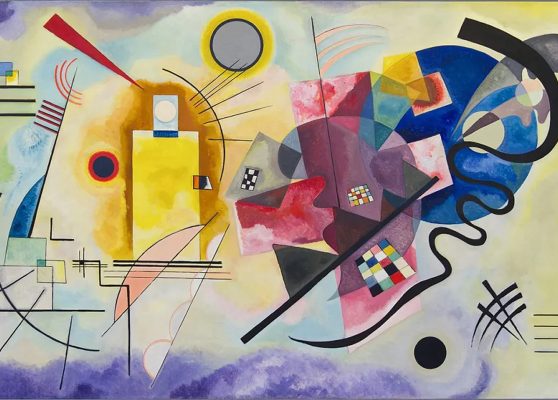
Wassily Kandinsky (Russian name Vasily Vasilyevich Kandinsky) occupies a foundational place in the history of modern art. Born in Moscow in 1866, he developed a highly original artistic vision shaped by Russian traditions, European modernism, symbolism, and music. His path toward abstraction was not sudden, but the result of a gradual transformation in which figurative elements increasingly dissolved into rhythms of color and line.
In his early works, landscapes and figures remain recognizable, yet they are already permeated by emotional intensity and chromatic freedom. The visible world becomes secondary to the expressive power of painting itself. Kandinsky progressively abandoned descriptive representation in favor of a visual language capable of communicating directly with the viewer’s inner sensibility.
Color as spiritual experience
One of the central aspects of Kandinsky’s artistic theory is the idea that color possesses an autonomous emotional and spiritual force. For the artist, colors were not decorative elements but living energies capable of affecting the human soul. Each tone carried its own psychological vibration, comparable to musical sounds.
This analogy between painting and music became fundamental to his work. Kandinsky conceived compositions as visual symphonies in which forms, contrasts, and chromatic harmonies functioned like notes and rhythms. The painting was no longer a window onto reality, but an immersive and emotional experience.
Concerning the spiritual in art
Kandinsky’s theoretical vision found its clearest expression in his influential text Concerning the Spiritual in Art. In this work, he argued that modern art should move beyond mere imitation of nature and instead express inner necessity. Painting, according to Kandinsky, had the power to reveal invisible dimensions of human consciousness.
This concept became one of the foundations of abstraction. The disappearance of recognizable subjects was not a rejection of reality, but an attempt to reach a deeper and more universal form of expression.
Music, rhythm and composition
Music plays an essential role in Kandinsky’s development and artistic philosophy. This is not merely a metaphorical reference, but a structural model. The artist regards music as the art form most free from material representation, capable of acting directly upon the senses without having to imitate objects or figures. From this realisation stem titles such as Improvisations, Impressions and Compositions, which reveal a desire to transfer principles inherent to the auditory experience into the visual realm.
Lines can be sharp, gentle, broken or ascending; colours can function as chords, dissonances or harmonies. The canvas becomes a temporal space, traversed by tensions, pauses, accelerations and counterpoints. This relationship with music enables Kandinsky to transcend the traditional structure of the painting and to conceive the work as a dynamic organism, rather than as a window onto an external world.
The theme of the exhibition: form, colour and spirituality
The exhibition focuses on the very essence of the artist’s work: the gradual liberation of painting from figurative subjects and the development of a language based on the relationship between form, colour and spirituality. The title itself identifies Kandinsky not merely as a leading figure in abstraction, but as a master of a new way of conceiving the image.
Visiting this exhibition means stepping into the studio of an artist who did not simply invent a style, but transformed the very question of the meaning of painting. What remains of the work when the figure disappears? How can colour and line communicate without depicting? What relationship is established between image and inner life? The exhibition invites visitors to engage with these questions, demonstrating how Kandinsky constructed a visual grammar capable of influencing not only twentieth-century painting, but also design, architecture, graphic design and many contemporary artistic practices.
Abstraction as a new visual language
Kandinsky’s abstraction is deeply structured and intentional. Even his most dynamic compositions reveal a careful balance between movement and order. Contrasts between curves and diagonals, between dense chromatic areas and empty spaces, generate visual tensions that engage the viewer directly.
This innovative language profoundly influenced twentieth-century art, design, architecture, and visual culture. Kandinsky’s paintings continue to appear remarkably contemporary because they address universal questions about perception, emotion, and the relationship between art and spirituality.
The value of the mark
In Kandinsky’s artistic journey, the mark gradually takes on an autonomous function. It no longer serves to delineate a naturalistic outline, but becomes a trace, an impulse, a direction. An oblique line may suggest tension; a curve may introduce fluidity; a dot may condense energy; a geometric shape may stabilise space or, conversely, set it vibrating.
This system of relationships makes Kandinsky’s work particularly relevant today. In an age accustomed to concise and immediate visual languages, Kandinsky reminds us that the mark is never neutral. Even when it does not represent an object, it produces meaning, guides perception and constructs a form of experience.
The dialogue with Expressionism and Der Blaue Reiter
A decisive turning point in Kandinsky’s artistic career was his relationship with the German Expressionist milieu and, in particular, with Der Blaue Reiter, the group founded together with Franz Marc and driven by a profoundly innovative vision of art. Der Blaue Reiter was not merely a stylistic movement, but a crossroads of experiences, sensibilities and explorations aimed at transcending the boundaries of traditional representation.
In this context, Kandinsky found fertile ground for developing his own concept of art as an expression of inner life. His focus on colour, and his interest in primitivism, folklore, folk art and non-European cultures, all contributed to the development of a style of painting free from academic conventions. However, compared with other leading figures of Expressionism, Kandinsky took his exploration a step further: the gradual disappearance of the subject and the emergence of an autonomous pictorial field.
The knight as an image of transition
The motif of the horseman, a recurring theme in the artist’s early phase, can be interpreted as a symbolic figure of transition. It still retains a narrative residue, yet is already tending towards dissolution within the energy of colour and movement. The horseman is not merely an iconographic presence: he is the sign of a painting in motion, the image of a transformation that is reshaping the very language of art.
From this perspective, the exhibition helps us understand how the abstract revolution did not arise suddenly, but through successive stages, experiments, digressions and theoretical explorations. Kandinsky did not abandon the figure on a whim; he moved beyond it because he felt the need for a language better suited to expressing the complexity of inner experience.
The influence of music
Music remained a decisive influence throughout Kandinsky’s career. Titles such as “Improvisations”, “Impressions”, and “Compositions” reveal his intention to transfer musical principles into visual form. Lines become rhythms, colors become harmonies, and the canvas becomes a space of movement and resonance.
For Kandinsky, painting was capable of producing emotional effects comparable to those created by music, acting directly upon the spectator without the mediation of recognizable imagery.
The exhibition path of “Vasily Kandinsky, Master of Abstraction”
The exhibition path follows the major stages of Kandinsky’s artistic development, from his early figurative works to the mature abstraction that defined his international legacy. Visitors can observe how his compositions gradually evolve from symbolic landscapes and folkloric references toward increasingly autonomous arrangements of color and form.
The exhibition also highlights Kandinsky’s connection with the German Expressionist movement and the group Der Blaue Reiter, founded together with Franz Marc. This experience proved crucial in shaping his vision of art as a spiritual and emotional language rather than a descriptive one.
From russian traditions to european modernism
Kandinsky’s Russian cultural roots played an important role in his artistic imagination. Folk traditions, religious icons, and decorative motifs influenced his sensitivity to color and symbolism. These elements remained present even as he embraced the avant-garde movements of modern Europe.
Rather than rejecting tradition, Kandinsky transformed it into a new visual vocabulary. His work bridges folklore, symbolism, expressionism, and abstraction, creating a unique synthesis that reshaped the course of modern art.
Folklore and visual memory
Elements linked to Russian folklore provide an important key to understanding the chromatic and imaginative richness of his early works. The visual memory of his childhood and his cultural heritage fuels a style of painting in which the narrative is often imbued with a sense of enchantment, suspension and transfiguration. Even when the figure is still present, it appears immersed in a mental atmosphere rather than a descriptive one.
This dimension helps to avoid an overly cold interpretation of Kandinsky’s abstraction. His art does not arise solely from formal calculation, but from a layering of experiences, memories, perceptions and spiritual tensions. The abstract order does not eliminate the imagination: it concentrates it into a more essential structure.
Folklore and visual memory
Elements linked to Russian folklore provide an important key to understanding the chromatic and imaginative richness of his early works. The visual memory of his childhood and his cultural heritage fuels a style of painting in which the narrative is often imbued with a sense of enchantment, suspension and transfiguration. Even when the figure is still present, it appears immersed in a mental atmosphere rather than a descriptive one.
This dimension helps to avoid an overly cold interpretation of Kandinsky’s abstraction. His art does not arise solely from formal calculation, but from a layering of experiences, memories, perceptions and spiritual tensions. The abstract order does not eliminate the imagination: it concentrates it into a more essential structure.
Studies and theoretical research
Alongside major artworks, the exhibition includes studies and materials that reveal Kandinsky’s intellectual rigor. His research into the psychological effects of color, geometric balance, and compositional harmony demonstrates how abstraction emerged through systematic experimentation as much as intuition.
These materials allow visitors to understand that Kandinsky’s paintings were never arbitrary. Behind their apparent spontaneity lies a carefully constructed visual system based on rhythm, tension, and emotional resonance.
Why visit the Kandinsky exhibition
Visiting the exhibition means engaging with one of the defining moments of modern art. Kandinsky did not simply introduce new forms into painting: he transformed the very way we understand the relationship between the artwork, the artist and the viewer. His legacy remains fundamental because it places the active dimension of perception at the centre. Standing before one of his paintings, the viewer seeks not merely a subject to recognise, but a system of relationships to navigate.
The exhibition therefore offers a significant opportunity not only for scholars and enthusiasts of modern art, but also for anyone wishing to understand the origins of many contemporary visual languages. Kandinsky’s abstraction paved the way for new expressive possibilities, influencing movements, disciplines and practices that extend far beyond easel painting.
An artist who remains contemporary
Kandinsky’s contemporary relevance lies in his ability to explore the relationship between image and sensibility. In a present dominated by a ceaseless production of images, his work invites us to slow down our gaze and appreciate the intrinsic quality of forms. Colour is not visual consumption, but experience; the line is not ornament, but direction; composition is not a random arrangement, but a structure of meaning.
This relevance makes the exhibition particularly significant. Kandinsky still speaks to us today because he addresses issues that remain crucial: the autonomy of visual language, the relationship between art and spirituality, the role of intuition, the emotional power of colour, and the possibility of creating images that are not descriptive but deeply communicative.
A key to understanding the twentieth century
To understand Kandinsky is to gain access to one of the interpretative keys to the artistic twentieth century. Without his work, it would be difficult to understand the deepest roots of many subsequent developments in abstract art, the Informel movement, modern design and visual composition. His work marks a before and after: before, painting was still predominantly tied to representation; after Kandinsky, the image can exist as an autonomous entity.
The exhibition allows visitors to follow this transformation from within, presenting to the public not only the final outcome of the abstract revolution, but also its premises, its hesitations and its gradual emergence.