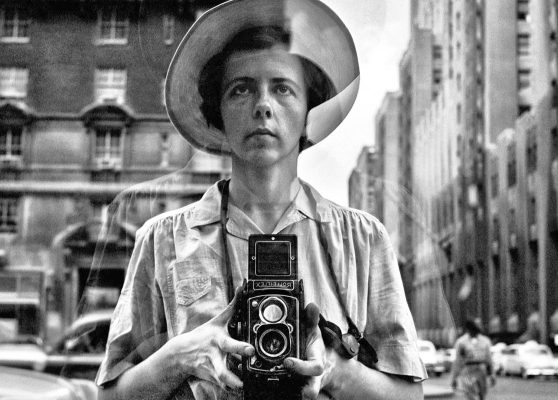
The exhibition “Vivian Maier and Ugo Nespolo” is conceived as a scholarly investigation into the plurality of visual languages that shaped the twentieth century. Rather than proposing a traditional comparative framework, the project establishes a critical dialogue between two artists whose practices differ profoundly in medium, intention, and historical positioning.
Vivian Maier’s photography, produced in near-total anonymity, and Ugo Nespolo’s multidisciplinary conceptual work are presented as parallel yet converging trajectories, united by a shared resistance to standardization and by an uncompromising commitment to intellectual autonomy.
Within a broader reflection on modern visual culture, the exhibition foregrounds the artist’s role as observer, analyst, and critical agent, encouraging a reassessment of how images participate in the construction of social meaning.
Independent visual languages in XX-century art
The twentieth century marked a decisive rupture in the history of visual representation. The proliferation of new media, the fragmentation of artistic movements, and the increasing intersection between art, mass culture, and politics fundamentally transformed the status of the image. Within this complex landscape, photography and contemporary visual art emerged as autonomous yet deeply interconnected languages, capable of articulating new forms of knowledge and critique.
Artistic autonomy as a critical position
Both Vivian Maier and Ugo Nespolo exemplify forms of artistic autonomy that resist assimilation into dominant cultural systems. Their practices cannot be understood merely as stylistic choices, but as deliberate epistemological positions. Autonomy, in this context, signifies the refusal to subordinate artistic production to external validation, whether commercial, institutional, or ideological.
Marginality and independence
Maier’s marginality was literal and structural: her photographic work remained unseen during her lifetime, developed entirely outside professional artistic circuits. Nespolo’s marginality, by contrast, was strategic: despite active participation in contemporary debates, he consistently avoided rigid affiliations, cultivating a language that eludes definitive classification. The exhibition frames these distinct forms of independence as equally significant responses to the pressures of twentieth-century cultural production.
Observation and intervention as complementary strategies
The dialogue between Maier and Nespolo articulates a fundamental polarity within modern visual practice. Maier’s work is grounded in observation, privileging attentiveness, patience, and ethical restraint. Nespolo’s practice operates through intervention, actively manipulating visual codes in order to expose their constructed nature. Together, these strategies delineate a broad spectrum of artistic engagement with reality.
Vivian Maier: street photography and the ethics of the gaze
Vivian Maier occupies a singular position within the history of street photography, not only for the extraordinary quality of her images but for the ethical stance that underlies her entire body of work. Her photographs are never conceived as spectacles of urban life; rather, they function as quiet acts of observation, grounded in attentiveness, restraint, and respect for the autonomy of her subjects. This ethical dimension distinguishes Maier from many of her contemporaries and situates her practice within a broader reflection on the responsibility inherent in the act of looking.
The city as a space of lived experience
Maier’s urban photography unfolds within streets, sidewalks, shop windows, and public transportation, spaces where social life reveals itself through fleeting gestures and unguarded expressions. The city emerges not as a monumental or idealized environment, but as a living fabric composed of individuals whose presence is often overlooked. Her camera records moments of waiting, walking, working, and observing, transforming the everyday into a visual archive of modern existence.
Time, contingency, and the decisive moment
Rather than seeking dramatic events, Maier focuses on moments of apparent insignificance. A glance exchanged between strangers, a child’s posture, or the rhythm of bodies in motion becomes meaningful through precise framing and temporal intuition. These images testify to a conception of photography as a tool for preserving transient human experiences, emphasizing contingency over narration.
Social margins and visual dignity
Throughout her work, Maier demonstrates a consistent interest in subjects positioned at the margins of dominant social narratives. Children, elderly individuals, women, and working-class figures appear not as symbols but as autonomous presences. Her approach avoids sentimentalism and moral judgment, allowing dignity and vulnerability to coexist within the photographic frame.
Distance as ethical choice
Maier’s physical and emotional distance from her subjects constitutes an ethical decision rather than a lack of engagement. By maintaining this distance, she resists appropriation and voyeurism, granting her subjects a form of visual autonomy rarely achieved in documentary photography.
Self-portraits and the problem of authorship
Maier’s numerous self-portraits represent one of the most conceptually complex aspects of her work. Often mediated through mirrors, shadows, or reflective surfaces, these images challenge conventional notions of photographic self-representation. The photographer appears fragmented, displaced, or partially concealed, suggesting a continuous questioning of identity and authorship.
Visibility and withdrawal
Rather than asserting presence, Maier’s self-portraits articulate a tension between visibility and withdrawal. The act of photographing oneself becomes an inquiry into the limits of self-knowledge, reinforcing the introspective dimension of her practice.
Black and white as moral and formal structure
The predominance of black and white photography in Maier’s work reflects both formal discipline and ethical clarity. The absence of color concentrates attention on composition, contrast, and human expression, reinforcing the documentary gravity of her images while stripping away superfluous visual distraction.
Ugo Nespolo: conceptual art, pop aesthetics, and cultural critique
Ugo Nespolo is a central figure in contemporary Italian art whose work defies rigid categorization. His artistic practice, spanning painting, sculpture, film, and applied arts, is grounded in a persistent interrogation of visual language and cultural conventions. Through conceptual art and Pop aesthetics, Nespolo articulates a critical vision of modern society that is both intellectually rigorous and formally playful.
Between Pop Art and conceptual experimentation
Nespolo’s engagement with Pop Art does not manifest as stylistic imitation but as critical appropriation. He adopts the visual immediacy and chromatic intensity associated with popular imagery while simultaneously undermining its communicative transparency. Text, symbols, and familiar forms are reassembled into compositions that resist straightforward interpretation.
Visual language as constructed system
By exposing the mechanisms through which images generate meaning, Nespolo reveals visual language as a constructed system rather than a neutral medium. His works encourage viewers to recognize how cultural values and ideologies are embedded within visual forms.
Irony as an analytical strategy
Irony constitutes one of the most distinctive elements of Nespolo’s artistic vocabulary. Far from functioning as mere humor, irony operates as a critical tool capable of destabilizing established hierarchies and exposing contradictions within artistic and cultural institutions.
Active spectatorship and interpretative freedom
Nespolo’s works demand intellectual participation. Meaning is never imposed but emerges through the viewer’s engagement with visual cues, linguistic fragments, and conceptual dissonance. This requirement for active spectatorship aligns his practice with the foundational principles of conceptual art.
Interdisciplinarity and expanded visual practice
Nespolo’s involvement in experimental cinema and performance extends his investigation into time, movement, and narrative. These practices situate his work within an expanded field of artistic production, dissolving boundaries between disciplines and reinforcing the conceptual coherence of his oeuvre.
“Vivian Maier and Ugo Nespolo” brings together two radically independent figures of twentieth-century visual culture. Through street photography and conceptual art, the exhibition explores ethics of the gaze, Pop aesthetics, and artistic autonomy, offering a rigorous investigation into how images construct meaning within modern society.
The exhibition path
The exhibition path of “Vivian Maier and Ugo Nespolo” is conceived as a structured yet fluid journey that privileges critical understanding over chronological narration. The curatorial project emphasizes clarity and depth, allowing each artistic language to unfold according to its own internal logic while encouraging moments of conceptual resonance.
Monographic sections and thematic dialogue
The exhibition is organized into distinct monographic sections dedicated to each artist, ensuring that their respective practices are presented with sufficient contextual depth. These sections are punctuated by thematic spaces designed to stimulate reflection on shared concerns such as identity, representation, and the role of the artist within society.
Respecting artistic specificity
The curatorial approach avoids forced comparisons, instead allowing affinities to emerge organically. Photography and visual art are presented as parallel languages, each retaining its autonomy while contributing to a broader discourse on twentieth-century visual culture.
Spatial rhythm and visual pacing
The spatial arrangement of works follows a rhythm that alternates between density and pause, encouraging sustained attention rather than rapid consumption. This pacing reflects the intellectual demands of both artists’ practices and fosters a contemplative mode of viewing.
Lighting, materials, and perceptual focus
Lighting and display systems are calibrated to enhance perceptual clarity without theatrical effects. This restraint reinforces the exhibition’s scholarly character, directing attention toward the works themselves rather than their scenographic framing.
Interpretive tools and critical mediation
Wall texts, archival materials, and interpretive resources provide essential historical and theoretical context. These elements are integrated discreetly into the exhibition path, supporting informed engagement while preserving the primacy of direct visual experience.