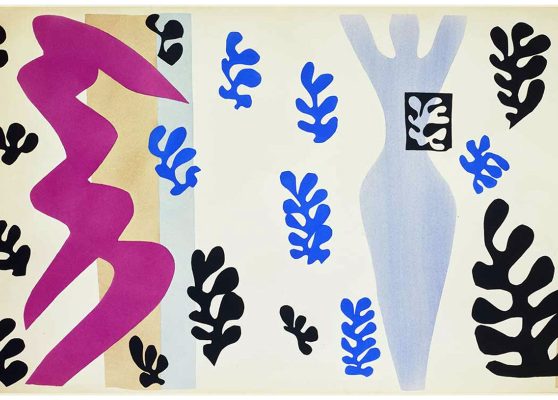
The exhibition offers a rare opportunity to explore one of the most intense and radical moments in the artistic research of Henri Matisse. The show, structured through an extensive itinerary of more than one hundred works from private collections, focuses on the French artist’s production on paper, highlighting the final phase of his creative activity. During these years—marked by physical limitations yet characterized by extraordinary intellectual clarity—Matisse developed a visual language that definitively moved beyond traditional painting, reaching a formal synthesis grounded in the interaction between line, color, and space.
Drawings, lithographs, illustrated books and the celebrated papiers découpés reveal the process through which the artist redefined the principles of modern composition. The exhibition does not merely present works of great visual appeal, but proposes a critical reflection on a decisive phase in the history of twentieth-century art.
Henri Matisse and the search for the essential
The master of Fauvism beyond painting
Henri Émile Benoît Matisse (Le Cateau-Cambrésis, 1869 – Cimiez, 1954) occupies a central position in the history of modern art. A protagonist of the European avant-gardes and a leading figure of Fauvism, the French painter revolutionized the use of color, transforming it from a descriptive element into a structural principle of composition. The celebrated canvases of the early twentieth century, characterized by intense chromatic contrasts and an anti-naturalistic approach, inaugurated a new conception of pictorial space and profoundly influenced European art.
However, reducing his work to this phase would oversimplify an extremely complex creative trajectory. After the Parisian avant-garde years, Matisse undertook a long stylistic evolution that gradually led him toward increasingly essential forms. During the 1920s and 1930s, the artist developed a research that crossed drawing, graphic arts, artists’ books, and stage design, expanding the field of his visual experimentation.
The Nice period and the transformation of language
A decisive chapter of this journey corresponds to the so-called Nice period, which occupies a significant portion of the artist’s career. In these years Matisse deepened the relationship between line and color, developing an increasingly synthetic visual grammar. The figure is no longer constructed through the accumulation of pictorial matter, but emerges from a calibrated balance between sign and surface.
The artist’s creative process is based on a principle of progressive reduction. Every superfluous element is eliminated until an essential structure is reached. In this context, graphic work assumes a fundamental role. Drawing becomes a space of formal concentration in which the gesture must be immediate and definitive. As Matisse himself observed: “I make no distinction between the execution of a book and that of a painting.” This statement underscores the continuity between the different fields of his research.
The line as a form of thought
In the drawings and lithographs produced from the 1920s onward, the line assumes an autonomous function. It does not merely delimit forms but becomes the place where the very idea of the image takes shape. The Matissian sign, apparently spontaneous, is in fact the result of a long mental elaboration.
This economy of gesture reveals a profoundly modern conception of the artistic process. The artwork does not arise from technical complexity, but from the ability to identify formal balance through a few essential elements. In this perspective, paper is not a secondary support but rather a privileged space of experimentation.
Works on paper and the birth of the Papiers Découpés
A formal revolution in twentieth-century art
Matisse’s production on paper represents one of the most significant contributions to postwar art. Drawings, lithographs and editorial illustrations testify to an approach to composition based on synthesis and on the equilibrium between solids and voids.
In these works the white of the paper plays an active role in the construction of the image. It is not merely a neutral background but a structural component of the composition. The relationship between sign and surface thus becomes an integral part of the creative process.
The famous Cut-Outs
In the 1940s, following a serious illness that often forced him to work from a wheelchair, Matisse introduced a technique destined to mark the history of modern art: the papiers découpés, also known as cut-outs.
The procedure appears deceptively simple. The artist painted large sheets of paper with gouache, cut them with scissors, and recomposed them on the surface according to a dynamic balance. In reality, behind this apparent simplicity lies a complex process of visual design.
The cut shapes become constructive elements of a language based on the relationship between color and space. The forms do not imitate reality but generate autonomous structures, often characterized by a visual rhythm that recalls music or dance.
The Book “Jazz” and editorial art
Among the most emblematic achievements of this phase is the celebrated book Jazz, published in 1947. The lithographic plates that compose it represent one of the highest moments of Matisse’s artistic research.
The images are constructed through colored forms that resemble visual improvisations, analogous to the musical structure of jazz. The result is a sequence of vibrant compositions in which color and rhythm become instruments of a new form of visual narration.
Exhibition path
Itinerary in four sections
The exhibition unfolds through four thematic sections, conceived to convey the complexity of Matisse’s graphic production. More than one hundred works allow visitors to observe the evolution of the artist’s language and the progressive transition from painting to paper as a privileged space of creation.
Verve: Matisse and art publishing
The first section is dedicated to the magazine Verve, an editorial project directed by Tériade that brought together some of the leading figures of modern art. The lithographs and drawings on display testify to the dialogue between image and text and show how Matisse used the printed page as a field of experimentation.
The line becomes essential, reduced to a few strokes capable of suggesting the figure with extraordinary effectiveness. This graphic economy anticipates many of the solutions developed in later years.
Artists’ books and illustration
The second section explores Matisse’s relationship with the illustrated book. Drawings created for literary works such as Une fête en Cimmérie and Lettres Portugaises demonstrate how the artist was able to translate emotional states and psychological tensions into images through only a few signs.
In these works the human face becomes the privileged site of expressive research. Thin and precise lines evoke complex emotions without resorting to unnecessary details.
The Book Jazz
A specific section is dedicated to the famous book Jazz, featuring a selection of lithographic plates that testify to the culmination of the artist’s research on paper cut-outs. Colored forms are arranged across the surface with a visual rhythm that resembles a musical score.
These images are not simple illustrations but fully autonomous compositions in which color becomes structure and movement.
Drawing
The final section of the exhibition is dedicated to drawing, a central element in Matisse’s poetics. Lithographs and graphic studies show how the sign can define the human body through a language reduced to its essential elements.
Particularly significant are the series of female nudes, in which the contour of the figure emerges from a few fluid lines. In these works the tension between abstraction and figuration reaches one of the highest points of the artist’s research.
Why visit the exhibition
Visiting the exhibition means confronting a phase that is often less known yet decisive in the artist’s career. Far from the stereotypical image of the Fauvist painter, Matisse appears here as an artist capable of reinventing his language until the final years of his life.
In this sense, the exhibition offers not only an aesthetic experience but also a reflection on the very meaning of artistic creation: a journey in which the search for the essential becomes the key to understanding the modernity of Henri Matisse’s work.
Understanding the artistic maturity of Matisse
Through drawings, lithographs and cut-paper compositions, visitors are invited to observe the process through which Matisse transformed artistic gesture into an act of balance and precision. The works, apparently simple, reveal a sophisticated and deeply innovative visual thinking.
Laboratory of modernity
The works on paper testify to a conception of art based on the freedom of means and on the ability to transform simple materials into instruments of radical experimentation. Paper, scissors and color become the elements of a research that anticipates many tendencies of contemporary art.
Value of formal synthesis
Matisse’s lesson emerges with particular clarity in the works on display: the complexity of the image does not derive from the accumulation of elements, but from the ability to identify an essential form. This pursuit of synthesis represents one of the most enduring contributions of the artist to the visual culture of the twentieth century.