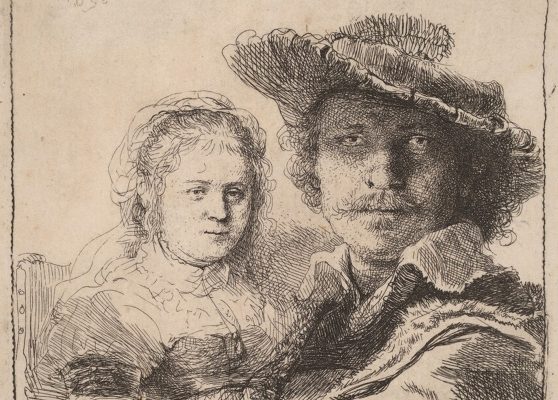
Curated by Patrizia Foglia, the exhibition brings together approximately fifty works from public and private collections, creating a journey through self-portraits, religious subjects, popular figures, scenes of everyday life and images capable of evoking the human and social atmosphere of seventeenth-century Holland. Among the works announced is the etching Self-Portrait with Saskia, created in 1636 and selected as the emblematic image of the exhibition.
The title Absolute Black does not refer merely to a chromatic quality. It alludes to the very heart of Rembrandt’s graphic research: his ability to transform ink into living matter, to construct space through shadow and to make faces, bodies and gestures emerge from seemingly impenetrable depths.
In his prints, black is not synonymous with emptiness. It is instead an active, shifting substance, traversed by sudden appearances of light. It can conceal, protect, suggest or reveal. It becomes the space in which the image takes shape while, at the same time, preserving part of its mystery.
Rembrandt and the invention of black
Rembrandt Harmenszoon van Rijn was born in Leiden in 1606 and died in Amsterdam in 1669. His fame is associated above all with his paintings, his large group portraits, biblical scenes and self-portraits, in which he observed the transformation of his own face over the years. Alongside his painting, however, the artist developed an autonomous and radically experimental body of graphic work.
Between 1626 and 1665, he produced approximately three hundred etchings and drypoints. In most cases, these were not simply reproductions of paintings. For Rembrandt, printmaking constituted an independent territory, governed by its own rules and open to solutions that painting could not offer in the same way.
Printmaking allowed him to work directly on the relationship between line and light. Every line could be altered, deepened, superimposed or erased. Each plate could be reworked several times, giving rise to different “states” of the same composition. The image was therefore not necessarily a definitive result, but rather a provisional stage in a constantly evolving creative process.
Light generated by shadow
In Rembrandt’s paintings, light often seems to emanate from within the figures. A face emerges from the darkness, an illuminated hand acquires narrative significance, and a secondary character suddenly becomes essential. In his prints, this principle reaches an even more radical intensity.
Without colour, the artist was compelled to construct every transition through the density of the lines. Closely spaced strokes generate deep surfaces; short, irregular marks define the texture of a garment; almost untouched areas of paper become sources of light. White is not simply the background, nor is black merely a form of filling: both participate in the construction of the image.
Rembrandt’s light does not describe everything with equal precision. It selects, separates and directs the gaze. Certain parts of the scene are presented with striking clarity, while others remain immersed in a half-light in which forms appear to be still in the process of taking shape.
This tension between the visible and the invisible produces a distinctive emotional quality. The viewer is not given every piece of information, but is invited to complete mentally what the artist has merely suggested.
Black as a psychological space
In the Western tradition, shadow had often been used to model bodies and give depth to space. Rembrandt, however, also endowed it with psychological significance. Darkness becomes the realm of uncertainty, meditation, suffering and memory.
His figures are not placed against neutral backgrounds. Instead, they appear to emerge from an inner space. Black envelops them without erasing them, transforming every appearance into an event. A barely illuminated face can convey weariness, concentration or unease through the slightest variations.
For this reason, Rembrandt’s prints cannot be viewed hastily. They require proximity, time and attention. Their often intimate dimensions compel the viewer to move closer, establishing an almost private relationship with the image.
The revolution of printmaking
During the seventeenth century, printmaking was one of the principal means through which images circulated. It made it possible to reproduce celebrated works, illustrate books and disseminate portraits and visual inventions in places far removed from those in which they had originally been conceived.
Rembrandt fully understood the possibilities of this medium, but refused to regard it merely as a system of reproduction. In his hands, the print became an autonomous art form, capable of generating unrepeatable images even when they originated from the same plate.
The artist intervened not only on the plate itself, but also in the methods of inking, the cleaning of its surface and the choice of paper. He could leave thin veils of ink on the plate, creating what is known as surface tone, or print on different supports in order to obtain warmer, softer or more luminous effects.
As a result, two impressions taken from the same plate could display considerable differences. The mechanical process of printing was transformed into a creative act in which every impression retained its own identity.
Etching, drypoint and the freedom of line
The technique most closely associated with Rembrandt’s graphic production is etching. The metal plate was covered with a protective ground, upon which the artist drew with a pointed tool. The plate was then immersed in an acid bath, which corroded the exposed areas and transformed them into grooves capable of retaining the ink.
Compared with engraving executed with a burin, etching allowed for a quicker gesture, closer to drawing. Rembrandt could move the needle with immediacy, alternating fine lines, broken strokes, areas of shading and sudden abbreviations.
The artist frequently combined this technique with drypoint, produced by incising the plate directly with a sharp instrument. The action of the point raised small ridges of metal along the edges of the groove, known as burrs, which retained a greater quantity of ink and produced dark, soft and velvety lines.
Rembrandt combined etching, drypoint and, in some cases, engraving with the burin, creating surfaces of exceptional complexity. His line could be precise or nervous, extremely delicate or deeply incised. Areas described with great care coexisted with passages that were merely suggested, as though the artist wished to preserve on the plate the immediacy of an intuition.
The plate as a work in transformation
One of the most revolutionary aspects of Rembrandt’s graphic work lies in the possibility of modifying a composition that had already been printed. After examining the first impressions, the artist could return to the plate, adding new shadows, removing certain figures or radically altering the distribution of light.
Different states of the same print were thus created. These were not merely corrections, but genuine variations on a theme through which a scene could acquire a different meaning. A setting that was initially clearly legible could gradually be invaded by darkness; a secondary figure could emerge through a new intervention of light; the emotional tone of the entire composition could shift from narration to meditation.
This method reveals how Rembrandt regarded printmaking as an open-ended process. The work did not necessarily correspond to a single image, but rather to the history of its transformations.
The act of printing itself also formed part of this research. By varying the inking or leaving different amounts of surface tone on the plate, the artist could produce more dramatic atmospheres or clearer, more luminous images. Originality therefore resided not only in the engraved design, but in the unrepeatable relationship between plate, ink, pressure and paper.
Faces, self-portraits and everyday humanity
The exhibition in Rome highlights the variety of themes explored by Rembrandt. His graphic production includes biblical scenes, self-portraits, landscapes, figure studies and representations of everyday life.
These subjects are not separated by rigid hierarchies. Rembrandt observes an episode from the Scriptures with the same attention he devotes to the gesture of a person encountered in the street. The sacred can reveal itself within a domestic setting, while a beggar, an elderly person or a worker can acquire monumental dignity.
The artist does not idealise bodies or conceal the signs of age, fatigue or poverty. Wrinkles, uncertain postures, worn clothing and lowered gazes become essential elements of the representation. The truth of the image arises precisely from the acceptance of imperfection.
The self-portrait as a laboratory
Rembrandt repeatedly used his own face as an instrument of research. In his early graphic self-portraits, he experimented with grimaces, expressions of surprise, theatrical poses and different lighting effects. He was not merely recording his appearance, but studying the workings of emotion.
The artist’s face became an ever-available laboratory. Through the mirror, he could observe the movement of muscles, the way light struck the forehead or left the eyes in shadow, and the transformation of an expression through the slightest variations.
This practice helped to free the self-portrait from its purely celebratory function. Rembrandt does not always present himself as an authoritative and idealised figure. He may appear young and curious, self-assured, absorbed in thought or marked by the passage of time. The face is not a fixed mask, but a mutable reality.
Self-Portrait with Saskia
Among the works included in the exhibition, Self-Portrait with Saskia, an etching created in 1636, holds particular significance. The composition shows Rembrandt in the foreground, looking towards the viewer, while Saskia van Uylenburgh appears behind him.
The image possesses an intimate tone, but it cannot be interpreted as a simple family portrait. Rembrandt carefully constructs the relationship between the two figures. His own face, closer and more clearly defined, dominates the scene, while Saskia’s emerges in the background, creating a sense of depth achieved almost entirely through overlapping forms and the use of line.
The work belongs to an important phase in the artist’s life. Rembrandt and Saskia had married in 1634, and the young woman appears in numerous drawings, prints and paintings. Yet even when beginning from a private experience, the artist avoids conventional sentimental description.
Saskia’s presence appears natural and silent. The relationship between the two figures is conveyed through proximity, differences in scale and the contrast between Rembrandt’s more strongly defined face and the woman’s more delicate features.
Executed in etching and known in different states, the composition demonstrates how closely the practice of self-portraiture was connected to technical experimentation. The work is dated 1636, and the impression held by the National Gallery of Art has a plate mark measuring just over ten centimetres in height. Its small dimensions reinforce the intimate character of the image.
Bringing the sacred back into life
Religious scenes occupy a central place in Rembrandt’s graphic work. The artist repeatedly addressed episodes from the Old and New Testaments, interpreting them in ways that moved away from celebratory rhetoric.
Sacred figures inhabit tangible settings populated by ordinary presences. Alongside the protagonists may appear elderly people, children, the poor, curious onlookers and marginal figures. Biblical history is brought back into the realm of human experience.
Once again, light plays a decisive role. It does not merely indicate the principal figure, but determines the spiritual meaning of the scene. It may focus on a gesture of mercy, isolate a face or transform a dark space into a place of revelation.
Rembrandt does not eliminate suffering, fear or doubt. The spirituality of his images arises from the fragility of the figures. The sacred does not appear distant from reality, but manifests itself precisely through human vulnerability.
Why visit the exhibition
The exhibition at the Historical Museum of the Infantry offers an opportunity to approach Rembrandt through a dimension quite different from that of his large canvases. Printmaking requires a different way of looking.
When standing before a monumental painting, viewers can immediately perceive the overall organisation of the scene. A small-format print, by contrast, requires them to move closer, slow down and follow the path traced by the lines.
This proximity makes it possible to recognise the technical complexity of the works. Viewers can observe the networks of cross-hatching used to construct the shadows, the isolated lines that define an expression, the areas in which the paper is left untouched and those where the ink acquires an almost material density.
The modest dimensions do not diminish the power of the image. On the contrary, they concentrate it. Within just a few centimetres, Rembrandt succeeds in suggesting deep spaces, numerous crowds, windswept landscapes or silent encounters between two people.
From reproduction to original work
One of the exhibition’s merits lies in reminding visitors that a print is not necessarily a copy of another work. In Rembrandt’s case, printmaking often represents the only form in which a particular artistic invention was conceived.
The plate is not a neutral instrument, but a field of experimentation. Every scratch alters the behaviour of the ink; each biting of the acid determines a different intensity of line; every passage through the press creates a new relationship between the mark and the surface of the paper.
Rembrandt developed this awareness to its most advanced consequences. His prints do not attempt to imitate painting passively. Instead, they exploit the specific qualities of the medium: repetition, variation, the reversal of the image, the possibility of reworking the plate and obtaining different results through the printing process.
In this respect, his research appears remarkably modern. The work is not conceived as an immutable object, but as a process. Reproducibility does not eliminate uniqueness, because every impression may possess its own distinctive characteristics.
Looking into the shadow
The title Absolute Black can also be understood as an invitation addressed to the visitor. Looking at Rembrandt’s prints means learning to distinguish what takes place within darkness. At first glance, certain areas may appear dense and impenetrable. Viewed more closely, however, the black reveals a complex texture of intersecting lines, deeper marks, veils of ink, imperfections and traces left by the cleaning of the plate.
The image takes shape slowly. The eye must adjust, just as it does when entering a dimly lit room. This gradual process transforms observation into an active experience. The depth of Rembrandt’s works therefore derives not only from the subjects represented, but also from the way in which viewers are invited to discover them. The Dutch master does not reveal everything immediately. He preserves areas of silence, margins of ambiguity and spaces in which the imagination can continue the work begun by the engraved line.
Rembrandt’s modernity
More than three and a half centuries after the artist’s death, Rembrandt’s prints retain an astonishing power. Their modernity lies not only in their technical freedom, but also in their ability to contemplate the human being without idealisation.
Dignity and fragility coexist in his faces. His figures are never reduced to social types or abstract symbols. Even when portraying beggars, elderly people or anonymous individuals, Rembrandt preserves the individuality of each subject.
The engraved line
The engraved line records hesitations, tensions and changes. It does not conceal the process through which the image was constructed. On the contrary, it makes that process visible. This technical honesty corresponds to an honesty of vision.
The exhibition in Rome therefore allows visitors to recognise Rembrandt’s graphic work not as a secondary activity in comparison with painting, but as one of the highest achievements of his artistic research. Through etching and drypoint, the artist transformed black and white into a language capable of expressing the body, faith, solitude, human affection and the passage of time.