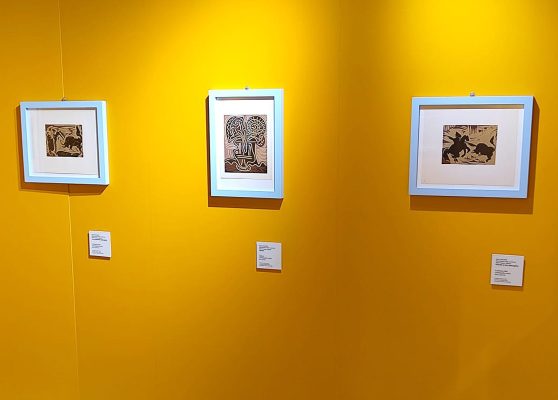
The exhibition “Picasso. The language of ideas” takes the public on a journey through the many phases of Pablo Picasso’s career (1881, Málaga, Spain – 1973, Mougins, France). Exploring the creative universe, the artist moved through styles and techniques while maintaining a relentlessly experimental attitude and an ever-evolving language, in which every gesture contains an aesthetic and intellectual reflection.
The show brings together over one hundred works by the Spanish master, paintings, drawings, prints, sculptures, ceramics, and graphic materials, offering a complex, layered view of the creative path of one of the twentieth century’s most influential artists. Visitors are guided through sections that delve into friendships, loves, technical experiments, and pivotal moments in his career.
Pablo Picasso: a genius in metamorphosis
The exhibition illustrates how Picasso turned the creative act into a constant laboratory: from friendships and relationships with women, to innovative techniques such as linocuts; from the stage designs for “Le Tricorne” to the experiences of his final years on the Côte d’Azur; from the early youth sketchbooks of A Coruña to the so-called minor arts and other experiments. A route that testifies to the inexhaustible nature of his genius, his innovative power, and his ability to turn every idea into image, presented across six sections:
First section: Picasso, friends, women
The first section of the exhibition, “Picasso, his friends, the women, muses and partners”, introduces visitors to a thematic core that is essential for understanding the artist’s entire creative journey. The works on display outline a complex system of emotional, intellectual, and professional relationships that represented one of the primary driving forces behind Picasso’s artistic research.
For Picasso, the biographical and artistic dimensions were inseparable. The women he loved, companions and muses who accompanied him throughout his life, as well as friends, colleagues, and fellow experimenters, never played a marginal role: they became true catalysts of formal and conceptual processes. The artist did not merely portray them; he adopted them as iconographic and symbolic matrices capable of guiding, at various moments, the evolution of his visual languages.
This section highlights how such figures constitute a kind of relational atlas through which the stylistic metamorphoses of the artist can be read: from the early bohemian years in Paris to the more mature phases, and up to his late explorations. What emerges is a complex system in which emotional bonds, inner tensions, and intellectual exchanges generate new forms and continuously broaden the expressive horizon.
Friends as a creative community
In Montmartre, Picasso surrounded himself with a circle of intellectuals: Guillaume Apollinaire, Max Jacob, André Salmon. With them he shared ideas, debates, and experiments. The portraits of friends on view show that they were not mere subjects but interlocutors in the search for a modern language. “I do not seek, I find,” Picasso declared: often it was precisely dialogue with friends that guided his discoveries.
The blue period: pain and introspection
From 1901 to 1904, Picasso lived through the Blue Period, dominated by somber atmospheres and a sense of existential mourning. The death of his friend Carlos Casagemas affected him deeply, giving rise to a pictorial language marked by cool tonalities. Works such as La Vie (1903) and The Old Guitarist (1903–04) bear witness. Elongated figures, downcast gazes, bare settings, everything contributes to a sense of isolation and spirituality.
The palette, dominated by blue, evokes solitude and transcendence. Drawings and prints from this period show how personal tragedy becomes a universal reflection on human suffering. Lost friendships become symbols of life’s precariousness, giving shape to a language that seeks to embody a collective human drama.
The rose period: the circus as metaphor
Between 1904 and 1906, with his move to Paris and encounters with new friends, the atmosphere shifted and his language changed. This is the Rose Period, characterized by warm tones and subjects from the circus world: harlequins, saltimbanques, acrobats. The tonalities lighten toward pinks and ochres. Beneath the grace and elegance of the circus, Picasso conceals deeper reflections: its characters are fragile, itinerant, symbols of the artist’s own condition.
This duality between lightness and melancholy emerges forcefully in the sheets on display and in works such as Family of Saltimbanques (1905). Sketches and gouaches in the exhibition bear witness to this moment.
Women as muses and metamorphosis
Picasso’s partners were central to his creative process and marked the most incisive phases of his production. Fernande Olivier, Olga Khokhlova, Dora Maar, Françoise Gilot, Jacqueline Roque: each signals a stylistic phase. A dedicated section of portraits and drawings shows how the female face becomes a mirror of the artist’s transformations. Every relationship coincides with a linguistic shift: classicism with Olga, Surrealism with Dora, chromatic vitality with Françoise. For Picasso, woman is never a mere model but an agent of metamorphosis.
Second section: linoleum, a new discovery
An entire section is devoted to the linoleum technique, which Picasso discovered and made his own in the 1930s. These are prints carved on linoleum, an inexpensive, easily worked material, that enabled radical experimentation, a relief-print medium typically used in popular contexts that became for him an arena of invention.
For Picasso, linoleum was not just a technique but a conceptual language. The prints became a ground for graphic experimentation, reducing forms to essentials and tightening the bond between sign and idea. This is reflected in the exhibition through sheets that present variations on the same subject.
Technical innovation
Traditionally, multiple colors were printed from separate blocks. Picasso instead devised a method of progressive carving: the same block was carved, printed, and re-carved, with colors overprinted in sequence. This practice demanded extraordinary precision, as every error was irreversible. On view are sheets documenting the process step by step, showing the transformation of the image from the first to the fourth color and highlighting his mastery in uniting material simplicity with visual complexity.
The crisp color fields, evident in works such as female portraits and still lifes, demonstrate how this technique fostered a rigorous linear economy, turning the mark into pure thought. The prints on display reveal the artist’s intent to push the limits of the medium to reach unprecedented conceptual clarity.
Third section: “Le Tricorne”
A fascinating chapter in Picasso’s career concerns his collaboration with the Ballets Russes of Sergei Diaghilev. In 1919 the artist created sets and costumes for the ballet “Le Tricorne”, with music by Manuel de Falla and choreography by Léonide Massine.
This collaboration with the Ballets Russes was not an isolated episode but marked Picasso’s entry into the world of theater and stage design. The experience shows how he conceived art as an open system, capable of being cross-pollinated by other forms. In the exhibition, materials related to “Le Tricorne” recall Picasso’s ability to bring innovation to performative languages as well.
Spanish tradition and modernity
“Le Tricorne” draws inspiration from Andalusian folklore. Picasso succeeds in fusing popular tradition and the avant-garde, preserving the colors and motifs of Spanish culture while interpreting them with modern synthesis. This section highlights the artist’s capacity to adapt his aesthetics to diverse media, anticipating the interplay between visual and performing arts.
Theatre as laboratory
The theatrical experience allowed Picasso to expand his language. The set and costume sketches, some of which are on display, demonstrate how he was able to transpose his style into the stage space. Cubist lines adapt to the dancers’ movement, transforming the stage into a total work of art.
Fourth section: the final period, Côte d’Azur, photographs, and exhibitions
The fourth section is devoted to Picasso’s mature years spent on the Côte d’Azur. Having settled in Vallauris, Picasso worked intensely in ceramics and sculpture, while also creating paintings of great chromatic freedom. Period photographs portray him in his studio, surrounded by friends and collectors, bearing witness to the mythical aura that surrounded him.
The ceramics of vallauris
In the 1940s and 1950s, Picasso devoted himself passionately to ceramics, experimenting with new forms and glazes. Working alongside local artisans, he created plates, amphorae, and vases decorated with mythological motifs, animals, and stylized figures, developing a language that was direct and joyful. These works, featured in the exhibition, demonstrate how even an art form considered “minor” could become a vehicle for invention. The ceramics reflect Mediterranean joy and the freedom of a language that united tradition and modernity.
Photographs and everyday life
The exhibition presents photographs portraying Picasso in his daily life on the French Riviera: working in his studio, spending time with friends such as Matisse and Chagall, and with his children Claude and Paloma. These images reveal an artist who, despite having become a global icon, remained deeply tied to everyday practice and continuous experimentation.
Fifth section: Carnet de A Coruña, 1895
The fifth section returns to Picasso’s beginnings: the sketchbook from A Coruña, created when he was only fourteen years old. Drawings of faces, animals, and scenes of daily life already reveal a precocious talent, mature in its observational precision.
The adolescent prodigy
These pages demonstrate Picasso’s early mastery of drawing. Anatomical studies, quick sketches, and motion studies all testify to a natural intuition and an extraordinary ability to capture the essence of reality. Displaying this sketchbook allows visitors to perceive the continuity between the prodigious boy and the future innovator.
From drawing to revolution
The Carnet de A Coruña is not merely a biographical document but also a symbol of the journey that would lead Picasso to reinvent art. His classical and academic roots became the ground from which the Cubist revolution would grow. Exhibiting the sketchbook alongside mature works enables visitors to grasp the continuity of research that spans his entire career.
Final section: the “Minor” arts and experimentation
The last section is dedicated to the so-called minor arts, which Picasso transformed into vital fields of experimentation. Ceramics, prints, illustrations, and stage designs, each domain became for him an opportunity to rethink art itself.
Graphic art and publishing
Picasso illustrated books by poets and friends, including Apollinaire and Paul Éluard. The engravings show his ability to adapt the line to literary texts, creating intense dialogues between word and image. This part of the exhibition highlights his editorial collaborations, revealing an inter-artistic dialogue that enriched both forms. A mosaic that restores the multifaceted and inexhaustible character of his genius.
Stage design and decoration
Beyond “Le Tricorne”, Picasso designed sets and costumes for other theatrical productions, showcasing his versatility. His decorative projects, such as mural panels, also express his desire to extend art into the public and collective sphere. As Apollinaire once wrote, “Picasso thinks by drawing and draws by thinking.” This immediacy explains the vitality of his production: every technique becomes an opportunity to translate a concept into image, a flash of intuition into visible form.
A language still relevant
More than fifty years after his death, Picasso remains an inexhaustible source of inspiration for artists, designers, and creators. His ability to change, to never settle into a single style, offers today’s audiences a lesson in intellectual freedom. Art as continuous research, as a language evolving alongside ideas.
Visiting this exhibition means engaging with an artist who redefined the boundaries of modern art. The works on display are not merely images but mental processes translated into form. Picasso reminds us that art is embodied thought, capable of questioning the present and transforming perception itself.