Within the evocative monumental setting of the Terme di Diocleziano the exhibition “Metamorphoses” by Wu Jian’an unfolds as an experience of remarkable visual and intellectual depth. Hosted within the Museo Nazionale Romano, the exhibition develops as an immersive journey where the dialogue between past and present becomes a foundational element.
Ancient Roman structures host contemporary works that reflect on transformation—not merely as physical change, but as a cultural and symbolic process. Through a layered artistic research, Wu Jian’an builds a bridge between Chinese iconographic tradition and a global sensibility, inviting visitors to engage with a conception of time that is not linear, but cyclical and continuously evolving. The Chinese artist reinterprets myths, symbols, and narratives, inviting visitors to reflect on the cycles of matter and culture. A project that brings together East and West in a visually and conceptually compelling exchange.
Wu Jian’an and the Language of Transformation
An Artist Between Tradition and Contemporaneity
Wu Jian’an stands out in the international contemporary art scene for his ability to merge traditional techniques with visual experimentation. His academic training in China is intertwined with a deep knowledge of historical craft practices, particularly paper cutting, which he elevates into a complex and conceptually layered expressive medium. This approach allows the artist to operate on a dual level: the recovery of cultural memory and its reinterpretation through a contemporary lens.
His works function as visual devices in which the past is never static, but constantly reinterpreted. This tension between preservation and innovation represents one of the defining elements of his poetics, making his work especially significant within the global contemporary art discourse.
Myth as a Narrative Structure
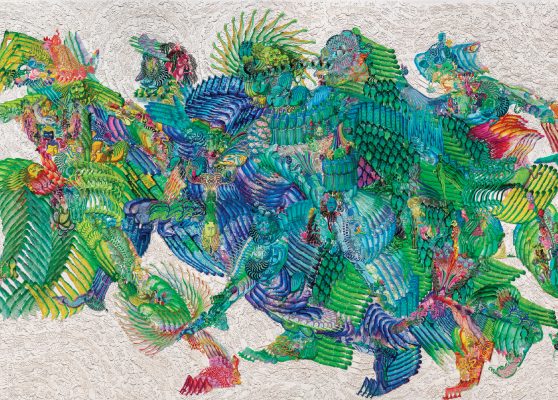
At the core of Wu Jian’an’s research lies a reflection on myth as a universal framework for interpreting reality. His compositions take shape as constantly transforming visual organisms, where human, animal, and fantastical figures intertwine in a dynamic flow. This approach allows the artist to explore themes such as birth, destruction, and regeneration, making visible a process of metamorphosis that spans across epochs and cultures.
Myth, in his practice, is not merely referenced but reconstructed through a visual language that emphasizes its archetypal dimension. In this sense, the works become true visual narratives, where each element contributes to building a complex, multilayered story.
A Poetics of Metamorphosis
The concept of metamorphosis lies at the core of Wu Jian’an’s artistic practice. His works do not simply represent change—they embody it, transforming themselves into open and fluid structures. The artist conceives transformation as a universal principle governing both nature and culture, proposing a vision of the world in which every form is destined to evolve.
This vision translates into a visual language characterized by a constant tension between stability and change. Figures dissolve and recompose, generating a dynamic visual rhythm that reflects the complexity of reality and its intrinsic instability.
The Exhibition Path of “Metamorphoses”
Dialogue Between Archaeology and the Contemporary
The exhibition “Metamorphoses” unfolds through a display that enhances the relationship between contemporary works and the archaeological space of the Terme di Diocleziano. Wu Jian’an’s installations are carefully integrated into the ancient architecture, creating a visual dialogue that amplifies the meaning of both elements. The Roman structures, as testimonies of a millennia-old civilization, become the ideal stage for reflecting on the continuity and transformation of history.
This encounter between ancient and contemporary is not limited to simple juxtaposition but generates new interpretative possibilities. Contemporary works seem to activate the archaeological space, restoring a dynamic and present dimension to it.
Immersive Installations and Paper Works
The exhibition path alternates large-scale immersive installations with smaller paper-based works. The former engage the viewer in a sensory experience, while the latter invite a more intimate and contemplative approach. In both cases, the artist’s extraordinary technical skill emerges, capable of producing compositions of remarkable formal complexity.
The installations, often characterized by a strong scenographic component, transform the exhibition space into an immersive environment. The paper works, on the other hand, reveal meticulous attention to detail, highlighting the artisanal dimension of the artist’s practice.
A Stratified Visual Narrative
The works on display unfold as chapters of a visual narrative that spans multiple temporal and cultural dimensions. The narrative does not follow a linear order, but develops through associations and references, encouraging visitors to construct their own interpretative path. In this sense, the exhibition operates as an open system, where meaning emerges through the interaction between artwork and observer.
This complex narrative structure invites an active form of engagement, where the audience participates in the construction of meaning. The exhibition experience thus becomes a process of progressive discovery.
The Title “Metamorphoses” as a Key to Interpretation
The title of the exhibition, “Metamorphoses”, explicitly recalls the classical tradition, evoking the renowned transformation narratives of ancient literature. However, Wu Jian’an reinterprets this reference in a contemporary key, expanding its meaning and adapting it to a global reflection. Metamorphosis thus becomes an interpretative category capable of crossing cultures and disciplines.
From this perspective, the title is not merely descriptive, but serves as a true key to accessing the entire exhibition project, guiding the reading of the works and their relationship with the space.
Themes and Meanings of the Exhibition
Regeneration and Cyclicality
One of the central themes of the exhibition is regeneration. Wu Jian’an’s works suggest a vision of the world in which destruction does not represent an end, but rather a phase within a broader transformative process. This approach is reflected in the very structure of the works, which appear as constantly evolving organisms. Regeneration is understood as a universal principle that traverses both nature and culture, challenging a linear conception of time and proposing instead a cyclical model.
Non-Linear Time
The exhibition proposes an alternative conception of time, based on a cyclical rather than linear model. The works invite viewers to consider past, present, and future as interconnected dimensions, each part of a continuous flow. This vision of time is translated into an exhibition structure that privileges simultaneity and overlap rather than chronological succession.
Interculturality and Global Dialogue
Another significant aspect of the exhibition is its intercultural dimension. Wu Jian’an draws from multiple cultural traditions, creating a visual language that transcends geographical and temporal boundaries. This approach is particularly meaningful in the context of Rome, a city historically shaped as a crossroads of cultures. The exhibition thus becomes a space of encounter and exchange, where cultural differences are not erased but valued as sources of mutual enrichment.
Why Visit the Exhibition
An Aesthetic and Intellectual Experience
Visiting “Metamorphoses” means engaging in an experience that involves both visual perception and critical reflection. Wu Jian’an’s works demand attentive and participatory observation, offering in return a profound interpretative depth. The exhibition stands out for its ability to stimulate reflection on the relationship between the individual and the world, between identity and transformation.
The Value of the Exhibition Context
The location of the exhibition within the Terme di Diocleziano represents a highly significant element. The dialogue between contemporary art and archaeology broadens the visitor’s perspective, highlighting the continuity of cultural processes across centuries. The architectural context plays a decisive role in shaping the reading of the works, creating a dialogue that enriches the overall experience.
A Contribution to Contemporary Debate
The exhibition engages with current debates on contemporary art and its relationship with tradition, offering a significant example of how innovation and memory can be effectively combined. In this sense, “Metamorphoses” is not only a major exhibition event, but also an opportunity to reflect on the role of art in the contemporary world. Through Wu Jian’an’s work, visitors are invited to question the potential of art to interpret and transform reality, contributing to the construction of new cultural horizons.