“La Grecia a Roma”, presented at the Musei Capitolini in the exhibition galleries of Villa Caffarelli, is constructed as an object-based argument on cultural transmission. More than 150 original Greek works—sculptures, reliefs, bronzes, ceramics, and architectural elements—are gathered to show how Greek images entered the city, how they were read by Roman patrons, and how they were transformed into instruments of identity, prestige, and power.
The exhibition’s most decisive choice is also its most demanding: by privileging Greek originals (some never exhibited before, others returned to Rome after centuries of dispersal), it shifts attention from “Roman imitation” to the material authority of what Rome desired to possess. The result is not a neutral panorama, but a critical itinerary in which art history, archaeology, and the politics of display converge.
Exploring the legacy of greek art in ancient Rome
The guiding idea of “La Grecia a Roma” is that greek art in the Roman world cannot be reduced to an abstract “influence.” Greek artefacts arrive in Rome through distinct historical mechanisms—commerce, conquest, diplomatic exchange, and collecting—and each mechanism leaves a trace in how works are interpreted and used.
The exhibition translates this premise into an intelligible structure: three broad phases—early importation, Mediterranean conquests, and the age of collecting—are always read alongside contexts of use: sacred spaces, public spaces, and private residences. This double lens (chronology and function) prevents the visitor from treating the objects as detachable “masterpieces.” Instead, they appear as historically situated agents within Roman society.
From object to sign: refunctionalization as historical evidence
A repeated theme throughout the exhibition is refunctionalization: the change of role an object undergoes when it is displaced. A votive figure originally intended to address the divine is transformed, in Rome, into a material proof of dominion; a funerary monument designed for commemoration becomes a collector’s trophy; a roofline statue becomes an aesthetic emblem within a cultivated garden.
The show encourages the visitor to read these shifts as historical evidence, not as curatorial narrative alone. In Rome, greek art could serve simultaneously as aesthetic standard, political symbol, and social currency. The Roman viewer did not simply admire greek art; he mobilized it, placing it where it could produce prestige, authority, or civic grandeur.
From votive and funerary origins to political symbolism
The exhibition’s most persuasive moments are those in which an object’s original purpose remains legible, even after its Roman recontextualization. It is precisely this tension—between origin and later use—that produces meaning. The curatorial narrative therefore treats objects as if they had “lives”: each work is capable of multiple readings across time. This approach clarifies why the exhibition is not simply an anthology of masterpieces.
It is a reconstruction of how Roman culture manufactured authority through images. A votive object speaks to a god; a trophy speaks to a crowd; a statue in a domus speaks to invited peers. To move an object between these settings is to change its audience, its ethics, and its semantic horizon.
Rome as a collector-city: the urban staging of greek art
As greek artworks accumulated, Rome itself began to function as a curated environment. Statues installed in porticoes, theatres, baths, libraries, and temples turned urban movement into a form of viewing. The exhibition points to this phenomenon without romanticizing it: Rome becomes, in effect, a city that displays conquered culture. greek art is present in civic settings not only to delight but to signify.
The show reads public display as a political grammar: the more Rome collected, the more it translated foreign cultural capital into civic identity. This logic also helps explain why later imperial Rome did not abandon Greek models, but institutionalized them as a norm of cultivated life.
The Templum Pacis: art, peace, and the rhetoric of empire
Among the Roman examples evoked, the Templum Pacis built by Vespasian after victory (75 CE) crystallizes the relationship between power and art. Founded as a monument of restored order, it soon became a space in which greek art could be staged at the centre of empire, offering a lesson in how Rome transformed images into political rhetoric. The exhibition’s broader claim follows: greek art was not a foreign body within Roman culture but a language Rome learned to speak fluently, precisely because it allowed the empire to represent itself as heir, curator, and arbiter of Mediterranean excellence.
Greek media, styles, and the Roman desire for Greekness
By assembling a wide range of artefacts, “La Grecia a Roma” reveals that Roman interest in greek art was not limited to monumental sculpture. The selection includes bronzes of exceptional technical ambition, ceramics tied to early exchanges and ritual settings, and key monuments that anchor the narrative in specific social functions.
This multiplicity matters: different media circulated differently, addressed different audiences, and carried different symbolic weights. The exhibition avoids treating “greek art” as a single style; instead, it shows how Roman desire attached itself to Greekness as a flexible category—sometimes archaizing, sometimes classicizing, sometimes Hellenistic—adaptable to Roman contexts and ambitions.
Greek originals as a curatorial and historiographical stance
The choice to privilege Greek originals is a decisive curatorial statement. In many museum contexts, greek art is known through Roman copies; here, the story begins from the material authority of the original. Originals are not presented as romantic “authenticity,” but as historical agents: costly objects whose materials, scale, and craftsmanship carried social weight in antiquity.
In Rome, an original Greek bronze was not merely a beautiful object; it was a rare, expensive, and recognizably prestigious possession. The exhibition thereby shifts the visitor’s attention from stylistic genealogy to social function: originals are the currency through which Roman elites negotiated education, status, and political legitimacy.
Returns and reunifications: when dispersal becomes part of meaning
The exhibition emphasizes that several works are displayed publicly for the first time, and others return to Rome after centuries of dispersal. This is not framed as spectacle, but as an additional historical layer: dispersal and return are part of the modern biography of antiquities, shaping how we interpret them today.
The reunification of sculptural groups—temporarily overcoming the fragmentation of collections—restores an ancient logic of viewing, allowing relationships of scale, rhythm, and narrative to re-emerge. It also makes visible a fundamental problem of classical reception: greek art’s “afterlife” has been shaped as much by modern collecting as by ancient conquest.
Key works as intellectual anchors
Within the large corpus, certain works function as conceptual keystones. The exhibition highlights the exceptional reunion of the great Capitoline bronzes and frames them within a broader reflection on technical mastery and the Roman appetite for metalwork.
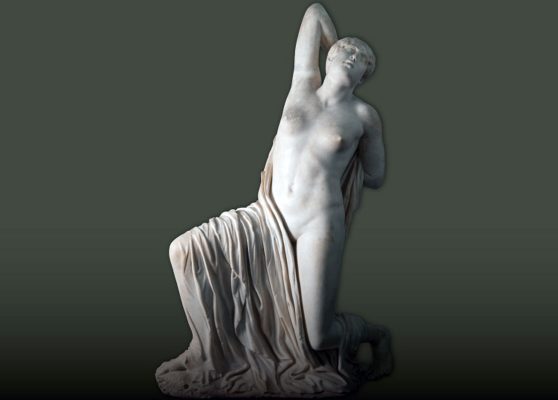
It points to monuments that concentrate meaning: the stele from the Abbey of Grottaferrata, whose formal dignity and commemorative function exemplify Greek sculptural language as public memory; the sculptural Niobids from the Horti Sallustiani, historically dispersed between Rome and Copenhagen and reunited to restore the coherence of a mythic narrative; and a female acroterial sculpture from the Al Thani Collection (Paris) whose return carries strong symbolic weight, since the work was in Rome in the seventeenth century.
The exhibition also underscores the presence of unpublished finds, including Attic ceramics recovered in recent archaeological excavations near the Colosseum, reminding the visitor that the story of Greek material culture in Rome is still being rewritten by archaeology.
The Niobids: myth, violence, and aristocratic display
The Niobid group exemplifies the Roman capacity to translate Greek myth into a language of elite space. The slaughter of Niobe’s children by Apollo and Artemis is a narrative of divine power and human limits, staged through bodies that dramatize vulnerability and punishment. When installed in aristocratic settings like the Horti Sallustiani, such imagery could operate as cultivated allegory and as social theatre: to host guests among Greek mythic violence was to signal both erudition and dominance.
The exhibition also notes stylistic affinities that have long encouraged comparisons with the Amazonomachy sculptures of the Temple of Apollo Sosianus, suggesting how Roman patrons and viewers might have recognized, even then, the authority of a Greek sculptural language capable of turning myth into an architecture of persuasion.
Exhibition route at Villa Caffarelli: five sections
The visitor’s itinerary is organized into five sections that develop a coherent narrative of artistic and cultural “contamination” between Rome and the Greek world. A graphic map introduces the structure, and the route is enriched by multimedia contents that combine archaeology with digital technology: reconstructions of architectural settings, ceremonial contexts, and decorative apparatuses clarify how works once interacted with space.
This integration is not ornamental. It functions as a methodological device, allowing the visitor to perceive not only the object but its historical ecology—where it stood, who could see it, and what forms of authority it was asked to serve.
I. “Rome Meets Greece”: trade routes, sanctuaries, and tombs
The first section explores the earliest contacts between Rome and Greek communities, already in the eighth and seventh centuries BCE. The exhibition links these contacts to Rome’s strategic position on the Tiber and within Mediterranean routes, which facilitated the arrival of refined imports, especially ceramics.
Crucially, these objects did not circulate randomly: they entered contexts of prestige—sanctuaries and aristocratic burials—where they could signal rank, ritual legitimacy, and access to a broader Mediterranean culture. The section thus frames early greek art in Rome not as “influence,” but as the material evidence of selective adoption.
Case studies: Euboea, the Esquiline, and early religious translation
Among the most revealing pieces are ceramic fragments from Euboea found in the Area Sacra of S. Omobono, and the so-called Group 125 from the Esquiline—an aristocratic funerary assemblage including valuable Corinthian imports. The section also addresses early religious translation through a fragment of a krater showing Hephaestus on a mule, discovered in the Roman Forum.
Such evidence suggests that images travelled with myths, and myths with objects: the adoption of Greek forms was intertwined with the early identification between Greek and Roman divinities. Even as Rome underwent political transformation between the sixth and fifth centuries BCE—from the end of monarchy to the establishment of the Republic—this desire for Greek models did not diminish; it intensified, producing a sustained importation of objects that ranged from bronze votive figurines to marble artefacts and cups used in sacred rites.
II. “Rome Conquers Greece”: appropriation through conquest
The second section is structured around a change of attitude: from admiration to appropriation. With Greece subordinated in the second century BCE, Rome’s acquisition of greek art becomes systematic. Statues, paintings, and precious metalwork arrive in the city as trophies and acquisitions that remodel its urban face and enrich temples and public buildings.
The section is staged to convey the scale of this transfer, emphasizing that the aesthetic enrichment of Rome is inseparable from military and political domination. Greek works are no longer merely admired; they are absorbed into the Roman economy of honour and visibility.
The Mithridates crater: an emblem of displacement and reinterpretation
The section’s emblematic object is the celebrated krater dedicated by King Mithridates Eupator, recovered from the seabed off the coast near Nero’s villa at Anzio. In a single object, the visitor can read the layered history the exhibition wants to make visible: a royal dedication, a mobile luxury object, a displaced artefact, and a modern recovered monument.
Its presence demonstrates how works could be detached from their original political function and reinserted into Roman narratives of possession. The exhibition’s broader claim becomes tangible: conquest does not only move objects; it converts meanings. What once praised a Greek sovereign can end by advertising Roman dominance, while still carrying traces of its first rhetoric.
III. “Greece Conquers Rome”: public display, education, and the museum-logic of empire
The third section shifts the argument from acquisition to integration. Works brought to Rome by victorious generals are inserted into the city’s public spaces—porticoes, temples, libraries—transforming the urban fabric and nourishing a Roman passion for Hellenistic culture that becomes integral to elite formation. The exhibition frames this moment as the emergence of a cultural paradox: Rome dominates Greece militarily, yet Greece dominates Rome culturally.
Greek art becomes a requirement of cultivated identity, an indispensable component of what a Roman “learned man” is expected to know, see, and possess. This is also the phase in which refunctionalization becomes systematic: votive offerings and royal monuments are displayed as symbols of Roman power within the city, converted into civic décor and political sign.
The Templum Pacis and the role of digital reconstruction
In this context, the Templum Pacis serves as a key reference: a monument of imperial rhetoric that also becomes a locus of greek art, revealing how Rome turns aesthetic possession into civic pedagogy. This section also hosts the exhibition’s technological core: a large-scale video installation that reconstructs lost environments through synchronized projection and lighting.
The visitor is invited to see how sculptures once “spoke” to architecture and to understand processes such as the recomposition of sculptural fragments. The digital apparatus is not presented as a substitute for the object, but as a way of restoring intelligibility to ancient display. It allows the visitor to imagine the relational nature of classical sculpture—how a work’s meaning depended on placement, sightlines, and the ceremonial or civic scripts that surrounded it.
IV. Greek art in private spaces: horti, villas, and cultivated self-fashioning
The fourth section addresses the elite domestic sphere. Not only temples and civic buildings, but also private residences could be enriched by greek art. The curatorial grouping distinguishes between works connected to the horti—luxurious garden complexes near the centre—and those linked to imperial villas, frequently in the suburban landscape.
This division is historically important: it clarifies how greek art could function both as an urban statement and as an intimate instrument of self-representation. In the private sphere, Greek images become an index of prestige and refinement, staged among nymphaea, fountains, and greenery, where art and nature collaborate in producing an environment of cultivated leisure.
The Horti Sallustiani, Maecenas, and Lamiani
The exhibition foregrounds the Horti Sallustiani between the Pincio and the Quirinal, celebrated for their sculptural riches. A selection of works is presented as an exceptional reunion, including the Niobid sculptures, whose dramatic mythic violence acquires a new social function when installed in spaces of leisure. The section also recalls the horti of Maecenas and the horti Lamiani on the Esquiline, expanding the perspective into a broader topography of aristocratic collecting.
From these examples, the visitor can infer a Roman logic of display: greek art is not only ornament, but a language through which owners define themselves as participants in an elite culture of knowledge, taste, and symbolic power. The domestic sphere thus becomes a microcosm in which Rome rehearses, in private, the cultural claims it makes in public.
V. “Greek Artists in the service of Rome”: ateliers, neo-attic production, and creative reuse
The final section completes the narrative by turning from collecting to production. From the second century BCE, Greek sculptors immigrate to Rome, establishing ateliers that create classicizing cult images for Roman temples. In the first century BCE, demand expands, and workshops—especially in Delos and Athens—develop refined, eclectic production for Roman patrons.
The exhibition situates this phenomenon within the rise of the so-called Neo-Attic style: an art of commissioned furnishings and decorative objects that re-elaborate Greek models, adapting them to new functions within Roman public and private spaces. Greekness, here, becomes both memory and manufacture: a repertory to be quoted, recomposed, and staged as social distinction.
Pontios and the rhyton fountain: signature, Dionysiac motifs, and Roman decorum
A particularly revealing work is the monumental fountain shaped like a drinking horn (rhyton), decorated with Maenads and signed by the artist Pontios. Its Dionysiac imagery is not an antiquarian quotation; it is a flexible motif adapted to Roman settings, where myth becomes ornament and ornament becomes status.
The presence of a signature matters: it shows that greek artists could maintain authorship and prestige within Roman patronage systems. The exhibition uses such works to clarify a crucial point: Neo-Attic production is not “mere copying,” but a creative re-authoring of the Greek past, tailored to Roman decorum, Roman spaces, and Roman social performance.
What “La Grecia a Roma” adds to the roman museum landscape
In a city where antiquity is omnipresent, “La Grecia a Roma” justifies itself through intellectual precision and material concentration. Its most original contribution is to treat greek art in Rome as a history of uses rather than merely of styles. By moving continuously between object, setting, and audience, the exhibition clarifies how greek art could shape Roman identity across centuries: first as imported prestige, then as conquered treasure, finally as cultivated capital within private collecting.
This trajectory also offers a contemporary lens. As recent cultural commentary has emphasized, the exhibition demonstrates how images can be absorbed, reinterpreted, and mobilized to define identity, memory, and the forms of power. Seen in this way, the show is not simply “about Greece,” nor only “about Rome”: it is about the mechanisms through which cultures negotiate authority through objects.
Loans and institutions: a temporary map of classical heritage
The exhibition’s network of lenders underlines its international scope and scholarly ambition. Alongside works from the Sistema Musei di Roma Capitale (including Musei Capitolini and related institutions) and from major Italian museums (such as the Museo Nazionale Romano, the Gallerie degli Uffizi, and the Museo Archeologico Nazionale di Napoli), “La Grecia a Roma” includes loans from the Ny Carlsberg Glyptotek (Copenhagen), the Museum of Fine Arts (Boston), the Vatican Museums, the Metropolitan Museum of Art (New York), the British Museum (London), and the Museum of Fine Arts (Budapest).
The exhibition is also completed by works from private collections, notably the Fondazione Sorgente Group (Rome) and the Al Thani Collection (Paris). For the visitor, this constellation is not a mere list: it is the contemporary echo of the very phenomenon the exhibition studies—objects circulating, narratives being recomposed, meanings being renegotiated through proximity.
Artworks as evidence
The show is designed for visitors willing to read artworks as evidence. Specialists will find the object biographies and reunifications particularly valuable, as they enable comparisons that are often impossible across dispersed collections.
Students of archaeology and art history will encounter a model of curatorial reasoning: a narrative built from material testimony, supported by contextualization and by digital reconstructions that serve interpretation rather than spectacle.
For a broader audience, the exhibition offers a disciplined form of wonder: not the wonder of quantity alone, but the wonder of understanding why these objects mattered so much to the Romans who sought them, displayed them, and transformed them. Ultimately, to visit “La Grecia a Roma” is to recognize that classical art history is inseparable from the history of collecting, display, and power—and that these histories are legible, with unusual clarity, when originals are gathered and made to speak in relation to one another.
A comprehensive archaeological and art-historical project, curated by Eugenio La Rocca and Claudio Parisi Presicce, conceived to investigate the complex dynamics of cultural transmission between Greece and Rome. The exhibition is promoted by Roma Capitale and the Sovrintendenza Capitolina ai Beni Culturali, with organizational support provided by Zètema Progetto Cultura.