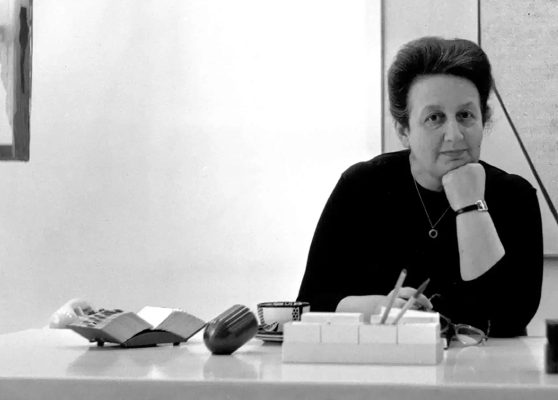
Among the figures who profoundly reshaped the geography of contemporary art and the mechanisms through which it gained recognition in the second half of the twentieth century, Ileana Sonnabend occupies a particularly prominent position. A collector and gallerist with an exceptional ability to anticipate the potential of emerging artistic languages, Sonnabend fostered encounters between European and American artistic research, contributing to the international circulation of works and ideas that would redefine the postwar visual landscape.
Curated by Mario Codognato, the exhibition explores this history through a selection of more than fifty works by 35 artists, drawn from the Sonnabend Collection Foundation in New York, the collection housed in Mantua, and other public and private collections. Paintings, sculptures, installations and conceptual works form an exhibition that traces some of the major transformations in international art, bringing different experiences into dialogue and highlighting the role played by a gallerist in shaping contemporary visual culture.
Ileana Sonnabend and the transformation of the art world
A leading figure in international visual culture
Born in 1914 and deceased in 2007, Ileana Sonnabend was one of the most influential figures in the international recognition of contemporary art. Her contribution extended beyond collecting significant works or managing exhibition spaces: through an ongoing commitment to selection, promotion and critical exchange, she actively helped shape the criteria through which new artistic practices were identified and interpreted.
Her story is intertwined with a period of profound cultural transformation, during which the traditional primacy of European art centres was gradually challenged by the emergence of New York as a major hub of artistic production. In this context, Sonnabend recognised the significance of works that questioned the conventions of painting and sculpture, expanding the boundaries of art to encompass new materials, images drawn from popular culture, serial processes and conceptual practices.
Her interests extended to artists with different backgrounds, origins and aesthetic orientations. The diversity of the artists she supported reflects a conception of contemporary art that cannot be reduced to a single movement or a linear succession of styles. Instead, artistic research emerges as a field of tensions in which reflection on the image, the exploration of materials, the transformation of the object and the redefinition of the relationship between artwork and viewer coexist.
The galleries in Paris, Geneva and New York
A central aspect of Sonnabend’s career was the international scope of her activities. Together with her husband, Michael Sonnabend, she developed a network of galleries connecting some of the leading centres of contemporary art production and dissemination. The Paris gallery, active from 1962 to 1980, the Geneva gallery, which operated in 1974 and 1975, and the New York gallery, active from 1970 to 2014, became venues for exhibitions and exchanges involving artists who would go on to exert a lasting influence.
The decision to operate on both sides of the Atlantic reflected a clear cultural vision. American artistic practices could be introduced to European audiences, while developments in Europe gained opportunities for visibility in the United States. In this way, the gallery became a space of mediation, circulating works, ideas and forms of expression that might otherwise have faced greater difficulties in crossing national borders.
Collaboration with artists extended beyond the presentation of their work. Long-standing relationships, a willingness to support proposals that had not yet achieved widespread recognition, and the ability to establish a context in which they could be understood all helped consolidate the international reputations of numerous leading figures in late twentieth-century art. From the perspective offered by the exhibition, the history of the Sonnabend galleries therefore also becomes a history of the processes through which artistic innovation gains visibility and reaches a wider audience.
The role of the collection in art history
The Sonnabend Collection provides tangible evidence of this activity. The works assembled are not merely significant examples of individual artistic practices; they also document a specific interpretation of the transformations taking place at the time. The collection makes it possible to examine how a gallerist’s choices helped bring different artistic languages into dialogue, anticipating developments that would later become central to the history of contemporary art.
From this perspective, collecting takes on a role that extends beyond the private sphere. The selection and preservation of works, together with the opportunity to present them in public exhibitions, make a network of cultural and professional relationships visible. Each work acquires significance both through its formal characteristics and through its position within a broader history shaped by choices, exchanges and recognition.
The Rome exhibition focuses precisely on this dual dimension: on the one hand, it offers visitors the opportunity to encounter works that are essential to understanding international art; on the other, it invites them to consider Sonnabend as an active participant in the historical process that brought these works to public attention. The result is an interpretation in which the history of the artworks and the history of their recognition illuminate one another.
From Pop Art to Arte Povera: movements and artists in the exhibition
Pop Art and the redefinition of the image
One of the most recognisable sections of the exhibition focuses on Pop Art, a movement that challenged the separation between high culture and mass culture by introducing images, objects and processes derived from commercial communication and reproductive media into artistic language. In this context, the works of Andy Warhol and Roy Lichtenstein represent two fundamental interpretations of the image’s new centrality in contemporary society.
The presence of these artists helps explain the extent to which Pop Art transformed the very concept of the artwork. Its subject matter no longer had to derive from historical tradition or the representation of the natural world: it could come from advertising, newspapers, cinema and mass communication. Artistic practice thus also shifted towards the selection, transformation and recontextualisation of images.
Jasper Johns and Robert Rauschenberg: beyond the boundaries of painting
The renewal of American artistic language found another significant expression in the works of Jasper Johns and Robert Rauschenberg. Both artists helped overcome the rigid distinction between painting, object and image, opening up new possibilities for relationships between materials drawn from everyday life and the construction of the artwork.
These works reveal a crucial development in postwar art: painting did not disappear, but was reconsidered through its encounter with other forms of visual production. Everyday objects, signs and materials acquired a new aesthetic status, while the artwork became a site of experimentation involving both perception and the viewer’s habits of looking.
Minimalism and Conceptual Art: form, material and idea
The exhibition also includes works associated with Minimalism and Conceptual Art, two approaches that substantially transformed the relationship between the art object, space and meaning. Despite their different premises, both challenged the idea of the artwork as an exclusive expression of the artist’s subjectivity or as a composition intended primarily for aesthetic contemplation.
In Minimalism, the reduction of forms and the use of essential structures shift attention towards the physical properties of the object and the conditions of its perception. Geometry, repetition and the choice of materials become integral elements of the work, while the exhibition space actively contributes to the experience. The works cannot be understood solely through their material configuration: their meaning also emerges through the distance, position and movement of those who observe them.
Conceptual practices expand this field further by placing particular emphasis on the idea, the procedure and the systems that make the existence of an artwork possible. The material dimension may be reduced, transformed or subordinated to an intellectual project, while language and exhibition conventions themselves become subjects of investigation.
The presence of artists such as Dan Flavin, Robert Morris, John McCracken, Mel Bochner and Barry Le Va conveys the diversity of these experiments. Their practices demonstrate how, during the 1960s and 1970s, art progressively expanded its field of action, questioning not only what is represented but also the conditions through which a form comes to be recognised as an artwork.
Arte Povera and italian artistic research
Another important area explored by the exhibition is Arte Povera, an artistic movement that emerged in Italy in the second half of the 1960s. It was characterised by the use of unconventional materials, an interest in natural processes and a critique of the established hierarchies of artistic production. The movement did not correspond to a unified style; rather, it brought together diverse practices united by the desire to expand the expressive possibilities of materials and challenge the idea of the artwork as a stable, self-contained object.
The works of Giovanni Anselmo, Pier Paolo Calzolari, Jannis Kounellis, Mario Merz, Michelangelo Pistoletto and Gilberto Zorio document the diversity of this period. Natural elements, industrial materials, organic components and physical structures can assume a decisive role, making processes of transformation, balance, energy and interaction visible. The artwork thus opens up to a process-based dimension in which time and environmental conditions can contribute to its definition.
Michelangelo Pistoletto’s research, in particular, helped renew the relationship between image, space and the viewer’s presence, while Mario Merz’s work explores structures, cycles and systems connecting matter with models of how the world is organised. Through his use of materials and objects drawn from everyday reality, Kounellis expanded the boundaries of sculpture and representation, bringing to the fore tensions between culture, history and daily life.
The significance of these artists within the Sonnabend Collection also lies in their ability to engage in dialogue with American artistic practices. Bringing Arte Povera into conversation with Pop Art or Minimalism does not mean erasing the differences between cultural contexts; rather, it makes it possible to examine how artists working in different environments addressed similar questions through different means and with different aims. The exhibition thus conveys the complexity of an international art scene in which innovation did not follow a single direction.
From the avant-gardes to more recent artistic practices
The exhibition extends beyond the historical movements of the 1960s and 1970s, including artists who continued or reinterpreted the questions raised by the avant-gardes. The works of Jeff Koons, Ashley Bickerton and Luigi Ontani demonstrate the diversity of subsequent developments and the continuing relevance of reflection on the relationship between object, image, identity and visual culture.
Koons has explored the relationship between art, consumerism and industrial production, questioning the criteria through which an object acquires aesthetic and cultural value. Bickerton engages with the codes of contemporary society and the conventions that determine how artworks are recognised, while Ontani has developed a visual language in which identity, self-representation, mythological references and figurative traditions intertwine in hybrid forms.
The inclusion of these artists broadens the exhibition’s historical perspective. The questions raised by Pop Art, Minimalism and Conceptual Art are not presented as definitively closed chapters, but as tools that remain relevant to interpreting transformations in art. The continuity between different generations becomes apparent through the relationships that the collection makes it possible to establish.
The exhibition: more than fifty works across eight rooms
An exhibition design based on dialogue between works
The exhibition unfolds across the eight rooms on the piano nobile, with a layout that prioritises dialogue between works rather than a simple chronological sequence or a rigid division into artistic movements. The installation takes the form of a complex composition in which juxtapositions and contrasts highlight formal affinities, differences in artistic language and cultural distances.
This approach reflects both the nature of the collection and the method through which Sonnabend developed her network of artistic relationships over time. The works are considered both in their own right and in relation to the other pieces on display, allowing visitors to observe how similar questions can be addressed through different solutions. The essential geometry of a Minimalist work, the media impact of a Pop image and the material presence of a sculpture can thus become points of comparison within the exhibition space as a whole.
Visitors are invited to focus on the characteristics of individual works while also recognising the relationships that emerge between them. One juxtaposition may highlight the centrality of the mark, another the role of material, and another the transformation of an everyday object into an artistic device. Interpretation therefore arises from direct observation and from the opportunity to establish connections between different artistic practices.
Masterpieces from the Sonnabend Collection in Mantua
The exhibition includes several particularly significant works from the Sonnabend Collection Mantua, which has been on permanent display at Palazzo della Ragione since 2025. Their loan to the Rome venue highlights the relationship between the two exhibition projects, conceived as complementary opportunities to explore the history of the collection and its importance within the international art scene.
These five works offer insight into the diversity of American artistic practices that helped redefine postwar art. Their inclusion in the Rome exhibition also has a further significance: it allows works held in Mantua to be viewed within a broader context, where they enter into dialogue with European artistic practices and other key figures represented in the collection.
Jasper Johns, Figure 8 (1959)
Johns’s work explores the numerical sign as a visual element, freeing it from its purely conventional function. The shape of the number eight becomes the subject of an investigation into perception and the possibility of familiar symbols acquiring new meanings through painting, thereby overcoming the traditional distinction between representation and sign.
The familiarity of the symbol does not preclude a complex interpretation: the number is simultaneously a symbol, a figure and a surface to be examined. The work highlights the conventional nature of images and the possibility of making them objects of renewed inquiry through painting.
Robert Rauschenberg, Kite (1963)
Rauschenberg’s practice expands the notion of painting through the integration of heterogeneous elements and an openness to the material dimension of the object. Kite, created in 1963, exemplifies an approach in which the construction of an artwork can involve materials, objects and processes that cannot be reduced to the act of painting alone.
The composition becomes a space of relationships in which the physical presence of its elements alters the perception of the image and challenges the conventional autonomy of the painted surface. The work forms part of an artistic trajectory that brings painting into contact with concrete reality, demonstrating how an image can be constructed through processes that extend beyond the boundaries of the traditional support.
Roy Lichtenstein, Wall Explosion II (1965)
Roy Lichtenstein, by contrast, engages with the visual codes of comic strips and commercial printing. In Wall Explosion II, created in 1965, the imagery of popular culture is transferred into an artistic context through a controlled visual language characterised by sharp outlines, contrasts and references to graphic representation. The work demonstrates how an apparently familiar visual repertoire can become the subject of reflection on the ways images are produced, recognised and consumed.
Lichtenstein brings the visual codes of popular communication into the realm of art, revealing the artificial and conventional nature of reproduced images. His work offers an opportunity to explore his investigation of print media, comics and the mechanisms through which mass culture produces immediately recognisable forms.
Bruce Nauman, Steel Channel Piece (1968)
Nauman’s presence introduces an artistic practice in which form, the body and space play an essential role. The work belongs to a context of experimentation that challenges traditional categories of sculpture and invites viewers to consider the artwork through its physical characteristics and the conditions under which it is experienced.
Andy Warhol, Nine Jackies (1964)
Warhol’s composition explores the relationship between public image and memory through the repetition of photographs associated with Jacqueline Kennedy. Serial repetition transforms a historical image into a visual structure that evokes the media circulation of events and the gradual transformation of experience into representation.
Warhol turned repetition and seriality into tools for examining the relationship between celebrity, consumerism and reproducibility. Stripped of its traditional uniqueness, the image becomes an element that can be replicated, varied and circulated, acquiring different meanings depending on its context. Nine Jackies, created in 1964, examines the media circulation of Jacqueline Kennedy‘s image through the repeated use of photographs associated with a traumatic historical event. Repetition does not erase the image’s emotional force; instead, it places that force in tension with the mechanisms through which the media construct and disseminate collective memory.
An international network of artists and artistic languages
Overall, the exhibition brings together more than fifty works by 35 artists, including Arman, John Baldessari, Georg Baselitz, Christo, Jim Dine, Tano Festa, Gilbert & George, Giorgio Griffa, Giulio Paolini, A. R. Penck, Mimmo Rotella, Mario Schifano, Richard Serra and Cy Twombly. The diversity of the artists represented reflects the breadth of Sonnabend’s interests and her attention to practices that, despite moving in different directions, contributed to the renewal of artistic languages.
The provenance of the works further reinforces this international dimension. Alongside works from the Sonnabend Collection Foundation in New York and the collection in Mantua, the exhibition includes loans from other public and private collections. The variety of sources makes it possible to bring together works connected to the history of the Sonnabend galleries and, through their combined presence, reconstruct some of the defining developments in contemporary visual culture.
The exhibition therefore goes beyond presenting a selection of celebrated names. Its structure encourages visitors to recognise the relationships between the works and the choices that determined their inclusion in the collection. In this sense, it offers an interpretation of art history based not only on individual masterpieces, but also on the cultural relationships that connect them and the contexts in which they were exhibited and recognised.
Why visit the exhibition
Understanding the avant-gardes through the artworks
One of the exhibition’s most compelling aspects is the opportunity to explore several movements in late twentieth-century art within a single itinerary. Pop Art, Minimalism, Conceptual Art and Arte Povera are presented not as isolated categories, but as artistic experiences that contributed, in different ways, to redefining the meaning of the artwork and the role of the artist in contemporary society.
The visit allows audiences to examine directly the formal strategies adopted by the leading figures of these movements: the use of seriality, the incorporation of images drawn from the media, geometric reduction, the use of non-traditional materials and the transformation of space into an integral part of the artistic experience. Considered together, these elements help explain why the second half of the twentieth century marked a departure from traditional conceptions of painting and sculpture.
The presence of works from different generations and cultural contexts also makes it possible to identify questions that have remained relevant over time. The relationship between art and consumerism, the reproducibility of images, the value of materials and the role of the viewer continue to be significant themes in subsequent artistic practices. The exhibition therefore provides tools for understanding not only a particular historical period, but also the origins of many of the issues that continue to shape contemporary art.
Rediscovering the role of a collector and gallerist
The exhibition is particularly significant because it restores prominence to a figure who worked behind the scenes of artistic production while making a tangible contribution to its international dissemination. Ileana Sonnabend’s career demonstrates how an artist’s recognition also depends on the presence of individuals capable of supporting artistic research, creating exhibition opportunities and encouraging exchanges between different audiences.
Through the works on display, visitors can reconstruct aspects of the cultural network Sonnabend established between Paris and New York, gaining insight into the role galleries played in circulating ideas. The exhibition thus broadens the conventional perspective on art history by including the promotional strategies, professional relationships and collecting decisions that helped shape the contemporary art scene.
The project’s value also lies in the juxtaposition of works now recognised as fundamental with artistic practices that, when first presented, introduced approaches that had not yet been fully assimilated. This perspective helps explain why artistic innovation is not an automatic process, but the result of an ongoing exchange between artistic production, interpretation and public reception.
The dialogue with the Mantua Collection
The connection with the Sonnabend Collection Mantua adds another dimension of interest. The Rome exhibition is conceived in relation to the permanent display at Palazzo della Ragione, creating two complementary opportunities for exploration that share the same historical foundations while offering different perspectives on the collection.
The loan of five works from the Mantua collection highlights the dynamic nature of artistic heritage. Collections are not simply groups of objects to be preserved, but cultural resources whose significance can be expanded through new displays, comparisons and interpretations. The opportunity to encounter the same historical groupings within different contexts encourages a more nuanced understanding of the relationships between artists and the decisions that shaped the collection.
The catalogue and critical perspectives
The exhibition is accompanied by a catalogue published by Marsilio Arte, edited by Mario Codognato, with contributions by the curator himself, Giorgia Gastaldon, Mirta d’Argenzio and Eduardo Cicelyn. The publication complements the exhibition and offers an opportunity to explore the collection, the artists and Ileana Sonnabend’s cultural legacy in greater depth.
The catalogue is a valuable resource for anyone wishing to investigate the relationships between the works, their historical contexts and the decisions that shaped the collection. Its critical framework places individual works within the artistic transformations of the second half of the twentieth century, broadening the interpretation offered by the exhibition design and documenting the diversity of the practices represented.
For contemporary art enthusiasts, students of the history of the avant-gardes and visitors interested in the mechanisms through which the cultural value of artworks is established, the exhibition offers an opportunity to examine a significant selection of works at close range while gaining a deeper understanding of one of the figures who helped secure their place in the history of international art.