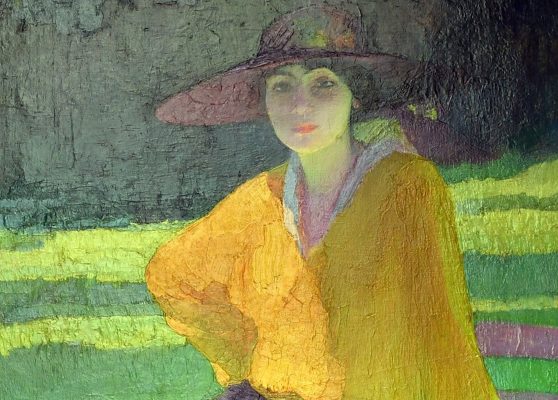
With “GAM 100. A Century of the Municipal Gallery 1925–2025”, Rome celebrates the centenary of its Gallery of Modern Art, retracing a hundred years of collecting choices, cultural policies, and transformations of taste. The exhibition offers a critical reading of the museum’s history as a public institution and as a privileged observatory of modern and contemporary Italian art.
The exhibition is conceived as a large-scale historical and critical project, designed to celebrate the centenary of the founding of Rome’s Municipal Gallery of Modern Art, established in 1925 as the first Italian civic museum dedicated to modern art.
Rather than simply commemorating an anniversary, the exhibition constructs an articulated narrative device that interweaves artworks, documents, and contexts, restoring the complexity of an institution that has accompanied, interpreted, and at times anticipated the transformations of art in the twentieth and early twenty-first centuries. In this sense, the exhibition presents itself as a reflection on the museum itself: on its functions, its public responsibilities, and its role in shaping Rome’s cultural memory.
The Municipal Gallery of Modern Art: a founding institution
The birth of the Municipal Gallery of Modern Art represents a crucial moment in the cultural history of the capital. Founded at a time of profound redefinition of the relationship between art, the city, and institutions, the GAM positioned itself from the outset as a space dedicated to contemporaneity, capable of engaging with the present without renouncing a historical perspective. Over the course of a hundred years, the museum has gone through different phases, reflecting political, aesthetic, and social changes, while consistently maintaining its public vocation.
From 1925 to the mid-twentieth century
The period between 1925 and the mid-twentieth century represents the foundational phase of the identity of the Municipal Gallery of Modern Art. During these decades, the museum faced the challenging task of defining what “modern art” meant in a context still strongly tied to academic tradition and figurative representation.
The first acquisitions reflect a cautious modernity, often mediated through languages that retain a firm connection to visible reality. Yet even at this stage, signs of tension and unease emerge, especially through artists associated with the Roman School. Figures such as Mario Mafai and Scipione embody an anti-rhetorical modernity, marked by intense expressiveness and a dramatic vision of reality, in sharp contrast with the official cultural directives of the period.
At the same time, the presence of artists such as Giorgio de Chirico introduces a metaphysical and conceptual dimension that radically expands the museum’s horizon. In this phase, the GAM gradually constructs its own identity, oscillating between adherence to and critical distance from dominant models, and laying the groundwork for the experimental openings of the postwar period.
The period up to the mid-twentieth century thus emerges as a phase of sedimentation, during which the museum defines its interpretive tools and its public role, preparing the ground for the radical transformations that would characterize the second half of the century.
The postwar period and the opening to contemporaneity
For the Gallery of Modern Art, the postwar period represents a moment of profound identity redefinition. The historical rupture caused by the conflict required the museum not only to update its artistic language, but also to reconsider its cultural role within society. In this phase, the GAM confronts the need to move beyond a purely representational conception of art, opening itself to practices that question figuration, subject matter, and the very function of the artwork.
The entry of abstract, informal, and sign-based material practices does not occur as a simple alignment with international trends, but as a critical response to a context marked by trauma, reconstruction, and ethical redefinition. Contemporary art is recognized as a space of questioning rather than consolation: a field in which visual language becomes a tool for knowledge and symbolic resistance. In this sense, the GAM progressively assumes the role of mediator between artistic experimentation and the public, fostering a mode of engagement that does not simplify but problematizes.
The exhibition’s theme: a century of collection and vision
The central theme of the exhibition is not a self-referential celebration of the institution, but rather a critical reading of the collection as a cultural project. The exhibition interprets the collection not as a neutral assemblage of works, but as the result of choices, exclusions, ideological orientations, and visions layered over time.
Each acquisition is implicitly read as a political and cultural act: a positioning in relation to the present and an assumption of responsibility toward the future. Within this framework, the collection becomes a form of historical writing, capable of conveying not only the evolution of artistic languages but also the transformation of the criteria by which modern and contemporary art has been legitimized. The exhibition highlights how the GAM has progressively abandoned the idea of a stable canon, adopting a dynamic and open vision of modernity.
The collection as an archive of modernity
One of the key concepts of the exhibition is the idea of the collection as an archive of modernity. In this context, the archive should not be understood as a static repository of works, but as an active system of selection, interpretation, and transmission of visual knowledge. The collection of the Gallery of Modern Art thus appears as a critical device, capable of reflecting the tensions, contradictions, and ambiguities that traverse artistic modernity.
Each artwork becomes a trace, a document of a specific historical and cultural position. The simultaneous presence of figurative, abstract, informal, and conceptual languages restores an image of modernity as a plural and conflictual field, far removed from any idea of linear progress. In this sense, the collection does not certify a history already written, but makes visible the conditions of its construction.
The exhibition underscores how the museum archive is also a place of selective memory: what is preserved, exhibited, and valorized coexists with what has remained marginal or has been excluded. This critical awareness reinforces the role of the GAM as an institution capable of questioning itself and challenging its own interpretive paradigms.
Artists, languages, and generations
One of the most significant aspects of the exhibition route is the coexistence of artists belonging to profoundly different generations and poetics, brought into relation not according to pre-established hierarchies, but through thematic clusters and conceptual affinities. The GAM collection bears witness to the plurality of languages that have crossed twentieth-century Italian art, from the persistence of figuration to the most radical experiments.
Alongside historicized figures such as Giorgio de Chirico, whose work interrogates the relationship between time, memory, and representation, emerge artists who redefined the very concept of form and matter, such as Alberto Burri, whose research marks a decisive rupture with pictorial tradition. The presence of Mario Mafai and Scipione instead restores the central role of the Roman School in constructing an uneasy, anti-rhetorical modernity.
The exhibition highlights how the GAM has been able to accommodate divergent languages without reducing them to a single narrative, fostering a complex and unresolved reading of the history of Italian art.
The Italian painters in the collection of the Municipal Gallery of Modern Art
The collection of the Municipal Gallery of Modern Art of Rome offers a stratified reading of Italian painting between the nineteenth and twentieth centuries, where the notion of “modern” does not coincide with a single avant-garde, but with a system of tensions: figuration and abstraction, memory and experimentation, urban identity and international horizon. The main Italian painters in the collection can be traced back to historical-critical clusters that clarify both the evolution of artistic languages and the museum’s function as an archive of modernity.
The Roman School and an uneasy modernity
A fundamental axis of the collection is constituted by the Roman School, which elaborates an anti-rhetorical and profoundly existential form of modernity. In these artists, painting becomes the site of an unstable perception of reality: the city, the body, and historical time are translated into an emotional language, often dramatic, resistant to any form of pacification.
- Mario Mafai: a lyrical and sorrowful figuration, marked by crepuscular tonalities and by an idea of form as a vulnerable trace of history.
- Scipione: visionary and deforming expressiveness, in which reality is transfigured into a symbolic and febrile image, suspended between pathos and unease.
- Antonietta Raphaël: an intense and archaizing figuration, capable of fusing memory, spirituality, and the modern construction of form.
Metaphysical Painting and the Suspension of Pictorial Time
The presence of metaphysical painting in the collection underscores the GAM’s attention to those investigations that called into question the very idea of representation. Here, space is no longer an environment “to be described,” but a conceptual machine that interrogates the relationship between object, memory, and gaze.
- Giorgio de Chirico: the construction of suspended and estranging scenarios, in which architecture, objects, and figures become signs of an interrupted time, generating a mental image before a narrative one.
Between figuration and modern realism
Alongside the more experimental trajectories, the collection preserves works by artists who renewed figuration without severing its bond with tradition, elaborating a modern realism founded on compositional discipline, the quality of drawing, and the psychological density of the image.
- Felice Casorati: formal rigor and classical tension, in which the figure is constructed as architecture and composition becomes a system of controlled equilibria.
- Carlo Levi: a form of painting in which the human dimension intertwines with critical intelligence, restoring the figure as a site of moral and historical testimony.
Informal Art: matter, gesture, surface
The postwar period introduces a decisive shift into the collection: painting no longer coincides with the image, but with matter and process. The surface becomes a field of action, wound, and sedimentation; gesture and sign acquire a cognitive value, often linked to the need to re-found language after the crisis of history.
- Alberto Burri: the work as a “wounded” and transformed surface, in which materials and combustions redefine painting as a physical event and historical memory.
- Giuseppe Capogrossi: the construction of a personal sign-based alphabet, in which the repetition of the sign produces rhythm, structure, and meaning beyond figuration.
From Italian Pop Art to late twentieth-century Rome
The collection also documents the emergence of a contemporaneity more directly connected to the media, urban culture, and symbols of power. In this context, painting interrogates the society of images, seriality, and political iconography, redefining the relationship between artwork and communication.
- Mario Schifano: painting as a reaction to the media flow and urban imagery; the surface becomes a critical screen on which signs and images are deposited and consumed.
- Franco Angeli: a language that interweaves emblems, stratifications, and collective memory, with a rigorous reflection on symbols and their historical ambiguity.
The meaning of presence within the collection
These groupings do not define an exhaustive repertoire, but reveal the cultural logic of the collection: the GAM preserves Italian painting not as a linear sequence of styles, but as a field of confrontation between continuities and ruptures. The collection thus becomes a tool for reading the twentieth century as a history of competing languages, where each artwork is simultaneously an aesthetic document and an index of the social and institutional transformations that have shaped the very idea of modernity.
The exhibition route
The exhibition route is conceived as a complex narrative structure, in which chronological progression constantly dialogues with thematic and conceptual clusters. This is not a simple succession of historical periods, but a critical device that makes visible the internal logics of the collection and the transformations of the museum as an institution.
The galleries guide the visitor through moments of differing historical density, alternating documentary sections – in which the institutional context, acquisition policies, and the role of administrators and directors emerge – with more overtly analytical spaces, dedicated to direct comparison between artworks. In this way, the route avoids celebratory rhetoric and instead constructs a problematized reading, in which works are not isolated as self-sufficient masterpieces, but inserted into a network of historical, cultural, and ideological relations.
The installation also emphasizes the processual dimension of the collection: the museum does not appear as a completed organism, but as a structure in continuous becoming, shaped by revisions, reconsiderations, and updates. The visitor is thus invited to read the history of the GAM not as a linear narrative, but as a stratification of perspectives on modernity.
The origins and the definition of a museum identity
Founded in 1925, the Municipal Gallery of Modern Art emerges in a context in which the civic museum assumes an eminently pedagogical and identity-building function. From the outset, the institution positions itself as a space of mediation between tradition and modernity, charged with representing the art of the present without severing its connection with history.
The museum identity of the GAM is constructed through a constant tension between openness and control, experimentation and institutional recognition. The first collections reflect a modernity still anchored in figuration, yet already traversed by impulses toward renewal. In this sense, the exhibition highlights how the museum’s identity has never been monolithic, but rather the result of continuous negotiations between aesthetics, cultural policy, and the public.
Between tradition and experimentation
The dialogue between tradition and experimentation constitutes one of the driving forces of the entire exhibition route. The GAM does not present itself as a place of radical rupture, but as a space of productive friction, in which consolidated languages and emerging practices coexist and interrogate one another.
The exhibition demonstrates how artistic modernity does not develop through substitution, but through overlap and reworking. The persistence of figuration alongside abstraction, the coexistence of painting and sculpture with conceptual and installation practices, restore an image of art history as a non-linear process, marked by returns, resistances, and semantic shifts.
The museum as a critical space
Finally, “GAM 100” offers an explicit reflection on the museum as a critical space, neither neutral nor purely conservative. The GAM emerges as an active cultural device, capable of producing meaning through display, the comparison of works, and the construction of interpretive routes.
From this perspective, the museum is not only a place of memory, but a laboratory of meaning, in which the past is constantly reread in the light of the present. The exhibition invites visitors to recognize the constructed nature of every museum narrative, stimulating a conscious and critical form of engagement. It is in this reflective function that the Gallery of Modern Art reaffirms, on its centenary, its contemporary cultural relevance.
Why visit the exhibition
Visiting “GAM 100” means engaging with a history that is both artistic and civic. The exhibition provides critical tools for understanding the role of museum institutions in shaping the cultural identity of a city like Rome, highlighting the public value of the collection.
An opportunity for study and in-depth exploration
The exhibition is addressed not only to a general audience, but also to scholars, art historians, and professionals in the field, offering a thorough and well-documented reading. The richness of the materials on display allows for multiple levels of interpretation, making the visit an experience of study as well as aesthetic enjoyment.
The GAM today
Finally, the exhibition invites reflection on the contemporary GAM, on its current role and future perspectives. In this sense, the centenary becomes a privileged vantage point from which to question the destiny of modern and contemporary art museums in the twenty-first century.