The Museo dell’Ara Pacis is hosting a major exhibition devoted to the Fayum portraits and the representation of individual identity in Roman Egypt. More than 110 works from leading international institutions document the encounter between Egyptian funerary traditions and Greco-Roman visual culture through panel paintings, shrouds, masks and archaeological evidence. At the heart of the exhibition are nearly fifty exceptionally rare portraits.
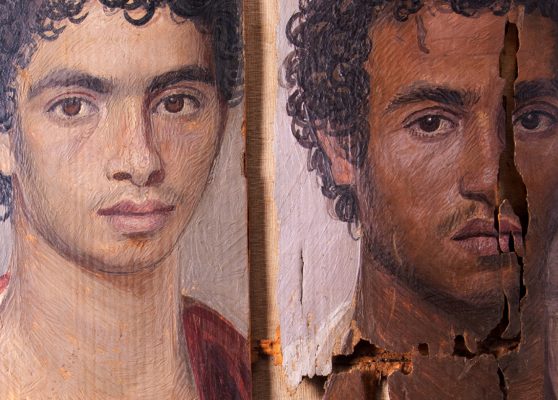
The human face has been one of the most closely examined subjects throughout the history of art, yet few ancient works retain a power to engage the viewer comparable to that of the Fayum portraits. Produced mainly between the 1st and 3rd centuries AD, these panel paintings depict men, women and children who lived in Roman Egypt, capturing their features with a naturalism of striking modernity. Originally placed on mummies, the images combine the funerary function of Egyptian tradition with the principles of Greco-Roman portraiture.
The Fayum portrait: a testament to roman Egypt
The so-called Fayum portraits take their name from the eponymous oasis, located south-west of Cairo, a region that became an important agricultural, economic and cultural centre during the Hellenistic and Roman periods. Works known by this name have been discovered at various sites throughout Egypt, mainly in funerary contexts. Their production developed between the late 1st century BC and the 3rd century AD, with a particular concentration during the early centuries of the Roman Empire.
These are images painted on thin wooden panels, generally placed over the faces of mummies, between the bandages that wrapped the deceased’s body. Their function was closely connected to Egyptian funerary tradition, in which the preservation of the body and the recognition of the individual held fundamental religious significance. Unlike earlier funerary masks, however, these paintings introduced a different visual language, based on the depiction of individual facial features.
The subjects do not belong to a mythological repertoire but are people who lived in a historically documented society. Differences in facial structure, hairstyles, beards, jewellery and clothing reveal a remarkable variety of human types. Some appear young, others more mature; their gazes, frequently directed towards the viewer, and the modelling of their features give the images a particularly powerful presence.
Between egyptian funerary tradition and roman visual culture
The distinctive character of this production lies in its intercultural nature. Its funerary purpose belongs to Egyptian tradition, while its pictorial language is clearly influenced by Greco-Roman visual culture. This phenomenon developed in a territory which, following the conquest by Alexander the Great and the subsequent Ptolemaic rule, had already experienced a long period of integration between different cultural models.
The funerary portrait is a particularly significant expression of this process. Painted wooden panels gradually came to be adopted in certain contexts in place of traditional masks, retaining the ritual function of the image while introducing greater attention to individual physiognomy. Individual portraiture, characteristic of Hellenistic and Roman visual culture, was thus integrated into a religious system deeply rooted in Egyptian civilisation.
The face as an expression of society
In the Roman world, portraiture had assumed a central role in both public and private representation. Images of ancestors, preserved in aristocratic homes and used in family ceremonies, helped perpetuate the prestige of prominent families. During the Imperial period, portraiture spread further, reaching increasingly broad social groups.
In Roman Egypt, this attention to individual physiognomy found a specifically funerary purpose. The details depicted now allow us to reconstruct aspects of clothing, aesthetic customs and social distinctions. Hairstyles, jewellery, garments and accessories serve not merely a decorative function but also provide information about the status and identity of the individuals portrayed.
The quality of the paintings varies considerably, as do their modes of representation. Some works favour a precise characterisation of facial features, while others adopt a more simplified approach. Both approaches reveal a conception of painting in which the face is not merely a decorative element but the focal point of the composition.
An artistic period limited in time
The production of Fayum portraits was concentrated within a relatively short chronological period, from the late 1st century BC to the 3rd century AD, when this practice gradually began to decline. The precise reasons for its disappearance are not fully understood. Changes in funerary practices, religious transformations and the evolution of social customs probably all contributed to altering the relationship between images and ritual.
The rarity of surviving works is also due to the conditions required for their preservation and the nature of the materials used. Paintings on wooden supports are particularly vulnerable to humidity and fluctuations in climate. The dry climate of certain Egyptian regions favoured the survival of a heritage that would otherwise have been largely lost in other parts of the Mediterranean. The need to ensure strict conservation conditions also makes the transfer of panels between museums complex, explaining the relative rarity of exhibitions bringing together such substantial collections.
Painting techniques and the construction of the image
The technical quality of the Fayum portraits demonstrates an advanced understanding of painting processes. Despite their modest dimensions and funerary purpose, these works display a remarkable ability to model volumes, modulate flesh tones and create effects of depth. Close examination of their surfaces reveals different methods of applying colour and a variety of technical approaches.
Encaustic and Tempera: two techniques compared
The main techniques employed were encaustic and tempera. In the former, pigments were mixed with wax, generally beeswax, and applied to the support using processes involving heat. The paint was particularly rich in texture, allowing artists to achieve intense colour surfaces and remarkable effects of depth.
Encaustic made it possible to work the paint through broad brushstrokes and overlapping layers, constructing forms through variations of light and shadow. Subtle gradations of flesh tones, highlights on the cheeks and forehead, and the definition of the eyes and hair all contributed to the naturalistic quality of the images. In some works, the texture of the paint remains clearly visible, allowing the viewer to appreciate the gestures involved in their execution.
Tempera, by contrast, used pigments bound with substances generally of organic origin, such as animal glue. The result was a more matt surface, in which tonal variations were created through carefully controlled colour transitions. The two techniques could be employed in different ways, producing a range of expressive effects.
The wooden support and surface preparation
The panels were made from various types of wood and were often only a few millimetres thick. The choice of timber and the preparation of the support were important stages in the process. In many cases, the surface was coated with a preparatory layer of plaster or another suitable material to make it ready for painting.
The shape of the panels was determined by their intended purpose. They had to be inserted into the bandages wrapped around the mummified body and fitted to the position of the face. Some therefore have altered or trimmed edges to allow them to be incorporated into the funerary wrappings.
Analysis of the surviving surfaces makes it possible to identify traces of preparatory drawings and different methods of applying paint. The presence of gilding, used particularly for jewellery and certain decorative details, also testifies to the attention paid to the representation of social status.
Light, colour and naturalism
The construction of the face through the relationship between light and shadow is one of the most characteristic features of this artistic production. Artists used variations in colour to model the cheeks, define the bridge of the nose, emphasise the eyelids and render the texture of the skin. The precision of certain details coexists with greater freedom in the execution of other elements, such as hair and clothing.
This combination of naturalistic observation and pictorial synthesis gives the paintings their distinctive expressive quality. Likeness does not derive solely from a meticulous description of anatomical features, but from the ability to select the elements that make a person recognisable. The result is a form of portraiture in which individual likeness is combined with a remarkable awareness of composition.
The exhibition itinerary
Curated by Claudio Parisi Presicce and Laura Petacco, the exhibition offers an art-historical interpretation that places the portraits within the broader system of cultural and funerary practices to which they belonged.
The main section comprises nearly fifty Fayum portraits, brought together through an international loan programme of exceptional significance. A substantial part comes from Egyptian collections: for the first time, almost all the panels held in the country’s museums have been made available on loan, including works that had never previously left Egypt. The opportunity to compare paintings belonging to different collections is one of the most significant aspects of the exhibition.
The Tondo of the Two Brothers and international loans
Among the most important works is the celebrated Tondo of the Two Brothers, preserved at the Egyptian Museum in Cairo and considered one of the finest examples of ancient portraiture. Painted in encaustic on a wooden support, it depicts two male figures standing side by side, characterised by particularly accurate rendering of their facial features.
The work is significant for its ability to combine the individualisation of the subjects with a carefully organised composition. The depiction of the two men, the definition of their features and the relationship between the figures make the painting a document of considerable interest for the history of ancient painting.
The Tondo underwent restoration work in Egypt, carried out by Italian conservators as part of the exhibition project. Its presence therefore also offers an opportunity to appreciate the results of conservation work essential to protecting an especially delicate artefact.
Another significant group of works comes from the Louvre Museum, which is lending twenty-three pieces, including painted panels and linen funerary shrouds. Particularly noteworthy are the textiles from Antinoe, or Antinopolis, featuring figurative decorations associated with the funerary practices of Roman Egypt.
Isidora, Eirene and the identities of the subjects portrayed
Among the international loans, the portrait of Isidora, now held at the Getty Museum, stands out. The refinement of its execution has led scholars to attribute the work conventionally to an anonymous artist identified as the Master of Isidora. This designation does not refer to a historically documented painter, but rather to an artistic personality reconstructed through stylistic analysis of the painting.
The panel is a significant example of the high quality achieved by funerary painting. The attention to detail, the rendering of clothing and jewellery, and the care devoted to facial features demonstrate how portraiture could also serve as a means of expressing social distinction.
The portrait of Eirene, from the Landesmuseum Württemberg in Stuttgart, is also of particular interest. The woman’s name appears on the panel alongside a prayer formula through which her family entrusted her soul to Osiris, a central deity in Egyptian funerary religion. The inscription makes it possible to link the image directly to an identified individual, providing evidence of considerable documentary value.
The prologue: two traditions of funerary representation
The exhibition opens with a comparison between Egyptian and Roman artistic traditions. On one side is a Ptolemaic-period funerary mask from the Museo Barracco, in which the face retains a predominantly symbolic and idealised character. On the other are marble portraits from the Capitoline Museums and Centrale Montemartini, documenting the role assumed by individual representation in Roman culture.
The comparison highlights two different conceptions of the funerary image. In Egyptian tradition, the mask was closely associated with the preservation of the body and its ritual transformation. In Roman portraiture, by contrast, physical likeness also acquired civic and social significance, contributing to public and family memory.
The exhibition’s five sections
The memory of the face and funerary plaster casts
The first section explores the origins of the desire to preserve individual features through a particularly rare group of casts from the Tomb of the Valerii, located beneath St Peter’s Basilica. These objects document the various stages of a process intended to preserve the impression of the deceased’s face and subsequently translate it into a commemorative marble image.
The casts help visitors understand the importance attached to physical likeness in Roman funerary practices. The image became the result of a material process through which facial features were transferred onto a support intended to endure over time.
From the mask to the painted panel
The second section is devoted to the encounter between the two funerary traditions. In Roman Egypt, the traditional mask gradually gave way to the painted panel, without the ritual function of the image being abandoned. The transformation primarily concerned the language of representation, which became more attentive to individual characteristics.
Among the works on display is the sarcophagus containing the mummy of the young girl Giupra, from the National Archaeological Museum of Florence. This object reconnects the portraits with their original purpose and helps explain how these images formed an integral part of the funerary treatment of the body.
The gallery of faces: individuals, families and social status
The third section forms the core of the exhibition’s presentation of Fayum portraiture. Dozens of painted panels are displayed in a comparison of the subjects’ different facial features and social characteristics. The paintings document a society in which personal appearance, clothing and jewellery all contributed to the definition of social identity.
Among the individuals represented are Demos and her little girl, a mother and daughter buried in the same tomb, as well as a soldier from the Eton College collection. Comparisons with sculpted portraits from the Capitoline collections make it possible to identify similarities and differences between the systems of representation adopted by the two cultures.
A further element of study is provided by jewellery from Pompeii and Herculaneum, displayed alongside the ornaments depicted in the paintings. Bracelets, necklaces, earrings and other decorative objects can thus be examined as material evidence of a culture of dress and appearance shared throughout the Mediterranean region.
The materials and techniques of funerary painting
The fourth section explores the material and technical aspects of this artistic production. Particular attention is given to the preparation of wooden panels, the use of encaustic and tempera, and the characteristics of the different materials employed in creating the images.
The comparison between wood, linen, stucco and marble reveals how the preservation of individual likenesses relied on different supports and techniques. The works thus become documents of the technical culture of Roman Egypt, as well as testimonies to its artistic production.
The final examples and the shrouds of antinoe
The fifth and final section documents the closing phases of painted panel portrait production, with works dating from as late as the 3rd century AD. The exhibition concludes with some of the last examples of this tradition and with precious painted shrouds from Antinoe.
The city, also known as Antinopolis, was founded by Emperor Hadrian in AD 130 in memory of Antinous, the emperor’s young companion who died in the Nile. The shrouds testify to the evolution of funerary representation: the painted face continued to serve an identifying function, but became part of a more elaborate visual structure in which the fabric and its decoration contributed to the overall composition of the funerary ensemble.
Why visit the exhibition
The significance of the exhibition lies first and foremost in the opportunity to see a particularly substantial group of works that, owing to their fragility and rarity, are rarely accessible to the public. The presence of nearly fifty portraits, largely drawn from Egyptian collections, offers the chance to compare paintings that are normally dispersed among museums and collections in different countries.
The project’s scholarly value also lies in the opportunity to study a form of painting of which relatively few examples have survived. The preserved wooden surfaces and pigments make it possible to examine technical processes that have been lost in the majority of works from antiquity.
A rare opportunity to discover ancient painting
Greek and Roman painting is known primarily through fragmentary evidence. The frescoes of Pompeii and Herculaneum, certain funerary decorations and a handful of other groups of works constitute only a small part of an artistic production that must once have been far more extensive. Many works created on perishable supports did not survive environmental conditions and historical transformations.
The Fayum portraits therefore represent a fundamental source for reconstructing the characteristics of ancient painting. The climatic conditions in certain parts of Egypt favoured the preservation of panels, pigments and surfaces that would otherwise have been destroyed. Direct observation makes it possible to appreciate the variety of techniques, the quality of the painted surfaces and the stylistic differences between artists.
A perspective on the society of roman Egypt
From this perspective, portraiture becomes a tool for understanding the processes of integration that characterised the ancient Mediterranean. Through clothing, personal attributes and facial features, it is possible to approach the reality of a complex society in which forms of self-representation reflected different cultural affiliations and social conditions.
The works provide valuable documentation of the society that produced them. Differences in clothing, jewellery and hairstyles help reconstruct aspects of everyday life and forms of social distinction. The jewellery depicted in the paintings finds parallels in archaeological objects from Pompeii and Herculaneum, while details of clothing testify to the circulation of aesthetic models between different regions of the Empire.
The dialogue between archaeology, art history and conservation
A further reason for the exhibition’s importance lies in the relationship between archaeological research, art-historical studies and modern conservation practices. Fayum portraits require specialised expertise to analyse their supports, understand their painting techniques and assess their state of preservation.
The restoration of the Tondo of the Two Brothers, carried out in Egypt by Italian specialists as part of the exhibition project, provides a concrete example of the importance of international collaboration in safeguarding ancient heritage. The inclusion of the youthful portrait discovered during excavations conducted by the archaeological mission of the University of Salento also highlights the relationship between new discoveries and the enhancement of museum collections.
The significance of the exhibition venue
The choice of the Museo dell’Ara Pacis introduces a further interpretative dimension. The Augustan monument, conceived to celebrate the peace and stability achieved under the principate of Augustus, belongs to a decisive period in Roman history, when imperial expansion profoundly altered the political and cultural balance of the Mediterranean.
The relationship between the monumental setting of the Ara Pacis and the works on display therefore makes it possible to place the exhibition within a broader historical perspective. The itinerary does not simply present a collection of funerary paintings, but reconstructs a period in which Roman culture entered into contact with one of the oldest and most highly developed civilisations of the Mediterranean.