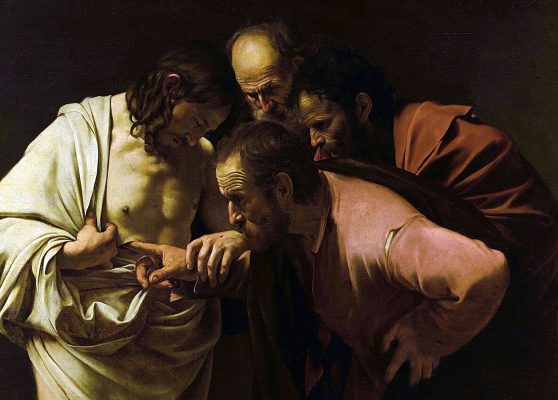
The exhibition “Caravaggio and the Masters of Light” takes shape as a wide-ranging exhibition project devoted to the most radical and transformative phase of European painting between the late sixteenth century and the early decades of the seventeenth century. The initiative aims to analyze the linguistic revolution introduced by Caravaggio and its rapid dissemination through a network of artists who, both in Italy and beyond national borders, embraced and reinterpreted his legacy.
The central role attributed to light, understood not merely as a physical phenomenon but as a dramaturgical and theological device, constitutes the core of the entire exhibition path. The show invites reflection on the modernity of a visual language that, breaking with Mannerist idealization, established a new relationship between image, reality, and viewer.
Caravaggio and the revolution of light
At the heart of the exhibition stands the figure of Caravaggio, protagonist of a radical transformation in figurative language. His work marks a turning point in the history of Western art: the abandonment of Mannerist abstraction, the rejection of the idealized construction of the body, and the choice of models drawn from everyday reality established a new visual paradigm. Caravaggesque naturalism was not mere imitation of the real, but a masterful construction of pictorial truth, founded on a calibrated use of light and shadow.
Light as narrative structure
In Caravaggio’s visual vocabulary, light does not merely define volumes or make space perceptible: it becomes the generative element of the scene. The beam of light isolates, selects, judges. Through sharp contrasts and sudden luminous epiphanies, the artist constructs a visual dramaturgy in which the sacred manifests within the everyday. Chiaroscuro thus acquires both theological and theatrical value, guiding the viewer’s gaze and emotionally involving them in the depicted event.
Naturalism and the truth of reality
The choice of popular models, the depiction of bodies marked by time, and the tangible rendering of objects and surfaces—from fabrics to musical instruments, from weapons to natural elements—demonstrate a desire to adhere to reality that deeply unsettled contemporaries. Painting becomes a space for direct engagement with matter and sensory experience, rejecting any abstract idealization.
Roman context and immediate reception
Within the cultural climate of Counter-Reformation Rome, Caravaggio’s painting found fertile yet conflictual ground. The demands for narrative clarity and emotional engagement promoted by ecclesiastical patronage intertwined with the innovative force of a language that broke with academic tradition. Success was rapid and controversial, generating a phenomenon of imitation and reinterpretation that gave rise to Caravaggism.
Caravaggism
The exhibition broadens its perspective beyond the figure of the master, reconstructing the complex network of painters who embraced his legacy. Caravaggism was not a unified movement, but a multifaceted constellation of experiences that interpreted the lesson of light according to different sensibilities and contexts. The exhibition highlights these variations, underscoring how Caravaggesque naturalism evolved into a European language.
Dialogue between master and followers
Within the exhibition, light emerges as the true unifying element between the master and his followers. It is not merely a technical device, but a structural principle that shapes space, models bodies, and organizes narrative. The luminous beam, often originating from a source outside the canvas, selects the protagonists and isolates them from the dark background, creating an effect of theatrical suspension.
In Caravaggio’s paintings, light assumes an almost judging value: it reveals, exposes, indicates. It constructs an internal hierarchy within the image, guiding the viewer’s eye toward the focal point of the action. This same device is embraced and reinterpreted by the Masters of Light, who at times amplify its contemplative dimension, at others its dramatic force. In the French sphere, for instance, light becomes more intimate and silent; in the Spanish context, it takes on harsh and material tones; among Italian painters, it tends to preserve a more explicit narrative tension.
Italian Caravaggisti
The first sections of the exhibition function as a critical threshold: not merely a prologue, but the immediate echo of the Caravaggesque impact. Around the figure of Caravaggio, European painting experienced a fracture that was both linguistic and moral. Within this context stand the followers closest to the master, such as Bartolomeo Manfredi and Antiveduto Gramatica, interpreters of a season in which Merisi’s lesson was adopted with almost programmatic intensity.
In Manfredi, the scene becomes close and compressed, inhabited by half-length figures immersed in compact darkness from which light emerges frontally and decisively. His naturalism concentrates the event, confining it within a closed space and transforming narrative into a direct confrontation between gesture and gaze.
Gramatica, more measured yet no less engaged, embraces Caravaggio’s luminous tension by modulating it within more composed structures, where chiaroscuro does not explode but silently engraves surfaces. In both cases, light is already an autonomous language, an ordering force that replaces traditional perspectival construction.
The Gentileschi
The path continues with figures who reinterpret Caravaggesque naturalism in a more intimate and poetic key. Orazio Gentileschi softens the harshness of contrast, replacing immediate drama with a clear, almost enamel-like light that envelops bodies with linear elegance. In his compositions, silence prevails over gesture, and theatricality transforms into lyrical suspension. Orazio translates dramatic tension into a more lyrical and controlled measure.
Among Caravaggio’s followers, Artemisia Gentileschi occupies a position of particular prominence, not only for the quality of her painting but for the depth with which she internalized and transformed the Caravaggesque lesson. While many interpreters merely replicated compositional models or lighting effects, Artemisia grasped its most radical core: the idea that the truth of the body and emotion could become the privileged vehicle of sacred and historical narrative. She intensifies the psychological dimension and the narrative force of female figures.
Spread across Europe
Caravaggism quickly crossed Italian borders, finding interpreters in France, Flanders, and Spain. The exhibition expands to an international dimension with foreign painters such as Stomer, De Ribera, and Van der Helst, artists who developed a poetics of nocturnal light and contemplative silence, transforming chiaroscuro contrast into inner meditation and restoring the international scope of the phenomenon.
Matthias Stomer brought to Northern Europe an intense nocturnal version of chiaroscuro, emphasizing the luminous vibration of scenes illuminated by torches and candles. Jusepe de Ribera, active in Naples, radicalized the material component: light cuts across skin, highlights its roughness, and renders the suffering of saints and martyrs tangible. In the Dutch context, Bartholomeus van der Helst absorbed the Caravaggesque lesson, translating it into a more descriptive sensibility in which luminous contrast dialogues with attention to detail and psychological rendering.
Particularly evocative is the comparison with Trophime Bigot, renowned for his ability to paint the flame of a candle as the sole generative center of the scene. In these works, light is not only a dramatic element but an intimate, fragile, almost domestic event: a silent revelation that finds in darkness its necessary counterpart.
Light as a shared language
Despite stylistic differences, what unites these masters is the use of light as a structural principle. Raking illumination, dark backgrounds, and compressed theatrical spaces generate an intense visual experience in which time seems suspended. Painting becomes stage, and stage becomes a place of revelation. Chiaroscuro thus becomes a shared language capable of crossing geographic and cultural boundaries. It is through light that Caravaggism spreads, transforming into a European poetics of the real.
Exhibition path
The focal point of the entire exhibition is the oil on canvas The Incredulity of Saint Thomas (1600–1601), an emblematic work of Caravaggio’s poetics. In this painting, light is not scenery but revelation. Thomas’s gesture as he plunges his finger into Christ’s side is not merely a Gospel episode: it is an act of knowledge, a tangible experience of faith. Light, concentrated on faces and hands, guides the viewer’s gaze into the wound, transforming observation into participation. Realism is pushed to the limit of physical contact, yet precisely in this concreteness the spiritual dimension manifests itself.
The exhibition itinerary unfolds in thematic sections that allow visitors to grasp the evolution of Caravaggesque language and its subsequent transformations. The display favors close dialogue between works, avoiding a purely chronological arrangement and instead proposing conceptual nuclei centered on themes such as vocation, martyrdom, music, meditation, and still life.
Thematic sections and direct comparisons
Particular emphasis is placed on visual comparisons between works by the master and paintings by his followers. These juxtapositions reveal affinities and divergences, highlighting how the original lesson was at times radicalized, at others softened. The curatorial strategy aims to make perceptible the dynamic transmission of language, rather than simply presenting a repertoire of masterpieces.
Representation of the sacred
A significant section is devoted to religious subjects, in which light assumes symbolic value. The sudden gesture, the expression captured at its culminating instant, and the concrete rendering of bodies convey an idea of incarnate spirituality. The experience of the divine manifests through sensory reality, according to a principle of identification that involves the viewer. Light becomes a sign of grace and divine calling, where luminous irruption coincides with the spiritual event.
Genre scenes and still life
Alongside sacred themes, the exhibition focuses on genre scenes and still lifes, fields in which Caravaggesque naturalism finds particularly evident expression. Everyday objects, musical instruments, fruits, and furnishings are rendered with extraordinary tactile precision, transforming the ordinary into a pictorial event.
Installation and space
The display, calibrated to enhance the luminous qualities of the works, allows for a clear perception of chiaroscuro contrasts as a shared language, offering visitors a critical and informed experience. Space thus becomes an integral part of the curatorial narrative.
Why visit the exhibition
Visiting the exhibition means engaging with one of the most decisive seasons in the history of European art. The show provides critical tools to understand how the Caravaggesque revolution redefined the relationship between art and reality, profoundly influencing the visual culture of subsequent centuries.
Opportunity for historical and artistic insight
The exhibition addresses both scholars and an informed, interested public, offering an articulated reading of seventeenth-century naturalism. Through a coherent and well-documented path, visitors are guided toward an understanding of the stylistic, iconographic, and cultural dynamics that determined the birth and spread of Caravaggism.
Modernity of Caravaggio
Caravaggio’s extraordinary relevance lies in his ability to convey the complexity of human experience without idealizing filters. His painting continues to question the contemporary viewer, raising issues related to truth, representation, and the relationship between light and shadow, understood not only as formal categories but as metaphors of existence.