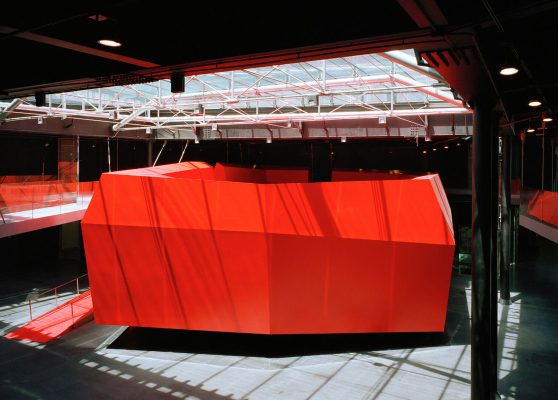
Cara Città (abbracciami) unfolds as a complex and layered exhibition project dedicated to Rome, conceived not merely as an urban environment but as a living, emotional, and symbolic entity. The exhibition positions the city at the center of a broad artistic and critical reflection, addressing its historical stratifications, social tensions, and affective dimensions. Rome emerges here as both subject and interlocutor: a city that shelters and rejects, welcomes and wounds, preserves memory while continuously transforming itself.
Through a carefully articulated curatorial vision, the project proposes a renewed reading of the contemporary metropolis, emphasizing the city’s capacity to generate narratives, images, and conflicts that resonate far beyond its geographical boundaries. The exhibition does not indulge in celebratory rhetoric, but rather adopts a lucid and analytical gaze, acknowledging Rome’s contradictions and fragilities. In doing so, it invites the public to engage with the city as a shared space of responsibility, imagination, and care, where the act of “embracing” becomes a metaphor for critical attention and civic consciousness.
Concept of the exhibition
At the core of Cara Città (abbracciami) lies a reflection on the city as a body, social, political, and emotional, constantly shaped by those who inhabit it. The exhibition title suggests an intimate, almost confessional relationship with Rome, invoking affection while implicitly acknowledging distance, fatigue, and disillusionment. This ambivalence becomes a guiding principle of the project, which explores the city as a space of coexistence between beauty and neglect, memory and erasure, belonging and exclusion.
Rome as a contemporary condition
Rather than presenting Rome as a historical backdrop or an immutable icon, the exhibition approaches the city as a contemporary condition. Artists are invited to respond to Rome as it exists today: a city marked by demographic change, political inertia, environmental vulnerability, and cultural resilience. The urban landscape is thus interpreted as a field of forces where personal biographies intersect with collective histories, and where artistic practice becomes a tool for investigation and critique.
Affective geographies and urban narratives
A significant thematic thread of the exhibition concerns the notion of affective geography. Works on display trace emotional maps of the city, revealing how places accumulate meaning through lived experience. Streets, peripheral neighborhoods, monuments, and forgotten spaces are reimagined as sites of attachment, loss, and resistance. The exhibition foregrounds the idea that the city is not only built through architecture and planning, but also through emotions, memories, and daily gestures.
Artists, practices and perspectives
The exhibition brings together a diverse selection of artists whose practices engage with urban reality through different media and conceptual approaches. Painting, photography, video, installation, sculpture, and performative practices coexist within a unified curatorial framework that emphasizes dialogue rather than stylistic coherence. This plurality reflects the complexity of the city itself, resisting any singular or reductive interpretation.
Artistic voices and urban engagement
Participating artists approach Rome from both internal and external perspectives, combining personal involvement with analytical distance. Some works stem from long-term research projects rooted in specific urban contexts, while others adopt a more symbolic or speculative stance. What unites these contributions is a shared attention to the city as a space of negotiation, where individual agency confronts structural constraints.
Memory, identity, and social dynamics
Several works address the role of memory in shaping urban identity, examining how collective narratives are constructed, transmitted, or suppressed. These artistic interventions highlight the tension between official histories and marginal stories, revealing the mechanisms through which certain voices are amplified while others remain invisible. The city is thus presented as a contested archive, constantly rewritten through social dynamics and power relations.
Critical art as civic practice
Within the exhibition, contemporary art is understood not as an autonomous aesthetic domain, but as a form of civic practice. The works do not offer solutions, but rather articulate questions, doubts, and critical positions. By doing so, they encourage viewers to reconsider their own role within the urban fabric, fostering an awareness of shared responsibility toward the spaces we inhabit.
Exhibition pat
MACRO reopens to the public with an exhibition season entirely dedicated to Rome, its artistic scene, and the creative energies that animate the city. Conceived by Artistic Director Cristiana Perrella, the programme envisions the museum as a living, porous, and responsive organism, one that reflects the city’s rhythms, contradictions, and transformative potential.
The season unfolds as a multidisciplinary narrative intertwining visual art, music, architecture, cinema, and performance, portraying Rome as an open laboratory shaped by both historical depth and grassroots cultural production. Past and future, institutional spaces and independent initiatives, local experiences and international dialogues converge in a shared reflection on the contemporary city.
The opening of the season is marked byfour exhibitions, inaugurated simultaneously on 11 December 2025, which together form a collective and stratified portrait of Rome through diverse artistic languages and perspectives:
UNAROMA (11 December 2025 – 6 April 2026), curated by Cristiana Perrella and Luca Lo Pinto, is a large-scale group exhibition featuring over seventy artists. Structured in three interconnected phasesf, Set, Live, and Off, the project offers a dynamic, intergenerational image of Rome’s vibrant and hybrid artistic ecosystem, expanding beyond the museum through collaborations with independent spaces across the city.
One Day You’ll Understand. 25 Years of Dissonanze (11 December 2025 – 22 March 2026), curated by Cristiana Perrella, revisits the influential Dissonanze festival, which between 2000 and 2010 positioned Rome as an international hub for electronic music, digital culture, and experimental art. Through extensive visual and sound archives, the exhibition reconstructs a pioneering moment in the city’s recent cultural history.
Jonathas de Andrade. Sorelle senza nome (11 December 2025 – 6 April 2026), curated by Cristiana Perrella, presents a newly commissioned video work by the Brazilian artist. Drawing on archival research and testimonies, the film recounts the story of a community of Brazilian nuns who, after breaking with religious vows in the 1960s, relocated to Rome under threat from the military dictatorship, continuing their political and social engagement as laywomen.
Abitare le rovine del presente (11 December 2025 – 22 March 2026), curated by Giulia Fiocca and Lorenzo Romito (Stalker), focuses on contemporary forms of dwelling and social housing in Rome. Developed from the Agency for Better Living project presented at the 2025 Architecture Biennale, the exhibition examines bottom-up practices of reuse, resilience, and regeneration in response to current environmental and social crises.
Together, these four exhibitions articulate a multifaceted reflection on Rome as a city in constant transformation, positioning MACRO as a platform for critical inquiry, cultural exchange, and collective experience.
Why visit the exhibition
Visiting the exhibition offers an opportunity to engage with Rome beyond conventional narratives. The exhibition provides a rigorous and nuanced framework for understanding the city as a contemporary phenomenon, addressing its contradictions with intellectual clarity and emotional depth. It appeals not only to art specialists, but also to anyone interested in urban culture, social transformation, and the role of artistic practice within public discourse.
Critical encounter with Rome
The exhibition encourages visitors to adopt a reflective stance toward the city, fostering a form of attentive observation that resists nostalgia and simplification. By presenting Rome as a shared and vulnerable space, the project calls for renewed forms of engagement grounded in awareness and responsibility.
Art as a tool for understanding the present
Ultimately, the exhibition demonstrates how contemporary art can function as a tool for understanding the present. Through diverse artistic languages and critical perspectives, Cara Città (abbracciami) articulates a compelling inquiry into the meaning of living in, with, and for the city today.