The event opens a five-year exhibition cycle devoted to the threats facing the written heritage, capable of endangering books, manuscripts and documents, while at the same time transforming those dangers into tools for knowledge and reflection. The first chapter is dedicated to water, an element essential to life but also an agent of destruction and deterioration. The exhibition brings together the history of the book, science, conservation and contemporary art, placing historical and scientific documents in dialogue with the contemporary work of JR and Bill Moran, as well as with the gastronomic culture explored by Fulvio Pierangelini.
AQVA: water, memory and contemporary languages
A library is created to preserve words against the dispersal of time; water, by contrast, can erase them within a matter of hours. From this opposition emerges “AQVA. Catastrophe and Wonder”, the first chapter of a five-year project in which the Vatican Apostolic Library examines the forces capable of threatening the written heritage and transforms them into instruments of knowledge.
The exhibition brings together the history of the book, art, science, conservation techniques and material culture, avoiding any reduction of water to the single image of catastrophe. Its very ambivalence governs the entire project: water is indispensable to life and scientific research, a medium of navigation and nourishment, a source of myths and fears, but also an agent capable of damaging paper and endangering written memory. The Vatican collections are placed alongside contemporary interventions by JR, Bill Moran and Fulvio Pierangelini.
Water between catastrophe, knowledge and the history of the Book
The intellectual premise of the exhibition rests on a paradox that is simple only in appearance. Books preserve the memory of societies and are conceived to survive the passage of time; yet their survival depends on vulnerable materials, sensitive to humidity, light, heat, microorganisms and human intervention. The exhibition cycle was conceived precisely to address these threats not only from the perspective of conservation, but also as categories through which to reflect on the relationship between human beings, nature and cultural memory. The following chapters will also focus on light and air, fire, insects and microorganisms, and ultimately on human intervention.
Water was chosen for the first chapter, perhaps because it expresses this contradiction more clearly than any other element. Without water there would be no life, agriculture, food production, navigation or many of the material processes that have accompanied the development of civilizations. At the same time, a flood can irreversibly damage libraries and archives. The exhibition therefore constructs a progression from fear to knowledge, gradually transforming the meaning attributed to the natural element.
The memory of the florence flood
One of the sections most directly connected with the vulnerability of cultural heritage recalls the Florence flood of 4 November 1966. Sixty years after the disaster, photographs preserved in the Vatican collections document the consequences of the overflowing of the Arno, when water also invaded the storage areas and reading rooms of the National Central Library of Florence. The reference is not merely commemorative: it introduces visitors to the concrete challenges of book conservation and shows how a substance usually associated with life can become a force capable of erasing evidence accumulated over centuries.
From destruction to the development of modern conservation
The Florence flood also occupies a fundamental place in the recent history of book conservation. The enormous number of damaged volumes and documents prompted an international mobilisation and accelerated the development of more systematic procedures for paper recovery, cleaning, drying and the treatment of water-damaged materials. Within the logic of the exhibition, the event therefore becomes a point of transition between catastrophe and the capacity to respond: loss becomes an opportunity to refine techniques and knowledge intended to protect cultural heritage in the future.
A Wunderkammer of the aquatic world
Once the initial dimension of threat has been overcome, the exhibition takes on the character of a Wunderkammer, a cabinet of curiosities in which the world of water appears in multiple forms. Marine bestiaries, evidence connected with navigation on the Tiber, numismatic objects and unusual books construct a cultural landscape in which scientific observation, imagination and antiquarian curiosity are not yet clearly separated. Among the objects featured in the exhibition is also a rare sixteenth-century booklet bound in sharkskin.
The arrangement of such heterogeneous materials evokes a culture of knowledge that predates modern disciplinary specialisation. A fish may simultaneously be a natural organism, a source of food, a symbolic image and a visual subject; a river may be a geographical phenomenon, a trade route, an infrastructure and a narrative space. The exhibition recovers this plurality without sacrificing historical precision, showing how knowledge of the aquatic world was constructed through the accumulation and overlap of different kinds of experience.
Ippolito Salviani’s Aquatilium animalium historia
The scientific and bibliographical core of the exhibition is the Aquatilium animalium historia by Ippolito Salviani, published in Rome in 1557 and represented through two particularly valuable copies. A sixteenth-century physician and naturalist, Salviani approached the study of aquatic animals according to criteria that reflect the growing importance of direct observation within Renaissance scientific culture. The treatise was at once a scientific, editorial and visual undertaking, in which the quality of printing and the precision of the images contributed directly to the construction of knowledge.
Observing nature before describing It
The importance of the Aquatilium lies above all in its method. Salviani chose to discuss animals that he had been able to study directly, also making use of dried specimens and drawings executed at natural size and in natural colours. Even the diplomatic network of the Holy See was involved in obtaining suitable material, a detail that reveals the organisational complexity of a scientific project in sixteenth-century Rome. The publication shows how the study of nature already depended on a network of observers, illustrators, engravers, printers and intermediaries.
The book thus becomes an object particularly suited to the theme of the exhibition: creatures belonging to the aquatic world are transferred onto paper through engraving and acquire a new visual existence. What may destroy the volume is at the same time the natural environment of the organisms that the book seeks to preserve through image and word.
JR, Bill Moran and Fulvio Pierangelini: contemporary languages in dialogue with the library
The encounter with the historical collections is not entrusted to a single artistic language. The curatorial approach brings together three figures from different fields: JR, an artist known for photographic interventions and environmental installations; Bill Moran, a contemporary interpreter of traditional letterpress printing; and Fulvio Pierangelini, a chef invited to explore the gastronomic and narrative dimensions of the aquatic world. This diversity is not incidental: it reflects the encyclopaedic character of the Library’s collections and the intention to observe water from multiple perspectives.
JR and the monumentality of the flood
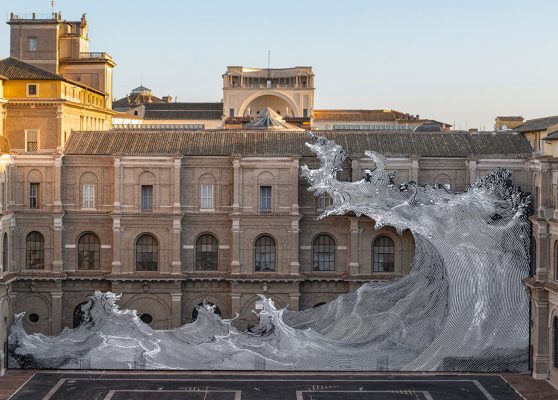
The first encounter is with Diluvium, a site-specific installation created by JR on the sixteenth-century façade of the Library. The work takes as its point of reference an engraving conceived by Gustave Doré for the illustrated Bible published in Tours in 1866. The image of the flood is enlarged to an architectural scale, making the building appear as though it were being engulfed by a mass of water. According to the official documentation, this is the first site-specific installation of its kind to be created in the Vatican.
JR does not use the image to illustrate the biblical narrative literally, but rather to create a perceptual tension between the stability of architecture and the instability of the wave. By definition, the Library is a place of permanence; water, by contrast, introduces the idea of sudden events, matter escaping control and the possibility of loss. The installation makes visible the paradoxical condition of the book: a vessel for ideas capable of surviving for centuries and, at the same time, an extremely fragile physical object.
From Diluvium to Undae
JR’s work also accompanies the final part of the exhibition through Undae, connected with the transformation of the Sala Barberini into a contemplative space. The sequence between the two installations creates a genuine narrative trajectory. If the initial wave breaks in as a threat, the concluding one gradually loses its catastrophic character and takes on a mental dimension. The same substance is therefore perceived in opposite ways without any need to alter its nature: what has changed is the visitor’s gaze after moving through the exhibition.
Bill Moran and the Letterfishes
With Bill Moran, the relationship between books and water passes directly through the tools of typography. The American artist uses letters, numbers and punctuation marks to construct images of marine creatures. The Letterfishes series includes fourteen works displayed throughout the exhibition spaces, twelve printed by hand on paper and two made in plexiglass.
The process reverses one of the fundamental principles of printing. Movable type, originally designed to compose words, ceases to produce readable text and becomes a graphic unit: curves, stems, dots and counterforms all contribute to the anatomical construction of the fish. Seen from a distance, the work resolves into a figure; viewed up close, that figure breaks apart into the individual signs of the alphabet. The image therefore exists on the threshold between reading and seeing, one of the most appropriate themes for an intervention conceived within a library.
The Typotheca Vaticana and the material memory of printing
The dialogue with Moran acquires further significance through the presence of the Typotheca Vaticana. For the first time, a cabinet made by A. Fouchier is being displayed, with 160 small drawers in its upper section designed to hold copper matrices for letters. The labels attached to the various compartments document the extraordinary range of languages and alphabets used by the papal printing press.
Placing this historical instrument alongside Moran’s typographic fish creates a dialogue between two functions of the printed character: on the one hand, the philological and linguistic transmission of knowledge; on the other, the contemporary possibility of freeing the letter from its semantic role and transforming it into image.
Fulvio Pierangelini: fish between books, memory and cuisine
The third contributor introduces a discipline that may initially appear more distant from the history of the library. In fact, the work of Fulvio Pierangelini reconnects naturalistic knowledge with material culture. The fish observed and classified by naturalists are also ingredients, commodities, elements of economic life and recurring presences in culinary tradition.
For the project, Pierangelini has composed six gastronomic narratives, also linked to the Library’s 2027 diary. The texts combine observations on ingredients, memories, literary and scientific references and an ironic component, transforming the recipe from a simple technical formula into a narrative form.
From Apicius to the cookbooks of the world
Around this contribution, the exhibition develops an itinerary through cookbooks from different geographical areas. Among the most significant materials is one of the oldest manuscripts of De re coquinaria by Apicius, in which the culinary text is presented through a decorative scheme reminiscent of the structure of a liturgical book. Alongside the European tradition is, among other examples, a rare Chinese cookbook from the Song period, preserved in an edition dating from the late fifteenth century and present in the Vatican collections since at least the mid-sixteenth century.
Gastronomy thus becomes a tool for tracing the circulation of knowledge. Ways of fishing, classifying, preparing and consuming aquatic animals reveal trade routes, cultural exchanges and different conceptions of nature.
The exhibition route
The exhibition is structured as a narrative progression rather than a chronological sequence of objects. The official itinerary moves from Impact to Fear, then to the wonder of collecting, science, typography, the geography of taste and conservation practices, before concluding in the Ocean of the Mind. Each section reshapes the visitor’s relationship with water, initially perceived as a hostile force and gradually recognised as an object of study, a source of images and even an instrument of care.
From impact to knowledge
Diluvium immediately introduces the theme of the disproportion between human beings and natural forces. The subsequent reference to the Florence flood transfers this perception from the realm of myth into documented history. The aquatic Wunderkammer then produces the first reversal: what inspires fear becomes something to observe, name and catalogue.
The transition to the Aquatilium animalium historia deepens this transformation. The marine animal ceases to be a fabulous creature and becomes the object of empirical verification; drawing and engraving participate in the construction of a science based on comparison and experience. Moran follows by returning those same creatures to the realm of imagination, but through the material tools of typographic culture.
Water as a tool for conservation
One of the most conceptually effective sections concerns the Conservation Laboratory of the Vatican Library. Here, the initial opposition becomes more complex: the very substance responsible for some of the most serious forms of damage to books can, under controlled conditions, be used in the processes designed to preserve them. The exhibition therefore presents water not through an absolute judgement, but through the relationship between matter, quantity, technique and knowledge.
Caring for the material substance of the book
Book conservation requires a physical understanding of the object. A manuscript or an early printed volume is not only the intellectual content it transmits: it is paper or parchment, ink, pigment, adhesive, thread, leather and wood. Each of these materials responds differently to its environment. Including conservation within the exhibition therefore removes the library from the abstract image of a mere repository of knowledge and reveals the range of technical expertise required for memory to remain accessible.
The Ocean of the mind in the Sala Barberini
The final section gradually abandons the analytical character of the preceding rooms. In the Sala Barberini, JR’s intervention leads towards what the project defines as the “Ocean of the Mind”: a space in which water no longer coincides with a disastrous event or an object classified by science, but instead takes on the value of a mental and contemplative image.
The choice avoids any consolatory resolution. The vulnerability of books remains real, just as the risks posed by natural elements remain concrete. What changes is the way they are confronted: uncontrolled fear gives way to knowledge grounded in observation, historical memory and the technical ability to intervene.
Why visit the exhibition
The exhibition is particularly compelling for the opportunity it offers to explore the collections of the Vatican Apostolic Library from an unusual perspective. Manuscripts, printed books, photographs, engravings, typographic materials and documents connected with the history of science are not arranged according to conventional chronological or disciplinary categories, but are instead examined through a single element: water.
This principle allows objects normally belonging to separate fields to be brought into relation. Renaissance ichthyology encounters contemporary art; the history of printing enters into dialogue with graphic practice; a medieval or Renaissance cookbook becomes a means of understanding the geographical circulation of knowledge; documentary photography introduces the techniques of conservation.
The fragility of memory
A second reason for the exhibition’s significance lies in the theme of conservation itself. A historical library usually presents what has survived. More rarely does it reveal the possibility of loss. “AQVA”, by contrast, draws attention to the material vulnerability of documents, reminding us that the transmission of culture is never automatic: it depends on institutions, specialists, techniques, environmental conditions and a continuous commitment to preservation.
The issue therefore extends beyond the specialist field. To conserve a book is to make it possible for people not yet born to encounter the words and images of earlier ages. From this perspective, water threatening a library becomes a particularly effective image of the precariousness of collective memory.
The dialogue between the ancient and the contemporary
The presence of JR and Moran is not used as a simple aesthetic updating of a historical collection. Their works arise from the characteristics of the place and from the objects preserved within it. Diluvium intervenes directly in the architecture and in the very meaning of the Library, while Moran’s Letterfishes take shape from the fundamental elements of printing.
Pierangelini also works from documentary heritage, using early texts on fish and historical cookbooks as material for new narratives. The result is a dialogue in which the contemporary does not replace the ancient, and the ancient is not reduced to an iconographic repertoire: both contribute to the creation of new associations.
A different way of entering the Vatican Library
Another element of interest is the opportunity to follow an itinerary that also includes the Salone Sistino, incorporated into the visits associated with the exhibition. This allows the temporary installation to be experienced alongside the historical dimension of one of Europe’s most important library institutions, established in its modern form in the fifteenth century and developed as a centre for the preservation, study and transmission of knowledge.
The first chapter of a five-year project
“AQVA” acquires a broader significance when considered as the opening chapter of “Catastrophe and Wonder”. The project unfolds over several years through the elements and agents capable of endangering the written heritage. The curatorial concept, however, is not intended to create a catalogue of threats: each becomes an opportunity to examine how human beings respond to forces they cannot entirely control.
The choice of water makes this approach clear from the very beginning. Destruction and regeneration, fear and knowledge, matter and image are not presented as rigidly separate categories. The same element that soaks and deforms paper can also be used in its restoration; what gives rise to the narrative of the flood is also what makes life possible; the sea inhabited by fantastic creatures in bestiaries becomes the object of Salviani’s scientific observation and, centuries later, reappears in Moran’s fish composed from typographic characters. It is precisely this continual reversal of meaning that gives the exhibition its most distinctive critical structure.