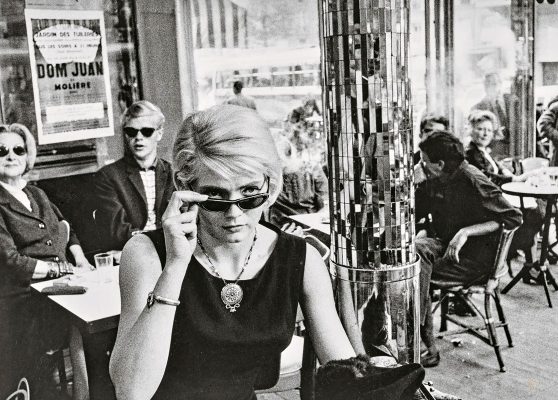
The exhibition Agnès Varda. Here and There, Between Paris and Rome unfolds as a critical and sensitive journey through the work of an artist who moved with absolute freedom across languages, disciplines, and geographies. Rather than offering a strictly chronological reconstruction of her production, the exhibition proposes a thematic reading capable of revealing the profound coherence of an artistic trajectory marked by close attention to reality, civic engagement, and a constant reflection on memory.
Through cinema, photography, installations, and archival materials, the curatorial project highlights the dialogue between Paris and Rome as symbolic and affective places, spaces of formation and return, within which Varda’s gaze gradually took shape as one of the most radical and compelling of our time. The result is a complex portrait that conveys the deep consistency of a body of work grounded in attention to the human condition, the responsibility of looking, and a continual interrogation of the real.
The theme of the exhibition: between real and imaginary geographies
The title of the exhibition, Here and There, evokes a condition of constant movement, of physical and mental traversal that characterizes Agnès Varda’s entire oeuvre. It refers not only to geographical displacement between Paris and Rome, but to a way of seeing: a position that is simultaneously inside and outside things, observing the world with both involvement and critical distance. The exhibition adopts this tension as its interpretive key, structuring the itinerary around the relationship between place, experience, and representation.
Paris and Rome as spaces of formation and return
For Varda, Paris represents the place of artistic formation and authorial affirmation, while Rome emerges as a space of confrontation, cultural resonance, and observation of the other. The exhibition reconstructs this dialogue through photographs, film excerpts, and visual notes that demonstrate how cities become true narrative devices, capable of shaping the very structure of the works. These are not postcard cities, but living contexts, traversed by bodies, marginal stories, and traces of memory.
The city as a narrative organism
In Varda’s work, the city is never a mere backdrop. It is a pulsating organism, crossed by social relationships, political tensions, and individual micro-histories. The exhibition underscores how urban space becomes a tool for questioning the present, revealing layers of lived experience and transformations over time.
The exhibition itinerary
The exhibition itinerary unfolds through the spaces in a fluid structure, guiding visitors through a sequence of thematic environments. The display privileges a direct dialogue between works and space, avoiding spectacular solutions in favor of a more intimate and reflective mode of viewing.
Historical photographs, film excerpts, installations, and archival materials form a heterogeneous yet coherent corpus. Visitors are invited to reconstruct Varda’s creative process, following the traces of a visual thought that develops through associations, returns, and variations.
Time as the material of the work
One of the most significant aspects of the itinerary is its attention to time: biographical time, historical time, and the time of memory. The works converse with one another, creating temporal short circuits that prompt reflection on the persistence of images and their capacity to interrogate the present.
École du Louvre
Arriving in Paris in 1943, Agnès Varda embarked on a formative path that would decisively shape her artistic identity. She attended the École du Louvre and chose photography as her first expressive language, drawn by the possibility of combining manual practice with intellectual reflection. During these years she shared an apartment near Pigalle with other young women: her roommates became the privileged subjects of her earliest portraits, while the banks of the Seine emerged as some of her first urban landscapes.
Already at this early stage, a recognizable style begins to emerge, characterized by a subtle, enigmatic quality, at times tinged with surrealist suggestions. For Varda, photography is not merely a tool of documentation, but a means of questioning the relationship between the one who looks and the one who is looked at. Thus takes shape a poetics of the gaze that will accompany her entire subsequent body of work.
Rue Daguerre, a space of life and creation
In 1951 Agnès Varda settled at number 86 rue Daguerre, a place destined to become the symbolic and operational center of her creative life. She converted two former shops, separated by a narrow courtyard-passage, into an atelier, studio, and laboratory. This space, both home and workplace, also became an environment of shared living, inhabited by the sculptor Valentine Schlegel and a family of Spanish refugees.
The courtyard of rue Daguerre is not merely a backdrop, but a true creative device. Here Varda organized her first photographic exhibition in 1954 and made her earliest films. Domestic space was transformed into a site of experimentation, where the boundaries between private life and artistic practice became porous, anticipating a mode of working that would prove central to her oeuvre.
Portraits and the postwar cultural landscape
In the 1950s Varda became the official photographer of the Théâtre national populaire directed by Jean Vilar and of the Festival d’Avignon. This experience allowed her to enter the theatrical and artistic world of Paris, expanding her scope and refining her visual language.
Her photographs portray key figures of the period’s cultural scene: Alexander Calder, Brassaï, Suzanne Flon, Giulietta Masina, Federico Fellini. In these portraits, Varda combines irony and ambiguity, at times venturing into darker tonalities. Gradually, she establishes herself as a singular voice within the intellectual landscape of the postwar era, capable of capturing the complexity of a time in transformation.
Staged photographs
Alongside reportage, Agnès Varda developed a photographic practice that already reveals a profoundly cinematic approach. Her images do not merely record reality, but are often staged with narrative awareness.
Like a filmmaker, constructs situations, directs her subjects, and explores the narrative potential of the still image. A child dressed as an angel or young actors mimicking amorous behaviors become elements of a “photo-writing” in which photography and cinema engage in continuous dialogue.
Paris and the Nouvelle Vague
The relationship between the individual and urban space finds one of its most accomplished expressions in Cléo from 5 to 7 (1961), in which Paris becomes a mirror of the protagonist’s emotional states, suspended between waiting and fear. The city is transformed into a sensitive organism, capable of reflecting inner and social tensions.
In 1967 returned to film Paris in resonance with the anxiety of a young mother affected by the Vietnam War. Close to the filmmakers of the Nouvelle Vague yet always independent, she inscribed her urban gaze within a constant dialogue between the private sphere and the political dimension, anticipating themes that would become central to contemporary cinema.
The gaze on women
One of the exhibition’s core sections is devoted to Varda’s gaze on women and, more broadly, on the human condition. In her photographs as in her films, the artist questions modes of female representation, rejecting stereotypes and simplifications.
In One Sings, the Other Doesn’t, she takes a clear stance in favor of women’s rights and contraception, while already in the 1950s she brought to light the impoverished population of the rue Mouffetard market in L’Opéra-Mouffe. In Daguerréotypes (1975), she focuses on the shopkeepers of her own street, whom she defined as the “silent majority”, recording their gestures and faces with poetic sincerity.
Portraits of young actresses and actors
Until the mid-1960s, the courtyard of rue Daguerre became the setting for portraits of young actresses and actors, including Delphine Seyrig and Gérard Depardieu. Over time, this space was symbolically transformed into a courtyard-garden, a place of memory and self-representation.
In works such as The Beaches of Agnès (2008), the courtyard extends ideally into the street and becomes the starting point for an autobiographical narrative in which Varda stages herself, reflecting on her own path and on the very meaning of making images.
The neighborhood and the banks of the Seine
Varda’s Paris is never the city of clichés. Her gaze rests on what goes unnoticed, on familiar places, on her neighborhood and the banks of the Seine. The materials presented in the exhibition reveal a camera that moves through urban space with curiosity and rigor.
Fiction, documentary, advertising, feature films, and short films coexist within a heterogeneous corpus, in which every form becomes an opportunity to question the relationship between image and reality.
Italy. A special focus for Villa Medici
A specific section of the exhibition is dedicated to Agnès Varda’s relationship with Italy. In 1959, during a journey to Venice and its surroundings, she photographed scenes of everyday life, capturing recurring motifs such as laundry hanging from windows and plays of light and shadow.
Rome and the dialogue with Italian cinema
In 1963, sent to Rome to photograph Luchino Visconti, she visited Jean-Luc Godard on the set of The Contempt and took the opportunity to portray established film stars such as Brigitte Bardot, Jack Palance, and Michel Piccoli. This Roman stay consolidated a profound dialogue with Italian cinema and today finds a natural resonance at Villa Medici.
Why visit the exhibition
Visiting Agnès Varda. Here and There, Between Paris and Rome means engaging with a body of work that profoundly renewed contemporary visual language. The exhibition offers an opportunity to understand how art can be at once rigorous and accessible, political and poetic, intimate and universal.
In an era marked by specialization and disciplinary compartmentalization, Varda’s trajectory appears extraordinarily relevant. Her ability to traverse languages without ever losing coherence represents a lesson in freedom and rigor, essential for understanding the transformations of contemporary art.
A lesson in artistic freedom
The exhibition does not provide definitive answers, but rather raises questions. It invites visitors to slow down, to observe, and to reflect on their own way of looking at the world. In this sense, Villa Medici becomes not only an exhibition venue, but a critical space, a place of dialogue between past and present, between individual memory and collective history.
The curators and the scholarly project
The Paris of Agnès Varda
The Parisian section of the exhibition is curated by Anne de Mondenard, Chief Heritage Curator and Head of the Department of Photography and Digital Images at the Carnavalet Museum – History of Paris. Her work stands out for its attention to the bond between Varda and the city, interpreted through a historical and visual perspective of great rigor.
The Italy of Agnès Varda
The Italian section is curated by Carole Sandrin, curator in charge of photographic collections at the Institut pour la photographie in Lille. Her contribution highlights the transnational dimension of Varda’s work and the central role of Italy within her visual imagination.