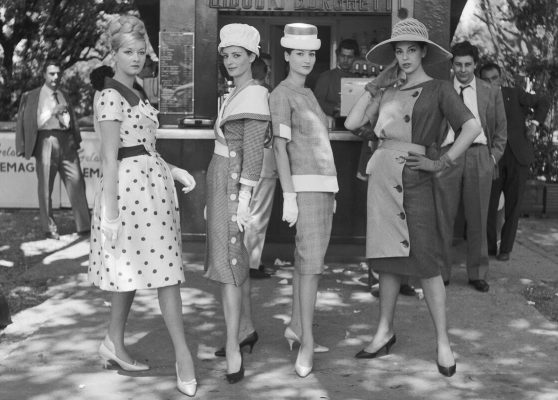
Between the mid-1950s and the mid-1970s, Rome experienced one of the most vibrant and influential periods of its contemporary history. Emerging from the hardships of the post-war years, the city gradually became a place where cinema, the visual arts, publishing, industry and haute couture came together to shape a new image of Italy.
While Cinecittà attracted major international film productions and Via Veneto became the symbol of a cosmopolitan lifestyle, Rome’s fashion houses were developing a distinctive language of elegance destined to achieve worldwide recognition. It was within this unique cultural environment that Made in Italy was born, not merely as a commercial label but as a broader cultural phenomenon: a synthesis of artisanal excellence, technological innovation, entrepreneurial vision and refined aesthetics.
The exhibition retraces this extraordinary period through a rich display of garments, photographs, newsreels, documents, magazines and archival materials, revealing how fashion helped redefine Italy’s cultural identity during the second half of the twentieth century.
Rome and the Birth of a new cultural identity
The history of Italian fashion extends far beyond the celebrated couture houses. It emerged from a complex network in which craftsmanship, industry, textile innovation, photography, cinema, publishing and the applied arts worked together to create a distinctive creative system. The exhibition presents this remarkable period as a collective achievement, in which each participant contributed to the development of a visual language that established Italian elegance on the international stage.
Rome occupied a unique position within this process. Fashion ateliers maintained close ties with the film industry, illustrated magazines transformed runway presentations into international events, and photographers used the city’s monumental heritage as the natural setting for their images. Within only a few years, the capital evolved into a creative laboratory where different disciplines converged, translating Italy’s manufacturing tradition into a compelling vision of modernity.
Fashion, Cinema and Photography
One of the exhibition’s greatest strengths lies in demonstrating how the success of Roman haute couture was supported by the creation of a powerful visual culture. Photographs from the Archivio Storico Luce, newsreels, illustrated magazines and fashion house archives reveal that garments were never presented as isolated objects. Instead, they became part of a broader narrative in which architecture, cinema, social life and the urban landscape all contributed to defining their cultural significance.
Historic squares, grand hotels, film studios and Rome’s panoramic terraces became theatrical settings for a new vision of elegance. Fashion thus assumed a broader cultural role, expressing the aspirations of a country confidently embracing the future while remaining deeply rooted in its extraordinary artistic heritage.
Perfetto. Mantengo lo stesso registro della prima parte: **non una traduzione letterale, ma una traduzione editoriale**, pensata per un pubblico internazionale interessato all’arte e alla cultura italiana.
The exhibition
Curated by Fabiana Giacomotti, the exhibition offers an interdisciplinary interpretation of Italian fashion, moving beyond a simple display of iconic garments. The exhibition brings together haute couture creations, photographs, films, documents, magazines, sketches and archival materials from major public institutions and private collections, demonstrating how the success of Italian fashion emerged from the convergence of creativity, industrial research and visual communication.
The remarkable holdings of the Archivio Storico Luce form the backbone of the exhibition’s narrative. Newsreels, photographs and documentaries guide visitors through a story in which fashion shows, ateliers, the work of skilled dressmakers and the circulation of images reveal how the visual identity of Made in Italy was shaped. Fashion thus emerges not merely as an expression of style, but as a historical document capable of reflecting the profound economic and social transformations that accompanied Italy’s post-war economic boom.
The leading figures of Roman Haute Couture
The exhibition brings together some of the designers who shaped the history of Italian haute couture. The creations of the Sorelle Fontana illustrate the close relationship between Rome’s fashion houses and the international film industry, while the work of Fernanda Gattinoni highlights the enduring dialogue between fashion design and cinematic costume.
Particular attention is devoted to Roberto Capucci, whose garments transform fabric into sculptural forms through an extraordinary exploration of volume and structure, and to Emilio Schuberth, one of the leading interpreters of post-war Roman elegance.
The exhibition also features creations by Simonetta, Irene Galitzine, represented by her iconic Palazzo Pyjamas, Renato Balestra, and Valentino Garavani, whose celebrated “Fiesta” dress reflects the stylistic maturity achieved by the maison during the 1960s. The narrative further extends to the history of Fendi, highlighting the creative contribution of Karl Lagerfeld, whose work exemplifies the continuity between Italian craftsmanship and contemporary design innovation.
Textile innovation and industrial research
One of the exhibition’s most distinctive features is its focus on the relationship between creative design and technological innovation. Rather than concentrating exclusively on celebrated designers, the exhibition demonstrates how the success of Italian haute couture was supported by the growth of the textile industry and by continuous experimentation with new materials, essential aspects that are often overlooked in the history of fashion.
A central role is assigned to SNIA Viscosa, one of Italy’s leading companies in the development of artificial and synthetic fibres during the years of the economic miracle. The introduction of innovative textiles dramatically expanded the creative possibilities available to designers: lighter, stronger and more versatile fabrics encouraged new silhouettes, refined structural solutions and unprecedented chromatic effects. The excellence of Italian fashion therefore emerged not only from artistic creativity but also from the fruitful collaboration between scientific research, the chemical industry and traditional manufacturing.
This perspective significantly broadens the understanding of the history of Made in Italy. Elegance is presented not simply as the result of individual artistic talent, but as the expression of a highly integrated system in which companies, workshops, technicians and artisans collaborated to produce garments combining aesthetic excellence with technical sophistication. It was precisely this balance between craftsmanship and industrial innovation that established the Italian model as one of the defining creative systems of the twentieth century.
Palma Bucarelli and the dialogue between Fashion and Contemporary Art
The exhibition further expands its cultural perspective through the figure of Palma Bucarelli, the visionary director of Rome’s National Gallery of Modern Art and one of the leading figures in the renewal of Italian museums after the Second World War. Her presence within the exhibition is more than a biographical reference: it highlights the growing dialogue that developed during those decades between the visual arts, design and fashion.
Bucarelli understood remarkably early that the culture of design could not be confined to the traditionally recognised fine arts. Like a work of design or an object of the applied arts, a garment could embody the historical, social and cultural values of its time. The exhibition embraces this broader perspective, inviting visitors to regard fashion as an integral part of twentieth-century artistic heritage, one that reflects the transformations of Italian society just as effectively as painting, architecture or industrial design.
Hollywood on the Tiber and the making of an international image
During the 1950s and 1960s, Rome experienced an extraordinary cultural season remembered as Hollywood on the Tiber. The arrival of major American film productions transformed the city into a vibrant meeting point between the international film industry and Italian creativity, providing Rome’s fashion houses with an exceptional stage on which to showcase their work.
The actors and actresses who lived and worked in the capital played a decisive role in bringing the prestige of Roman haute couture to an international audience. Creations by the Sorelle Fontana, Gattinoni, Schuberth and many of Italy’s leading couturiers appeared not only on screen but also at film festivals, gala receptions, premieres and editorial photo shoots. Cinema became an extraordinarily powerful medium, transforming Italian elegance into an internationally recognised symbol of style and sophistication.
The photographs and newsreels presented throughout the exhibition vividly capture this remarkable period. Rather than simply documenting garments, they portray a city alive with artists, filmmakers, journalists and photographers, where fashion played an active role in shaping Rome’s image as a modern, cosmopolitan capital while remaining deeply connected to its artistic and cultural heritage.
Fashion Photography as historical evidence
The exhibition also highlights the fundamental role of fashion photography. Advertising campaigns, editorial features and photographs from the archives of leading fashion houses demonstrate how photography helped define the visual identity of Made in Italy. Through the photographers’ lenses, garments became part of a broader narrative, engaging in a dialogue with Rome’s architecture and the rhythms of everyday urban life.
By presenting these images as historical sources rather than simple illustrations, the exhibition enables visitors to explore not only changing tastes in fashion but also the evolution of visual communication, advertising and the representation of Italian society during the years of the economic miracle.
Dialogue with the Centrale Montemartini
One of the exhibition’s most compelling features is its relationship with the unique setting of the Centrale Montemartini. Housed within a former thermoelectric power station, today one of Rome’s most distinctive museum spaces, the exhibition creates a meaningful dialogue between industrial archaeology and artistic heritage. In this context, exploring the relationship between fashion and technological innovation becomes especially relevant.
The monumental machinery preserved inside the museum recalls the central role of industry in shaping modern Italy, while the garments on display demonstrate how Italian creativity transformed technological research and manufacturing excellence into a distinctive aesthetic language. Rather than serving merely as a backdrop, the building itself becomes an integral part of the exhibition, reinforcing the connection between Rome’s industrial past and one of the creative sectors that most profoundly shaped Italy’s cultural identity during the twentieth century.
A library for exploring fashion history
The exhibition concludes with a reading area featuring books, exhibition catalogues and specialist publications, underscoring how fashion history has become a well-established field of academic research. This curatorial choice broadens the exhibition’s scope, encouraging visitors to consider Italian haute couture as an essential part of the history of art, design and material culture.
Why visit the exhibition
The exhibition’s greatest achievement lies in its ability to present Italian fashion within the broader framework of twentieth-century cultural history, moving beyond a purely aesthetic appreciation of clothing. Through the dialogue between garments, photographs, archival documents, newsreels and other historical materials, it demonstrates that the success of Made in Italy emerged from the convergence of artistic creativity, industrial innovation, technological research and visual communication.
The richness of the works on display, the authority of the participating institutions and the exceptional documentary value of the Archivio Storico Luce encourage visitors to see fashion not as an ephemeral phenomenon but as a powerful testimony to the economic, social and cultural transformation of post-war Italy. The creations of leading designers become tangible expressions of an era in which elegance, innovation, and industry came together to redefine modernity and establish Italy as a global benchmark for creativity.