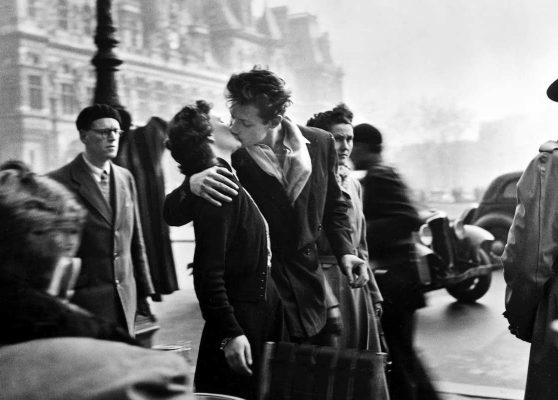
The exhibition stands out as one of the most significant events of Rome’s exhibition season, not only for the international stature of the artist, but also for the quality of a project that allows for a thoughtful reconsideration of the role of photography within the cultural context of the twentieth century.
It is not merely a showcase of famous works, but a broad reading of his visual language, capable of highlighting the tension between document and construction, between observation and invention, between everyday chronicle and universal vision. In this sense, the exhibition offers visitors the opportunity to engage with an artist who transformed streets, anonymous faces, marginal gestures, and urban spaces into material for a visual narrative that remains extraordinarily relevant today.
Robert Doisneau and Humanist Photography of the Twentieth Century
A gaze that transforms the everyday into narrative
Robert Doisneau occupies a central position in the history of twentieth-century photography and, in particular, in the definition of so-called French humanist photography. Born in Gentilly in 1912, the artist developed a visual language grounded in a radical proximity to ordinary experience: street life, work rhythms, children’s games, and the small rituals of urban affection.
In his iconographic universe, nothing is monumental or celebratory: his attention is instead focused on what appears marginal, transient, almost invisible. It is precisely in this choice that his greatness lies. For Doisneau, photography is not the realm of the exceptional, but the device through which the ordinary reveals its narrative density.
His images do not merely record reality. They construct a vision of the world in which the human returns to the center with a force free of rhetoric. Stolen kisses, running children, workers on break, café patrons, passersby caught in sudden suspension: everything contributes to defining a poetics of proximity, in which photography becomes a tool of participatory observation and sensitive interpretation. In this sense, Doisneau is not merely a chronicler of Parisian life, but an author capable of transforming the modern city into a repertoire of relationships, encounters, and micro-stories.
The human dimension at the center of the image
The distinctive trait of his research is the constant centrality of the human figure. Even when urban architecture or collective scenes take on a significant role, the image always retains an emotional center linked to gesture, gaze, and posture. His is not sociology in a strict sense, nor mere documentation of customs. Rather, it stages a humanity observed with irony, empathy, and precision, avoiding both sentimentalism and explicit judgment.
Paris as a moral and visual landscape
The city of Paris constitutes the privileged stage of this vision. However, Doisneau’s Paris does not coincide with the postcard imagery of monuments or the tourist geography of the French capital. It is a lateral city, made of sidewalks, suburbs, cafés, courtyards, schools, workshops, and markets. An urban fabric lived from within, in which photography records the minimal energy of social life. The street thus becomes a space of spontaneous theater, but also a compositional structure through which the artist organizes relationships between bodies, objects, movement, and depth.
Between document, direction, and image construction
One of the most interesting aspects of Doisneau’s poetics concerns the never fully resolved relationship between spontaneity and construction. The popular success of his images has often fueled the idea of a photography entirely entrusted to chance and the speed of the instant. In reality, a significant part of his work reveals discreet direction, staging, and conscious compositional planning. This does not diminish the truth of the images; on the contrary, it clarifies their deeper nature. Doisneau’s photography does not coincide with a neutral transcription of reality, but with its poetic interpretation.
The emblematic case of Le Baiser de l’Hôtel de Ville clearly shows how his work moves along the boundary between document and invention. Yet the strength of that image, as of many others, Un chien à roulettes, La concierge aux lunettes, L’information scolaire, lies not in chance. Together, these images build a coherent repertoire that reflects his interest in ordinary life, observed with participation but without emphasis. They represent recurring typologies of his work: everyday irony, attention to marginal or anonymous figures, and observation of social contexts.
The expression “contribute to telling the story of a photographer” suggests that these are not merely individual works, but fragments of a broader narrative: that of his artistic research. Photography thus becomes a means through which a visual biography is constructed, made not of exceptional events but of minimal and repeated situations.
It does not lie in the illusion of absolute spontaneity, but in the ability to make what is carefully constructed appear natural. Doisneau manages to integrate direction into the flow of urban life, making the image credible, open, and narrative.
Poetic realism as a stylistic hallmark
For this reason, his language has often been associated with poetic realism. This definition is particularly effective, as it captures the dual nature of his photography: on the one hand, fidelity to the real world; on the other, the ability to transform it without distorting it. His images are never purely illustrative, yet neither are they abstract or self-referential. They remain anchored in concrete experience, while constantly opening toward a surplus of meaning belonging to memory, emotion, and imagination.
Doisneau’s poetics between city, childhood, and social life
A photography of proximity
The exhibition clearly highlights the major thematic cores that run through Doisneau’s work and define its historical significance. At the center emerges a photography of proximity, in which the subject is never distant, hierarchically separated, or reduced to a mere object of observation. The figures in his images seem to belong to the same ethical and human horizon as the author: they are approached with a measure that avoids both pity and emphasis.
This proximity produces a particular narrative quality. The viewer is not confronted with a closed scene, exhausted within its surface, but with a fragment of experience that suggests a before and an after, a broader context, a barely glimpsed intertwining of lives. From this derives the extraordinary accessibility of Doisneau’s photography: the images are immediate, but not simplified; welcoming, but never naïve.
Childhood as a space of freedom
Among the most recurring themes is childhood, observed as a privileged space of invention, play, and disobedience to conventions. Doisneau’s children are not decorative presences nor generic allegories of innocence. They are active subjects, full of energy, capable of disrupting the order of urban space with their unpredictability. In them, the photographer recognizes a form of original freedom, a practical and bodily intelligence that resists the disciplinary structures of the adult world.
Work and the dignity of the everyday
Alongside childhood, another major theme is work. Workers, craftsmen, employees, and residents of working-class neighborhoods form an essential constellation of his vision. Doisneau does not idealize labor, but restores its human and social value. The images devoted to this sphere show attention to bodies, repeated gestures, and the materiality of productive environments. In them, one recognizes a form of respect that coincides with the rejection of spectacular hierarchy: everyday labor becomes worthy of representation not for its exceptionality, but for its reality.
Affections, encounters, and relationships in public space
The affective dimension constitutes another fundamental axis. Kisses, glances, waiting, complicity, episodes of tenderness or ironic courtship run through his work and define its emotional temperature. In these cases, what interests Doisneau is not the celebration of love as an abstract theme, but its appearance in public space, its inscription within the life of the city. Relationships thus become a form of symbolic occupation of urban space, a way in which the private becomes visible without losing intimacy.
Why Doisneau still speaks to the present
One of the exhibition’s main merits lies in demonstrating how Doisneau’s photography does not belong solely to the visual memory of the twentieth century, but retains a strong ability to address the present. In an era dominated by the proliferation of images and the speed of visual consumption, his work reminds us of the value of duration, waiting, and conscious composition. His gaze invites us to consider photography not as an automatic gesture, but as a form of attention to the world.
This relevance does not derive solely from the iconic beauty of certain images, but from the quality of the relationship they establish with the viewer. Doisneau remains contemporary because he forces us to slow down, to read details, to recognize the cultural significance of what we often consider negligible. His photography restores depth to common experience and, precisely for this reason, stands in opposition to the superficiality of instantaneous vision.
The exhibition path
A retrospective constructed as a narrative
The exhibition path of “Robert Doisneau” is conceived as a true visual narrative. The display does not merely line up famous works, but constructs a progressive reading of his research, placing iconic shots and lesser-known photographs in dialogue. This choice is particularly effective, as it avoids reducing the artist to a repertoire of icons and instead allows for an understanding of his linguistic complexity.
The presence of over 140 photographs makes it possible to convey the breadth of his production and to follow the evolution of a visual method that is consistently coherent yet capable of renewal. The visitor thus moves through an emotional and social geography centered on twentieth-century France, while opening onto a broader reflection on the image as a form of knowledge.
The function of iconic images
Within the exhibition, the most famous photographs do not serve a merely attractive role. They act as nodes of recognition, entry points into a complex poetics. Their familiarity to the general public allows immediate access to Doisneau’s universe, but the exhibition context rescues them from trivialization and restores their formal, historical, and symbolic density.
Rediscovering lesser-known works
The comparison with lesser-known images proves crucial. Here, the consistency of his gaze, the variety of registers, and the ability to balance humor, melancholy, social observation, and compositional precision emerge most clearly. These works do not appear marginal to the iconic ones, but expand their meaning, showing how the entire body of work is shaped by the same idea of photography.
Thematic sections and the readability of the exhibition path
The thematic structure encourages an experience that is both orderly and layered at the same time. Visitors can clearly recognize the major fields of Doisneau’s research, the city, childhood, work, affection, everyday life, without the exhibition path losing its fluidity. This organization responds effectively both to the needs of a general audience and to those of visitors who wish to read the exhibition from a historical-critical perspective.
The narrative character of the installation also makes it possible to grasp how each photograph does not exist in isolation, but enters into relationship with the others through analogies, contrasts, recurring themes, and recurring visual structures. In this way, the retrospective functions as an interpretative device capable of making the lines of force of the artist’s work clearly visible.
An accessible exhibition path without renouncing complexity
One of the project’s most successful aspects is its balance between accessibility and rigor. The exhibition does not simplify the artist, but makes him legible. The clarity of the exhibition narrative does not diminish the complexity of the works; on the contrary, it enhances it, offering visitors the necessary tools to understand the relationship between Doisneau’s fame and the depth of his visual language.
Doisneau’s style: composition, black and white, narrative time
The rigorous construction of apparently simple images
One of the aspects that the exhibition makes it possible to appreciate with particular clarity is the formal quality of Doisneau’s photography. Behind the immediacy of his images there is in fact a rigorous visual construction, based on extremely careful control of space, the relationships between figures, lines of force, and the internal rhythm of the composition. Nothing appears accidental, even when the scene suggests spontaneity. Every element seems placed at the exact point where it can produce the greatest balance between readability and narrative openness.
The city as a compositional structure
In urban photographs, pavements, façades, windows, café tables, signs, and the trajectories of passers-by do not constitute mere environmental elements, but true components of visual syntax. Urban space is organized in such a way as to guide the gaze, create depth, define relationships between foreground and background, and place stillness and movement in tension. Paris is therefore not only a subject, but also a compositional principle.
Black and white as a linguistic choice
Doisneau’s black and white should not be understood as a simple technical feature or as nostalgia for an era. It is a precise linguistic choice, one that strips away the superfluous and concentrates attention on the relationships between light, volume, expression, and gesture. The absence of color does not impoverish the scene, but intensifies its readability and emotional density. The contrasts are generally measured, free of excessive theatricality: light shapes without spectacularizing, reveals without invading.
Subtraction as a form of precision
This visual economy is an integral part of his poetics. By removing color, Doisneau concentrates the energy of the image on the encounter between bodies, objects, and spaces. The result is an essential yet never impoverished photography, capable of bringing out the tactile and temporal qualities of the scene with extraordinary subtlety.
The instant that opens onto a story
Doisneau’s images capture a precise moment, but they are never exhausted by the instant itself. In each photograph one senses the presence of a broader temporality: something has just happened or is about to happen, and the viewer is invited to imagine what follows. This narrative quality clearly distinguishes his work from purely descriptive photography. The shot is never an end in itself; it is the threshold of an implicit story.
The viewer’s participation
It is precisely this narrative openness that actively involves the viewer. Looking at a photograph by Doisneau means completing it mentally, projecting hypotheses, imagining voices, trajectories, and relationships. It is a photography that offers itself with immediacy, but asks to be inhabited with attention.
Why visit the exhibition
An important exhibition for those who follow photography in Rome
For the public interested in photography exhibitions in Rome, this retrospective represents an especially significant opportunity. Not only because of the artist’s fame, but because it makes it possible to observe at close range a body of works broad enough to restore the deep structure of his research. In an exhibition landscape often dominated by projects centered on a single iconic image or by overly simplified interpretative paths, this exhibition instead offers a solid, readable, and critically grounded perspective.
An essential artist for understanding visual modernity
Doisneau’s persistence in the contemporary imagination does not depend solely on the editorial fortune of his most famous photographs. It depends on the fact that his work helped define a modern idea of the image: no longer merely testimony, not only an aesthetic form, but a place of relationship between author, subject, and viewer. His photography remains fundamental for understanding how the twentieth century developed a new sensibility toward urban life, the crowd, and intimacy exposed within public space.
Photography as an exercise in attention
Ultimately, the exhibition is timely because it restores photography to its highest dimension: that of an exercise in attention. Attention to bodies, places, details, and the smallest moments of existence. In a present dominated by visual saturation, Doisneau’s work preserves the rare ability to teach us how to look. And it is probably in this, even more than in his fame, that the deeper reason lies for why this exhibition is worth visiting.
The project
The project stems from collaboration between Arthemisia, the Italian Ministry of Defense, the Italian Army, and Difesa Servizi. The exhibition is supported by the French Embassy in Italy, the Lazio Region, and the City of Rome, curated by Atelier Robert Doisneau and Gabriele Accornero, and produced by Arthemisia.
Developed in collaboration with Bridgeconsultingpro, the project is supported by Fondazione Terzo Pilastro Internazionale and Poema, with backing from Generali Italia as part of the Generali Valore Cultura program.