The exhibition “Richard Avedon. In the American West. 1979–1984” presents one of the most significant photographic investigations of twentieth-century America through a series of portraits that profoundly transformed the representation of American identity. Taken during an extensive journey across the western regions of the United States, these photographs move away from the heroic imagery of the frontier to focus on ordinary people, workers and individuals frequently excluded from the dominant narratives of American society.
At Palazzo Esposizioni Roma, the entire project is presented through 110 original photographic prints, accompanied by documents and archival materials that reconstruct its complex development. The result is a body of work in which the formal precision of portraiture meets a reflection on the human condition, the relationship between the individual and society, and photography’s ability to question reality rather than merely reproduce it.
Richard Avedon: photographic portraiture as an exploration of identity
Richard Avedon (1923–2004) occupies a central position in the history of contemporary photography for having transformed portraiture into a means of psychological and social investigation. His work encompasses fashion photography, advertising, portraits of celebrated figures and photojournalism, while maintaining remarkable consistency in his pursuit of a direct relationship between the subject and the camera.
Born in New York, Avedon developed an early interest in representing the human figure. His professional breakthrough came through illustrated magazines, where he introduced a profoundly innovative visual language that challenged the static conventions of fashion photography. Models no longer appeared as rigidly posed figures but became dynamic presences, placed in situations suggesting movement, spontaneity and emotional engagement.
From fashion photography to psychological exploration
His collaboration with Harper’s Bazaar, followed by Vogue, helped establish a new approach to editorial photography. Avedon distinguished himself through his ability to create images in which compositional sophistication coexisted with a powerful sense of physical presence and individual personality.
This approach gradually extended to portraits of artists, writers, politicians and leading figures in international culture. The fame of his subjects did not prevent the photographer from seeking less conventional elements: an unexpected expression, tension in the eyes or an apparently involuntary gesture could become more significant than the outward symbols of social prestige.
In Avedon’s visual language, the photographic portrait is not intended merely to confirm an already recognisable public identity. Instead, it becomes a space of confrontation between the image subjects present of themselves and the one the photographer constructs through framing, lighting and the precise moment of exposure.
The white background and the elimination of context
One of the most recognisable features of Avedon’s photographic approach is his use of a white backdrop, which isolates the person being photographed from any environmental reference. This seemingly reductive choice intensifies the act of observation: attention becomes concentrated on the face, posture, clothing and physical characteristics of the body.
The neutrality of the background, however, does not imply an absence of interpretation. By eliminating context, the photographer establishes a particular way of reading the image. Every detail acquires significance, and the human figure assumes an almost sculptural presence, in which time appears to be concentrated into a single instant.
This formal approach would become fundamental to In the American West, where the isolation of the subjects enabled Avedon to construct an extensive gallery of individual identities, united by the same photographic method yet profoundly different in their experiences and social circumstances.
A photograph attentive to American contradictions
Alongside his commercial work, Avedon developed a photographic practice concerned with the political and cultural tensions of American society. His interest in the civil rights movement, the consequences of the Vietnam War and the contradictions of national identity demonstrates the importance of social issues throughout a substantial part of his work.
The volume Nothing Personal, produced in 1964 in collaboration with the writer James Baldwin, represents an important precedent. Through a sequence of photographs and texts, the book challenges reassuring representations of American society, addressing issues such as racial discrimination, violence, power and individual isolation.
The project devoted to the American West develops this perspective further, shifting attention from public figures to a population generally absent from mainstream cultural representation. Celebrity gives way to anonymity, while success is replaced by the hardships of everyday life and the vulnerability of human existence.
“In the American West”: constructing a different image of America
The project “In the American West” began in 1979 following a commission from the Amon Carter Museum of American Art in Fort Worth, Texas, an institution particularly devoted to the history and visual culture of the American West. The initiative developed through the interest of its director, Mitchell A. Wilder, who recognised in Avedon’s photography the possibility of creating a representation of the region radically different from that established by traditional iconography.
An important precedent dates back to 1978, when the photographer took a portrait of Wilbur Powell, a ranch foreman in Montana. The image attracted Wilder’s attention and contributed to the development of a photographic investigation that would occupy several years of the artist’s career.
The journey across the American West
Between 1979 and 1984, Avedon travelled extensively throughout the western United States, covering a total of twenty-one states. His journeys, undertaken mainly during spring and summer, took him far from the major cultural centres and into places defined by manual labour and industrial activity.
Petrol stations, truck stops, livestock markets, rodeos, fairs, mines, oil fields and slaughterhouses became the locations where he sought out the protagonists of his project. His purpose was not to produce a geographical survey of the region, but to encounter individuals whose lives reflected significant aspects of American society.
The photographer produced images of more than a thousand individuals, subsequently selecting a limited number of portraits for the final project. This extensive undertaking required careful organisation, numerous journeys and substantial preparatory work involving collaborators and assistants.
The key players in working America
The subjects came predominantly from rural and industrial communities: ranchers, miners, farmers, factory workers, waiters, seasonal labourers, fairground workers and unemployed individuals. Alongside the adults appear children and adolescents, whose presence broadens the investigation into social conditions and the prospects facing younger generations.
Their physical appearance becomes an essential element of the narrative. Worn clothing, hands marked by manual labour, weary expressions and bodies exposed to the hardships of work reveal living conditions that rarely found a place in the dominant imagery of the United States.
Avedon nevertheless avoids constructing a simple sociological classification. Each person retains a distinct individuality, while the repetition of the same compositional framework makes it possible to recognise similarities and differences without erasing the complexity of individual experiences.
Beyond the myth of the frontier
American culture has long identified the West as a place of freedom, conquest and individual renewal. From nineteenth-century painting to landscape photography and Western cinema, the image of the frontier gradually became established through vast natural landscapes, heroic figures and narratives centred on territorial expansion.
Avedon challenges this tradition by radically shifting its perspective. In his portraits, monumental mountains, boundless plains and desert landscapes disappear. The territory remains present, but survives primarily through the physical characteristics, occupations and material circumstances of the people photographed.
The American West is no longer presented as the setting for an idealised collective destiny. Instead, it becomes a social landscape marked by inequality, economic transformation and contrasting opportunities in life.
The crisis of the image of American success
The historical context helps clarify the significance of the work. By the late 1970s, the United States was experiencing a period marked by the consequences of the oil crises, inflation, industrial restructuring and difficulties affecting numerous productive sectors.
During the early 1980s, while advertising and television continued to promote ideals of prosperity and individual achievement, a substantial part of the population faced economic insecurity and major changes in the labour market.
Avedon’s portraits emerge from this contradiction. Their critical force does not derive from explicit social denunciation, but from the decision to give visual prominence to individuals generally regarded as marginal within the dominant national narrative.
Photography thus raises a fundamental question about the relationship between social visibility and artistic representation: who is recognised as a protagonist in a nation’s history, and who remains excluded from the images through which that nation constructs its identity?
Photographic technique and the construction of the portrait
To produce the series, Avedon used an 8×10-inch large-format camera, capable of recording facial features, clothing and the texture of the skin with exceptional precision. This photographic process required working methods and exposure procedures fundamentally different from those associated with spontaneous photography.
Each subject was positioned in front of a large white backdrop set up outdoors, generally in a shaded area. Natural light produced a soft, even tonal range, while the absence of scenic elements concentrated attention entirely on the individual.
This photographic arrangement created a condition of isolation resembling that of a studio, although it was constructed in the locations encountered during the journey. The separation between the subject and their familiar surroundings constitutes one of the most distinctive aspects of the entire project.
Between documentation and interpretation
The descriptive precision of the photographs might suggest an immediate documentary objectivity. In reality, the selection of subjects, the arrangement of poses and the timing of each exposure reveal a highly deliberate visual construction.
Avedon makes no attempt to conceal his own authorship. The portrait emerges from an encounter between two individuals and the tension established in front of the camera. The gaze, the position of the hands, the distance from the lens and the subject’s bodily attitude all contribute to defining the image.
The series therefore occupies a space between documentary photography and artistic portraiture. Each photograph bears witness to the existence of a real person, while simultaneously offering an interpretation shaped through a rigorous formal language.
The exhibition route
Curated by Clément Chéroux, director of the Fondation Henri Cartier-Bresson, the exhibition brings together, for the first time in Italy, the complete series of 110 photographic prints included in the book of the same name, published in 1985 by Harry N. Abrams.
The project is promoted by the Department of Culture of Roma Capitale and Azienda Speciale Palaexpo, organised by the Fondation Henri Cartier-Bresson with works on loan from the Richard Avedon Foundation, in collaboration with Azienda Speciale Palaexpo.
The selection includes the prints used for the original publication, accompanied by documentary materials that illuminate the development of the project and the relationships established between the photographer and the people he portrayed.
The 110 photographs of the original series
The main section of the exhibition allows visitors to examine the project in its entirety, avoiding the fragmentation that often characterises retrospective presentations of Avedon’s work.
The photographs form a succession of individual presences, each identified by name, occupation, location and date of the sitting. This information restores a specific biographical context to the subjects, counteracting the risk that the aesthetic intensity of the portraits might transform their identities into purely symbolic figures.
The repeated use of the white background establishes a visual continuity that allows individuals from different backgrounds to be compared. At the same time, the variety of expressions and postures disrupts any impression of uniformity.
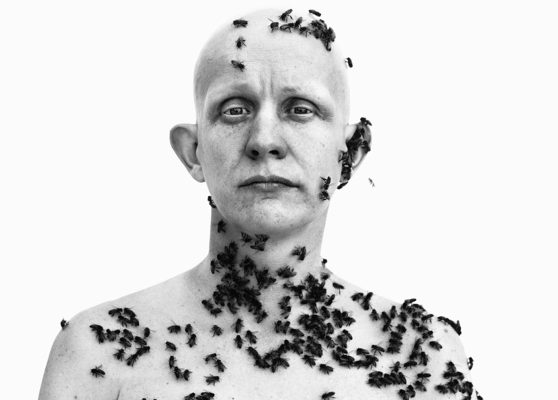
Ronald Fischer: the beekeeper covered in bees
Among the best-known portraits is that of Ronald Fischer, a beekeeper photographed in Davis, California, on 9 May 1981. The man appears bare-chested, covered with numerous bees spread across his skin and around his face.
The image creates a powerful sense of visual tension. The presence of the insects introduces an element of potential danger, while the subject’s composed attitude suggests an unusual familiarity with risk.
The photograph also demonstrates Avedon’s ability to transform a situation associated with a professional occupation into a composition of considerable symbolic complexity. The human body becomes the site of an ambiguous relationship between mastery and vulnerability, control and the unpredictability of nature.
Sandra Bennett and Boyd Fortin: childhood in the american west
Another significant aspect of the series concerns the representation of children and adolescents. Sandra Bennett, photographed at the age of twelve in Rocky Ford, Colorado, in 1980, belongs to a gallery of young figures through whom Avedon explores the relationship between individual identity and social environment.
Equally revealing is the portrait of Boyd Fortin, a thirteen-year-old photographed in Sweetwater, Texas, in 1979, identified through his occupation as a rattlesnake skinner.
The presence of such young subjects, associated with unusual occupations and living conditions, invites reflection on the distance between idealised representations of childhood and the diverse realities of rural America.
The photographer avoids sentimental treatment. The subjects’ age remains an essential element of their identity, but it does not lead to a visual language separate from that used for adults. The younger figures are portrayed with the same attention to posture and individual expression.
Miners, workers and communities of the american west
Individuals employed in industrial and manual occupations occupy a particularly important place in the series. The group portrait of Roger Tims, Jim Duncan, Leonard Markley and Don Belak, miners photographed in Reliance, Wyoming, in 1979, introduces a different dimension from that of the individual portraits.
The presence of several figures within the same image makes their shared working environment visible without erasing their individual differences. Their clothing, faces and bodily attitudes document a professional experience that leaves recognisable physical traces.
Other photographs broaden the social diversity of the series. Petra Alvarado, a factory worker photographed in El Paso on her birthday, David Beason, a shipping clerk in Denver, and Jesse Kleinsasser, a worker from a Hutterite colony in Montana, belong to profoundly different social and cultural settings.
Their juxtaposition demonstrates that Avedon does not construct a single model of American identity, but rather a plurality of individual experiences shaped by different economic circumstances, cultural traditions and community affiliations.
Individual dignity and the language of the body
One of the most significant aspects of these portraits is the way the body becomes a bearer of social information. Physical fatigue, exposure to the elements, the characteristics of clothing and the effects of manual labour emerge with a precision that leaves little room for idealisation.
The frontal composition gives the subjects a monumental presence, regardless of their social position. In this sense, photography establishes an unexpected relationship between economic marginalisation and visual prominence.
This process does not eliminate the inequalities inherent in the relationship between photographer and subject. On the contrary, it makes it all the more important to consider the responsibility involved in observing and representing living conditions different from one’s own.
Archival materials and Avedon’s working method
Alongside the finished photographs, the exhibition presents a selection of materials from the Richard Avedon Foundation. Manuscripts, preparatory Polaroids, documents and correspondence provide insight into how the project developed over the years.
Of particular interest are the files devoted to individual subjects, which contain information and accounts relating to the photographic encounters. This documentation reveals a dimension of the project that cannot be fully reconstructed from the finished images alone.
The Polaroids and the preparation of the images
The working Polaroids document several preparatory stages of the photographic process and provide insight into the decisions made during the construction of each portrait.
The differences between the preliminary studies and the final prints reveal the extent to which the apparent immediacy of the images depends on careful preparation. Rather than simply recording a chance encounter, each photograph emerges as the result of deliberate compositional and technical decisions.
Correspondence with the people photographed
The correspondence preserved in the archives adds another layer of interpretation. The people portrayed no longer appear merely as visual presences, but as individuals with whom the photographer established relationships and maintained communication.
This dimension offers a deeper understanding of the relational nature of portraiture and raises fundamental questions in the history of photography: the subject’s participation, their awareness of the image being created, and the relationship between personal experience and public representation.
The 1985 book and the critical reception of the work
The first public presentation of In the American West took place in 1985 at the Amon Carter Museum in Fort Worth, coinciding with the publication of the photographic book of the same name.
The work initially provoked mixed reactions. Its departure from traditional representations of the West and its emphasis on individuals marked by physical hardship and economic difficulties were interpreted by some observers as an excessively harsh portrayal of American society.
Over time, the series acquired a fundamental place in the history of photographic portraiture, particularly for its ability to challenge conventional distinctions between fine art photography, social representation and historical documentation.
To accompany the exhibition, a new edition of the book has also been published, featuring Italian translations of texts by Avedon and Laura Wilson, who collaborated with the photographer throughout the project, together with a critical essay by Clément Chéroux.
Why visit the exhibition: photography, history and social representation
The exhibition’s significance lies above all in the opportunity to experience a complete photographic project that helped redefine the role of portraiture in the second half of the twentieth century. The 110 images reveal the consistency of Avedon’s visual language and demonstrate how the repetition of a single photographic approach can produce remarkably different results.
The exhibition also provides an opportunity to explore the relationship between photographic art and social history, through images in which the economic and cultural transformations of the United States emerge indirectly from the physical characteristics and individual experiences of the people portrayed.
A landmark work in the history of photography
Viewing the complete series reveals the systematic nature of Avedon’s photographic investigation. Each photograph possesses its own expressive autonomy, yet acquires additional meaning within the sequence as a whole.
The consistent use of the white background, the precision of detail and the frontal presentation of the figures establish a visual language that engages with the tradition of painted portraiture while retaining distinctly photographic characteristics.
The scale of the prints and the sharpness of the images heighten the physical presence of the subjects. Viewers are encouraged to examine details that might otherwise escape their attention, recognising in the face and body a complex accumulation of visual information.
The relationship between photographer, subject and viewer
The photographic method developed by Avedon creates a direct confrontation between the person portrayed and the viewer. The absence of environmental elements limits the possibility of interpreting the image through external references, demanding closer attention to the individual.
Yet this visual encounter is not neutral. Viewers must confront the knowledge that every portrait results from a process of selection and a deliberate artistic decision.
Photography thus becomes a space of negotiation between identity, representation and interpretation, in which the apparent realism of the image does not exclude the presence of artistic construction.
1980s America through its less visible figures
The series also possesses considerable value as a historical record. Although it was not conceived as a statistical or sociological investigation, it provides an opportunity to observe a range of individuals living through a period of profound economic transformation.
The prominence given to manual labour contrasts with the imagery of technological modernisation and prosperity that characterised much of American media and public communication during the period.
Through these portraits, a less homogeneous nation emerges than its public representations might suggest, marked by territorial, cultural and social differences that cannot be reduced to a single national identity.
The persistence of the american myth
One of the exhibition’s principal points of interest lies in the relationship between the photographs and the longstanding iconographic tradition of the frontier. The imagery of the West contributed to the construction of an idea of the United States founded on individual independence, courage and the possibility of personal achievement.
Avedon does not simply offer a representation opposed to this myth. Instead, he questions its underlying assumptions, portraying individuals in whom independence and resilience coexist with frequently difficult material circumstances.
The tension between individual aspiration and social reality gives the series a significance that extends beyond its original historical context, making it equally relevant to contemporary reflections on inequality and the mechanisms of public visibility.
Photography as an experience of observation
Another significant aspect of the exhibition is the opportunity to engage directly with the physical qualities of the photographic prints. The tonal richness of the black-and-white images, the scale of the prints and the precision of their details acquire particular significance when viewed at close range.
The exhibition encourages a slower, more attentive approach to observation, in which the succession of faces allows viewers to recognise differences and connections between individuals belonging to apparently distant social realities.
The inclusion of preparatory materials further enriches the visitor experience, demonstrating that the finished image represents only one stage in a more complex process involving encounters, technical experiments, editorial decisions and personal relationships.
The historical and critical value of the archive
Documents and working photographs make it possible to understand In the American West not merely as a succession of celebrated images, but as a coherent artistic project developed through sustained research and a consistent methodology.
The archive becomes an integral part of the artistic interpretation, providing insights into the distance between the original photographic encounter and the eventual publication. The information collected about the subjects, the photographic studies and the correspondence help situate the portraits within specific human relationships.
It is precisely this interaction between artwork, document and testimony that makes the exhibition particularly significant: Avedon’s photography emerges simultaneously as an aesthetic construction, an interpretation of American society and a tangible record of encounters that took place at a particular moment in history.