Now a permanent exhibition, the show explores one of the most complex aspects of Leonardo’s legacy: the relationship between observation, drawing, experience and mechanical construction. The exhibition route brings numerous projects contained in Leonardo’s manuscripts into three-dimensional form through machines made predominantly of wood, working models and interactive devices.
Visitors can thus follow the transition from the drawn page to the mechanism itself, gaining an understanding of principles related to the transmission of motion, lifting systems, flight, hydraulics and military engineering. Multimedia display cases and nine holograms broaden the experience, while in the underground areas the visit reaches the Roman tomb of Aulus Hirtius, discovered in 1938 and today partially submerged by the waters of the ancient Euripus.
Leonardo and the culture of machines in the Renaissance
To understand the significance of the machines on display, it is necessary to place Leonardo da Vinci within the technical culture of his own time. The modern image of the solitary genius who anticipated every future invention by centuries risks oversimplifying a far more complex historical phenomenon. Leonardo achieved exceptional results, but he worked within the profound transformation of mechanical knowledge that swept through Italy between the fourteenth and fifteenth centuries and that historians of science have described as a true “Renaissance of Machines”.
Artists, architects and engineers such as Filippo Brunelleschi, Mariano di Jacopo known as Taccola, and Francesco di Giorgio Martini had already developed devices for lifting heavy loads, hydraulic machines, transmission systems, military apparatuses and mechanisms designed for construction sites. Leonardo absorbed this tradition but brought it to an extraordinarily more systematic level of analysis. In his drawings, the machine is not merely an object to be built: it becomes an instrument through which to investigate the laws of motion.
From the Renaissance workshop to scientific drawing
Leonardo’s training in the workshop of Andrea del Verrocchio brought him into contact with an environment in which painting, sculpture, metallurgy, mechanics, stage design and construction techniques all belonged to the same practical culture. In the fifteenth century, the modern separation between the visual arts and engineering disciplines was far less rigid: building a machine, designing theatrical apparatus or organising the casting of a large statue required geometrical and mechanical knowledge comparable to that employed in architecture.
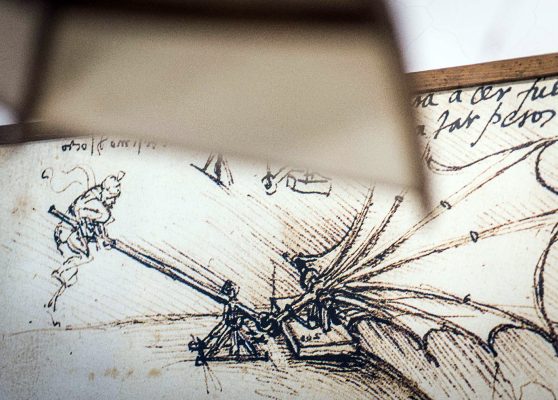
Leonardo made drawing the principal tool of this investigation. Cogwheels, screws, pulleys, bearings, blocks, levers and transmission systems are frequently isolated, broken down and studied from different viewpoints. Graphic representation does not simply illustrate a machine that has already been conceived, but makes it possible to understand how it works and progressively modify its structure.
The Codices as a research laboratory
Leonardo’s manuscripts should therefore be interpreted as an immense intellectual laboratory. They bring together observations derived from experience, copies and reinterpretations of earlier devices, unsuccessful attempts, innovative insights and projects destined to remain on paper. They are not catalogues of inventions ready to be built, but records of a form of thought constantly subjected to testing and revision.
His studies of perpetual motion are particularly revealing. Leonardo reconsidered devices already present in the medieval tradition and in the work of Sienese engineers, analysing wheels in which weights and movable arms were intended to create a continuous imbalance. After studying numerous variations, however, he came to understand their impossibility. This is an important step because it shows that his greatness lay not only in imagining new machines, but also in subjecting technical hypotheses to critical scrutiny based on the observation of phenomena.
Nature as a model for the machine
A second essential element is the relationship between mechanics and nature. Leonardo observed the movement of water, the flight of birds, the articulation of bones and the action of muscles, seeking principles that could be described in terms of forces, levers, pressure and trajectories.
This approach emerges with particular clarity in his studies of flight. His early hypotheses for machines with flapping wings gradually gave way to a more accurate analysis of the behaviour of birds and air currents. In the Codex on the Flight of Birds, compiled in the early sixteenth century, Leonardo focused above all on the possibility of remaining airborne and manoeuvring by exploiting the wind, moving closer to the principle of gliding flight.
Between invention and reinterpretation
The presence in the exhibition of devices such as the Archimedes’ screw also helps to clarify Leonardo’s method. Leonardo did not invent this ancient system for raising water: he studied it, drew it and incorporated it into the broader repertoire of hydraulic solutions known in his time. The same applies to many mechanisms inherited from the technical tradition and transformed by him through new combinations and applications.
It is precisely this historical continuity that makes Leonardo the engineer even more compelling. His originality does not depend on the myth of an isolated inventor: it emerges instead from his ability to gather earlier knowledge, compare it with experience, break it down into its essential elements and develop possibilities that had previously remained unexplored.
The exhibition route
The core of the exhibition consists of three-dimensional reconstructions derived from drawings contained in Leonardo’s codices. The exhibition covers approximately one thousand square metres and brings together more than sixty machines and models, accompanied by multimedia installations and in-depth sections devoted to the different fields of research explored by the artist.
No original manuscripts or paintings by Leonardo are displayed: the museum project deliberately takes a different approach, transforming technical drawing into a physical experience. The reconstructions make it possible to observe dimensions, relationships between individual components and movements that, on the surface of a page, would require specialist knowledge to be fully understood.
The machines: from drawing to movement
The wooden machines are the most distinctive feature of the exhibition. Some of the reconstructions are considerable in size and allow visitors to examine gears, lever systems, pulleys and devices designed for the transmission of force at close range.
The exhibition includes different families of projects: machines related to flight, hydraulics, lifting and handling, civil engineering and warfare. In this way, the wide range of Leonardo’s technical interests is revealed without artificially separating fields that continuously intersect in his manuscripts.
The armoured vehicle and military engineering
Among the most immediately recognisable reconstructions is the famous armoured vehicle, developed by Leonardo in drawings during his Milanese period. The project envisages a large mobile structure protected by a sloping covering and equipped around its perimeter with numerous firearms.
Rather than interpreting it as a modern tank anticipated by four centuries, it is historically more accurate to place it within the context of Renaissance military engineering. The introduction and refinement of firearms were transforming fortifications, sieges and military tactics, while court engineers were increasingly required to devise complex offensive and defensive machines. Leonardo’s project belongs to this environment, while standing out for the exceptional graphic clarity with which the relationship between structure, movement and armament is visualised.
The parachute and studies of flight
Another celebrated insight is represented by the parachute, conceived as a pyramidal structure covered with fabric and designed to slow a man’s descent by exploiting air resistance. The project belongs to Leonardo’s broader investigation of flight, which included flapping wings, articulated devices and studies on the possibility of gliding.
Here too, its historical value lies above all in the intellectual process behind it. Leonardo sought to transform the behaviour of air into a mechanical and geometrical problem. Drawing thus became an experimental space in which surfaces, weights and forces could be assessed before the device was ever physically constructed.
Mechanisms, water and the transmission of force
Alongside the most spectacular machines, the exhibition also presents apparently simpler devices that are fundamental to understanding Leonardo’s method. Cogwheels, screws, pulleys, lifting systems and transmission mechanisms reveal the attention he devoted to the elementary components of mechanics.
Leonardo tended to break down a complex machine into functional units. Once the behaviour of each element had been understood, it could be combined with other devices to create different systems. This modular method represents one of the most modern aspects of his approach to technical problems.
Interactivity as a method of understanding
One of the exhibition’s most significant features is the possibility of interacting with numerous machines. Visitors do not simply observe their form, but can set gears and mechanisms in motion, directly following the transmission of force from one component to another.
Interactivity therefore serves a genuinely educational purpose. Turning a crank and observing the resulting rotation of a sequence of cogwheels makes a principle immediately understandable that might otherwise remain abstract if explained solely through technical language.
From a machine to observe to a machine to experiment with
This type of experience establishes a particular connection with Leonardo’s own method, which was based on the primacy of experience. Naturally, the contemporary reconstructions should not be confused with machines historically built and used by the artist: they are three-dimensional interpretations developed from his drawings.
Their purpose is precisely to test visually and mechanically what the manuscript suggests. In this way, visitors can also recognise the difficulties inherent in reconstruction: a sheet by Leonardo may be extremely detailed in some areas while leaving materials, dimensions or connecting systems undefined. Transforming it into a functioning machine therefore necessarily involves a process of interpretation.
The seven thematic display cases
The route through the machines is complemented by seven thematic display cases containing reproductions of Leonardo’s drawings and codices, accompanied by tablets and interactive content. The in-depth sections explore numerous fields of his research, including anatomy, botany, mathematics, architecture, engineering, aeronautics, music, cooking and theatre, demonstrating how Leonardo’s thought developed across disciplines that were closely interconnected.
Tablets, high-resolution images, three-dimensional reconstructions and video explanations make it possible to enlarge details and explore subjects that the machines alone could not fully document. This approach also avoids reducing Leonardo to a purely technological figure, recalling how inseparable his work as an engineer was from his activity as an artist and observer of nature.
The Holograms and “Da Vinci, a new dimension”
A specific section of the exhibition, entitled “Da Vinci, A New Dimension”, uses nine holograms to develop the three-dimensional interpretation of Leonardo’s projects even further. The virtual images are devoted to studies of flight, warfare, engineering and painting.
Here, digital technology performs a different function from that of the physical reconstructions. The machine is no longer simply a static object placed before the visitor, but can be visualised while operating, with its individual parts and movements isolated and examined.
Visualising what the drawing suggests
The hologram thus becomes a contemporary extension of technical drawing. Leonardo frequently used multiple views, sections and exploded representations to depict a machine beyond what could be observed from a single viewpoint; three-dimensional animation pursues a similar objective using modern technological tools.
The value of this section therefore lies not in producing a merely spectacular effect, but in making the potential movement contained within Leonardo’s drawings easier to understand. Gears and components can be followed while in motion, clarifying the relationship between individual elements and the overall functioning of the machine.
The submerged Tomb of Aulus Hirtius
At the end of the section devoted to Leonardo, the visit introduces a completely different element, yet one that is closely connected to the museum experience: in the underground areas of the Palazzo della Cancelleria lies the tomb of Aulus Hirtius, one of the lesser-known archaeological remains of the ancient Campus Martius.
The monument was discovered by chance in 1938. Its identification is confirmed by boundary stones bearing the name of Aulus Hirtius, the Roman consul who died in 43 BC. Today largely surrounded by water, the tomb represents a particularly unusual feature within the exhibition route and allows visitors to physically reach a level of the city that predates Leonardo’s lifetime by more than fifteen centuries.
Who was Aulus Hirtius?
Aulus Hirtius was a general and associate of Julius Caesar. He took part in Caesar’s military campaigns and was later appointed consul for 43 BC. Following Caesar’s assassination the previous year, the political situation in Rome rapidly deteriorated into conflict between the different Caesarian factions and the Senate.
Although he came from Caesar’s political circle, Hirtius, together with his colleague Gaius Vibius Pansa, took command of the senatorial forces opposing Mark Antony, who was besieging Decimus Brutus at Mutina. Both consuls died during the campaign. Hirtius was killed during the assault on Antony’s camp in the War of Mutina in 43 BC.
From Caesar’s associate to latin author
Hirtius is also important from a literary point of view. He is widely regarded as the probable author of the eighth book of the De bello Gallico, written to connect Caesar’s account of the Gallic campaigns with the period immediately preceding the civil war.
The deaths of Hirtius and Pansa were considered worthy of exceptional recognition: the Senate decreed a public burial in the Campus Martius for both men. The presence of Hirtius’ tomb beneath the Cancelleria and the discovery nearby of an inscribed slab associated with Pansa’s funerary monument confirm the tradition recorded by ancient sources.
The discovery of 1938
The tomb was identified during works carried out in the Palazzo della Cancelleria. The funerary structure consists of a quadrangular enclosure with a tufa base, brick walls and a travertine crowning element with a double-pitched profile. The foundations of the Renaissance palace partially intersect the ancient structure.
The inscribed boundary stones made it possible to identify the owner of the monument with certainty. Important archaeological finds were also discovered in the area, including the Altar of the Vicomagistri and the celebrated Cancelleria Reliefs, now preserved in the Vatican Museums; casts of the reliefs can be seen in the underground areas.
The Euripus and the water surrounding the monument
The feature that makes the tomb immediately recognisable is the presence of water. The monument originally stood near the Euripus, a canal that crossed the western sector of the Campus Martius and channelled water towards the Tiber.
The present submerged appearance, however, does not correspond to the tomb’s original condition. With the construction of the Tiber embankments at the end of the nineteenth century, several outlets belonging to the drainage systems of the area were altered or obstructed. The rise and stagnation of water gradually transformed the underground archaeological site into the unusual configuration visible today.
An ancient roman monument included in the visit
The tomb is not a reconstruction or an installation symbolically connected with Leonardo, but an authentic archaeological monument accessible through the exhibition route. For this reason, it deserves a distinct place within the presentation of the event.
The transition from Renaissance machines to a Republican funerary monument introduces a sharp but meaningful change: after a route centred on reconstructions of projects preserved on paper, visitors encounter an ancient structure still located in the place where it was built more than two thousand years ago.
Why visit the exhibition
The exhibition provides an opportunity to explore an aspect of Leonardo’s work that is sometimes overshadowed by the fame of his great paintings. Leonardo was undoubtedly one of the leading figures of Renaissance painting, yet a substantial part of his intellectual activity is documented in the manuscripts in which he investigated machines, water, anatomy, optics, flight, architecture and natural phenomena.
Seeing these projects transformed into three-dimensional structures helps visitors understand how central technical drawing was to his way of thinking. The reconstructions do not replace the original codices, but they help interpret their complexity and visualise problems that Leonardo explored through sequences of sketches and annotations.
Moving beyond the myth of the inventor of the future
One of the most interesting aspects of the visit lies precisely in the possibility of recognising a historically more complex Leonardo than the popular image of a prophet of modern technology. The armoured vehicle is not simply a modern tank designed in the fifteenth century, just as the aerial screw cannot be directly identified with the contemporary helicopter.
These projects instead belong to the technical culture of the Renaissance and demonstrate Leonardo’s ability to push existing knowledge beyond its established limits, bringing together mechanical traditions, observation of nature and graphic experimentation. It is precisely this interpretation that fully reveals the scope of his research.
An experience based on function
Interactivity also makes the exhibition particularly effective for understanding elementary mechanics. A gear transmitting motion, a lever multiplying force or a system of pulleys demonstrates in concrete terms principles that Leonardo investigated through drawing.
Visitors are therefore confronted not only with the final result, but also with the problem the machine was designed to solve. It is in this relationship between question, project and function that the exhibition finds its particular character.
From the codex to the machine, from the machine to archaeology
The presence of the seven thematic display cases and the nine holograms further broadens the interpretation of the models, connecting mechanics with the other fields of Leonardo’s research. The route thus moves from the physical presence of the wooden structures to the manuscript page, and from the page to the digital simulation of movement.
The final descent towards the tomb of Aulus Hirtius adds an unexpected dimension to the visit. It is not directly connected with Leonardo, but it represents a genuine and distinctive part of the experience offered by the exhibition: beneath the route devoted to Renaissance experimentation emerges a surviving trace of the Republican Campus Martius, still shaped by the presence of the ancient water system. Two very different ways of understanding the past, the reconstruction of machines and archaeological preservation, are thus encountered within the same itinerary.
Leonardo beyond painting
The visit is particularly significant for those who know Leonardo above all through works such as the Mona Lisa, the Last Supper or the Vitruvian Man. The Cancelleria exhibition presents an artist for whom artistic practice was inseparable from the observation of physical reality.
In the study of a machine, a watercourse, the movement of a wing or the structure of the human body, the same need to analyse the visible world that characterises his painting constantly reappears. The tools and subjects of investigation change, but the desire to understand forms, movement and proportion remains unchanged. It is precisely this continuity that makes the exhibition particularly useful for approaching the complexity of Leonardo da Vinci and the extraordinary breadth of his intellectual laboratory.
Opening hours: Monday to Friday, 09:30 – 19:00. Weekends and public holidays, 09:30 – 19:30.