The painting of Renato Guttuso spans much of the Italian twentieth century while maintaining an unwavering confidence in the expressive power of the figurative image. The exhibition “Renato Guttuso. Mediterranean Soul” offers an interpretation centred on his Sicilian roots, memory, materiality and the civic dimension of art. Around sixty works, including oils, drawings and prints, trace a chronological arc from the 1930s to the 1980s, bringing together pieces from public collections, including MART in Rovereto, as well as important private collections.
Curated by Vittorio Sgarbi with Marina Giordano, the exhibition avoids a strictly chronological structure, instead organising the works into thematic groups that connect Guttuso’s public and more intimate sides, collective history and personal affections, Sicily and Rome, observation of reality and the memory of the great European painting tradition.
Renato Guttuso and the figurative power of the mediterranean
Born in Bagheria in 1911, Guttuso developed from an early stage a visual language in which his knowledge of the European avant-gardes never led him to abandon visible reality. His relationship with the Mediterranean cannot be reduced simply to his geographical connection with Sicily: it concerns a way of perceiving the world in which light, colour, bodies, vegetation, labour and matter acquire an intensely physical presence.
In his paintings, objects are rarely neutral. A cut-open fruit, a basket, a plant, a reclining figure, a fisherman or goods arranged on a market stall become elements of a reality subjected to expressive tension. Guttuso heightens chromatic contrasts, at times reinforces contours and compresses space, creating images that preserve the recognisability of things without limiting themselves to mere description.
Sicily as memory and language
Sicily remained one of the fundamental sources of Guttuso’s imagination even during the many decades he spent away from the island. Bagheria, Palermo, the markets, the sea, fishermen, agricultural labour, sun-scorched vegetation and the energy of the Mediterranean landscape do not form a picturesque repertoire, but rather a reservoir of experiences to which the artist returned throughout his career.
In his work, the Sicilian landscape can take on an almost telluric dimension. Light does not soften forms, but often exposes them with even greater clarity; earth, stone, sea and vegetation participate in the same chromatic tension. Even when an image originates in memory, Guttuso avoids idealised nostalgia: recollection is transformed into pictorial construction.
Colour, matter and sensory perception
It is above all through colour that this Mediterranean identity acquires substance. Reds, greens, yellows, blacks and blues are not used merely to describe natural reality, but become instruments for organising space. Colour establishes relationships between objects, creates visual hierarchies and makes the very temperature of things almost tangible.
From this perspective, Guttuso’s Mediterranean is first and foremost a sensory experience: the heat of the light, the density of fruit, flesh, fish, leaves, fabrics and bodies are conveyed through a painting that insists on the physicality of the world.
From Expressionism to Realism
Guttuso’s formation took place within the unsettled cultural climate of Italy between the 1930s and 1940s. His contact with the artists associated with Corrente (an influential italian artistic and literary movement active in Milan from 1938 to 1940), together with his interest in European Expressionism, helped reinforce his opposition to official rhetoric and to a purely celebratory conception of painting. Works such as Crucifixion of 1941 already reveal his determination to turn figurative language into an instrument of moral and civic inquiry.
His encounter with Picasso and Cubism later offered him new possibilities for constructing figures and space. Guttuso, however, never adopted Cubist fragmentation as an autonomous formal exercise: he used it to give greater force to the representation of reality, while keeping the human figure and historical experience at the centre of his work. In the post-war period he became one of the leading figures in the debate on realism, taking part in the Fronte Nuovo delle Arti and developing a form of painting deeply attentive to labour, social conflict and the condition of the working classes.
Painting as a presence in its own time
For Guttuso, the artist does not exist outside history. His commitment to figurative painting also reflects the need to preserve a legible relationship between image and world. Peasants, workers, fishermen, demonstrations and collective struggles therefore enter his work not as mere documents, but through a formal construction that seeks a broader, collective dimension.
This tension explains why his realism cannot be reduced to naturalistic reproduction. Reality is interpreted, deformed and recomposed. The lessons of Expressionism, Picasso and modern European painting remain active even in those works most explicitly connected with contemporary society.
The exhibition route
The exhibition is organised into five thematic sections: Faces, Sicily, Living nature, Still lifes, Artist and Society and The Feminine. Rather than following a strictly chronological sequence, the route brings together works from different phases of Renato Guttuso’s career, highlighting both the continuity of certain subjects and the evolution of his visual language.
Paintings, drawings, works on paper and prints offer a close view of the artist’s working method and of the central role of line in the construction of figure and space. Graphic work thus acquires an autonomous value while also revealing how Guttuso developed and transformed the same motif through different techniques.
The various sections present the principal areas of his research: portraiture, his bond with Sicily, still life, the representation of society and the female body. Together they provide a broad view of his production, in which personal experience, observation of reality and an acute awareness of contemporary history remain closely interconnected.
Faces: portraiture as interpretation
The section devoted to Faces brings together portraits and self-portraits dating from the late 1930s onwards. Friends, intellectuals, people close to the artist and figures from his cultural circle become an opportunity to explore the distance between physical resemblance and pictorial interpretation.
Guttuso did not conceive portraiture as a neutral recording of facial features. The face is transformed in ways that suggest character, emotional tension and the human presence of the sitter. Realism therefore coexists with expressive distortions, variations of line and heightened chromatic accents that prevent the figure from being reduced to mere recognisability.
Mimise and the private dimension
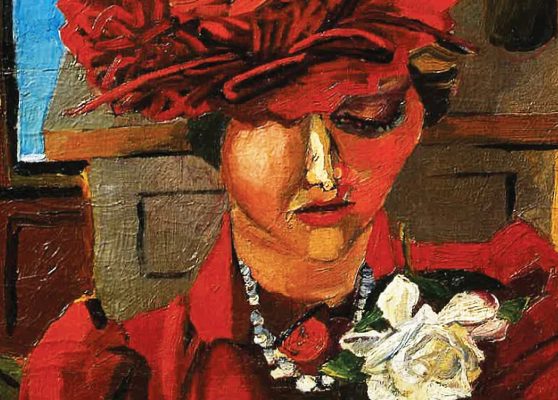
Particular importance is given to works associated with Mimì “Mimise” Dotti, the artist’s wife and a central figure in his private life. Portrait of Mimise with the Red Hat introduces a more intimate dimension of Guttuso’s work, in which chromatic intensity derives not from the desire to represent a public event but from the emotional closeness between artist and subject. The exhibition thus places alongside the painter of civic engagement an artist equally capable of observing personal relationships with concentrated attention.
Sicily: landscape, labour and memory
The section devoted to Sicily represents one of the key stages of the exhibition. Landscapes, figures, fishermen, images of labour and memories of towns and villages evoke a territory that, in Guttuso’s work, assumes both biographical and symbolic significance.
Sea and sunlight coexist with lava, vegetation scorched by the light, urban rooftops and the vitality of popular markets. Sicily is not presented as an unchanging region removed from history: in scenes of labour and in works addressing social themes, the landscape also becomes a setting for human relationships, hardship and conflict.
La Vucciria: from memory to pictorial construction
Particularly significant is Study for La Vucciria, a 1974 watercolour on canvas-mounted paper, accompanied in the exhibition by a later lithographic version. The subject refers to one of the best-known themes in Guttuso’s oeuvre: the Palermo market is transformed into an almost dizzying concentration of goods, bodies and colours.
The power of these images does not depend solely on their chromatic richness. The market space almost eliminates any contemplative distance: fruit, vegetables, meat, fish, crates and human figures seem to advance towards the viewer. Painting turns vision into a physical experience, bringing abundance into dialogue with transience, sensory attraction with an awareness of matter.
Living nature, still lifes
The largest section of the exhibition is devoted to Living Nature, Still Lifes. The apparent contradiction contained in the title precisely identifies one of the most distinctive aspects of Guttuso’s work: his ability to endow objects with such a powerful presence that the traditional opposition between living nature and still life almost disappears.
Interiors and exteriors, plants, fruit and everyday objects are constructed through sharply defined chromatic relationships. Things seem to share the same energy as human figures. Composition does not arrange them passively before the viewer; instead, it places them in tension: objects occupy space, confront one another and generate rhythm.
Still life as narrative
By the middle phases of his career, Guttuso had already transformed still life into something more complex than an exercise in observation. Objects can suggest a social environment, a season, a gesture just completed or the temporary absence of a human presence. Still life thus acquires a narrative quality without relinquishing the autonomy of painting.
Urban views participate in the same conception. Buildings, streets, windows and objects do not merely form a backdrop but preserve traces of lived experience. Reality becomes a surface upon which personal experience and collective memory continually overlap.
Artist and society
In the section Artist and Society, the public dimension of Guttuso’s painting emerges with particular clarity. Labour, hardship, social relationships and the conflicts of the twentieth century are themes that accompanied the artist for decades. References to Sicilian reality take on particular importance here, especially when the representation of landscape becomes intertwined with that of peasants and workers.
Guttuso’s social realism nevertheless retains a formal complexity that prevents it from being interpreted as mere ideological illustration. Figures are often constructed through angular forms of post-Cubist origin; colour intensifies contrasts; and composition tends to concentrate action within dense, tightly organised surfaces.
Between conflict and everyday life
Alongside works more directly connected with social issues, the exhibition includes images in which narrative tension becomes less pronounced. Footballers, from the Fondazione Sicilia, demonstrates Guttuso’s ability to turn his attention towards the everyday and collective dimension of sport. The movement of the bodies allows the painter to keep the human figure at the centre without necessarily investing it with dramatic meaning.
Other works, such as The Night of Gibellina, instead return the viewer to the memory of a Sicily marked by history and transformations of the landscape, showing how the island remained for the artist a place where personal experience and collective consciousness continually intersect.
The feminine: body, desire and art history
The final section addresses a recurring theme in Guttuso’s work: the female figure. The female body is represented through different registers, moving from portraiture to nudity and from emotional intimacy to erotic tension. Corporeality is not idealised according to a single model of beauty but can emerge through irregular forms, complex poses and an openly asserted physical presence.
A dialogue with the masters
This section also makes particularly clear Guttuso’s relationship with art history. The exhibition evokes comparisons with artists such as Ingres and George Grosz, while throughout his broader oeuvre Guttuso maintained a continuous dialogue with Picasso, Van Gogh and numerous other masters. These are not learned quotations introduced as secondary references: the art of the past becomes active material, subjected to reinterpretation and brought into relation with the concerns of the present.
Between Sicily and Rome: a biography through painting
One of the most significant aspects of the exhibition is the possibility of considering together the two essential geographical poles of Guttuso’s biography. If Sicily represents his origins, memory and the sensory repertoire to which the painter would return throughout his life, Rome became the place of his cultural maturation, intellectual relationships and public activity.
Guttuso settled in the capital in 1937 and, with several interruptions, remained there until his death in 1987. It was in Rome that his pictorial experience became increasingly intertwined with Italian cultural and political history. The city brought him into contact with artists, writers and intellectuals, but above all became the setting in which his idea of painting confronted some of the major issues of the twentieth century.
Antifascism and the responsibility of the image
The experience of antifascism was decisive in shaping Guttuso’s artistic position. In the years before and during the war, he rejected the idea of an art detached from contemporary tragedy. The murder of Federico García Lorca, war, persecution and, later, the Nazi occupation entered his work either directly or indirectly.
In the cycle of drawings later known as Gott mit uns, produced during the war years, historical violence is addressed through an essential and dramatic line. The human figure remains recognisable precisely because it must embody a concrete experience: the body becomes the place upon which history leaves its consequences.
Realism as a modern choice
Guttuso’s position in the post-war artistic debate was often at the centre of the opposition between figuration and abstraction. To interpret his realism as a rejection of modernity, however, would be reductive. The painter had a profound knowledge of avant-garde experimentation and employed spatial fragmentation, Expressionist distortions and intense chromatic effects derived from his engagement with European art.
His choice was instead to preserve the relationship between these formal devices and reality. The modernity of artistic language had to continue confronting human beings, objects, society and history.
From current events to memory
Over the decades, Guttuso’s painting gradually broadened its scope. More directly social narratives were accompanied by images connected with memory, eroticism, urban experience and dialogue with tradition. Works such as The Funeral of Togliatti, La Vucciria and Caffè Greco, although very different from one another, demonstrate his ability to move from collective history to the theatre of everyday life without abandoning an immediately recognisable visual language.
A figuration in constant transformation
Guttuso’s long-standing commitment to figuration did not therefore mean remaining within a fixed formula. From the Expressionist climate of the 1930s to his Neo-Cubist phase, from social realism to the freer and more allegorical compositions of his maturity, his work underwent continuous transformation. What remained constant was the conviction that painting should preserve a direct relationship with experience.
Why visit the exhibition
The exhibition offers, above all, an opportunity to explore more than fifty years of artistic research through a sufficiently broad selection of works to move beyond an identification of Guttuso with only a handful of celebrated images. The combination of paintings, drawings and prints makes it possible to understand the process through which a subject was studied, transformed and, at times, revisited using different techniques.
A thematic route beyond the traditional retrospective
The organisation into five thematic sections also allows works from chronologically distant periods to be placed in dialogue. Visitors can therefore observe how certain themes, portraiture, Sicily, objects, labour and the female body, recur over time while acquiring different meanings. The result is a transversal reading that does not replace the artist’s biography, but makes it visible through the persistence and transformation of images.
Drawings and prints as a key to Guttuso’s method
The presence of graphic works is particularly significant. Drawing played a central role in Guttuso’s practice: it was not merely a preparatory stage, but an autonomous instrument of analysis. Line defines the structure of bodies, organises the scene and allows the artist to test rapidly the relationships and tensions that, in painting, are also entrusted to colour.
Printmaking, by contrast, shows how the same iconographic repertoire could be transferred into a different language, based on contrast, the synthesis of line and the reproducibility of the image. The juxtaposition of study, painting and graphic translation therefore helps clarify the continuity of the creative process.
A key to understanding twentieth-century italian art
Approaching Guttuso’s work also means confronting some of the central issues of twentieth-century Italian art: the relationship between figuration and the avant-garde, the social role of the artist, the reception of Cubism, the question of realism, the legacy of European painting and the relationship between individual experience and collective history.
The exhibition makes it possible to examine these themes without separating formal research from the biographical dimension. Sicily, Rome, politics, personal relationships, memory and sensuality are not independent chapters: they continually overlap, shaping the complex identity of an artist for whom painting meant interpreting his own time through the concrete power of images.
The persistence of matter and the body
In a century marked by the progressive dematerialisation of the artwork and by the rise of abstraction and conceptual practices, Guttuso remained closely attached to the materiality of painting and to the presence of the body. This choice becomes particularly evident in the sections devoted to still life and the feminine, where objects and figures possess an almost tactile consistency.
It is perhaps precisely in this persistence of vision that the exhibition locates the “Mediterranean soul” evoked by its title: not a folkloric category, but a way of understanding painting as a physical, historical and sensory experience. The Mediterranean thus becomes the matrix through which Guttuso observes the world, from the memory of Sicily to the tensions of contemporary society, while keeping at the centre the figure, colour and the irreducible concreteness of things.