For the first time, a major monographic exhibition offers a comprehensive reconstruction of the entire creative career of Jacopo Carucci, known as Pontormo, a central figure in the transformation of Florentine painting between the High Renaissance and Mannerism. Promoted by ALES – Scuderie del Quirinale in partnership with the Uffizi Galleries and produced with Electa, the exhibition is curated by Cristina Acidini, together with Elena Capretti, Philippe Costamagna, Bruce Edelstein and Carlo Falciani.
Paintings of exceptional importance, portraits and a substantial selection of works on paper allow visitors to follow the artist from his formative years to the experiments of his maturity, revealing the complexity of a body of work that progressively challenged classical equilibrium in favour of images governed by tension, instability, emotional intensity and a deeply personal conception of colour.
Pontormo and the transformation of the Florentine Renaissance
Jacopo Carucci was born in 1494 in Pontorme, near Empoli, the village from which the name by which he entered art history derives. His training took place in Florence at a moment of extraordinary cultural vitality, when the legacy of Leonardo, Michelangelo and Raphael coexisted with the investigations of a younger generation engaged in rethinking the visual language of the early sixteenth century. Pontormo worked in the studios of Piero di Cosimo and Mariotto Albertinelli before joining that of Andrea del Sarto, where he also worked alongside Rosso Fiorentino.
It is precisely through his relationship with Andrea del Sarto that the distinctive character of Pontormo’s language can best be understood. From his master he absorbed the solidity of pictorial construction, a refined sensitivity to light and an elegant use of colour, yet he soon transformed these elements into something more restless. Figures gradually begin to withdraw from perspectival stability, poses become less predictable, and space progressively loses the rational clarity that had constituted one of the foundations of Renaissance culture.
From Classicism to Mannerism
To define Pontormo simply as a Mannerist painter, however, risks reducing the complexity of his artistic development. His language emerged within Renaissance culture and continued to retain its extraordinary discipline of drawing, its knowledge of anatomy and its engagement with antiquity. What changed was the relationship between these elements. Form no longer necessarily aimed at stability; beauty no longer coincided with order; and space ceased to function simply as a measurable container within which figures could be harmoniously arranged.
In Pontormo’s painting, the body may elongate, turn or assume positions that are difficult to reconcile with natural balance. Figures move closer together until they almost compress the available space, or appear to float within settings whose depth becomes deliberately ambiguous. The result is a form of painting that preserves the sophisticated visual culture of the Renaissance while questioning its certainties.
A generation after Michelangelo and Raphael
Pontormo belonged to a generation that was compelled to confront models which seemed to have brought painting to a level of perfection that could hardly be surpassed. His response did not consist in abandoning those models, but in absorbing and creatively transforming them.
Michelangelo remained fundamental to his monumental conception of the human body, while the Florentine tradition of drawing continued to form the underlying structure of his images. To these references Pontormo added an interest in Northern European prints, particularly those of Albrecht Dürer, which contributed to the development of narrative and compositional solutions less closely tied to Italian Classicism.
Crisis as a creative principle
To speak of restlessness in Pontormo’s painting does not mean simply projecting a modern psychological category onto the artist. Tension belongs to the very structure of his images. It emerges in the contrast between the monumentality of the figures and the uncertainty of the spaces they inhabit, between the precision of the drawing and the anti-naturalistic use of colour, and between the physical proximity of the protagonists and their frequent emotional distance. The result is a form of painting capable of preserving extraordinary elegance while denying the viewer any easy sense of visual resolution.
Florence, the Medici and a new visual culture
Pontormo’s career developed mainly in Medici Florence, during one of the most politically and culturally complex periods in the city’s history. Religious commissions, dynastic celebration and private portraiture offered different contexts in which the painter explored constantly evolving solutions. Yet this variety did not lead to a succession of separate styles: in sacred paintings as in portraits, the same interest in the human presence repeatedly emerges, observed both as physical reality and as the locus of an inner tension that remains difficult to define.
It is also for this reason that Pontormo’s painting exerted a particular fascination on twentieth-century culture. Artists and intellectuals far removed from the context of the sixteenth century recognised in his figures a sensibility capable of transcending its own time. Pier Paolo Pasolini looked at his painting with particular attention, while in more recent decades Bill Viola identified in the suspended power of Pontormo’s gestures and encounters a precedent surprisingly close to contemporary sensibility.
Colour, space and psychology in Pontormo’s painting
One of the most immediately recognisable aspects of Pontormo’s art is the progressive liberation of colour from a purely naturalistic function. Pinks, greens, blues, oranges and iridescent tones do more than describe fabrics and surfaces: they actively contribute to the emotional construction of the image. Chromatic relationships can become unexpected and even dissonant, altering the perception of the bodies and separating them from the surrounding environment.
Colour, however, is never independent of drawing. Pontormo remained an exceptional draughtsman and developed his inventions through intensive graphic preparation. The relationship between the discipline of line and chromatic freedom is one of the most fascinating aspects of his work: beneath surfaces that may appear spontaneous lies a prolonged investigation into poses, movements, relationships between figures and the direction of their gazes.
The human figure at the centre of the image
Pontormo’s painting is dominated by the presence of the body. Even when architecture plays a significant role, it is the figures that determine the structure of the composition. The body is not used simply to narrate an action: it becomes the principal means through which the artist organises rhythm, emotion and narrative tension.
In his religious paintings, gestures can acquire an almost ritual slowness. Hands meeting, arms crossing and faces seeking or avoiding other gazes construct a network of relationships more complex than the straightforward narration of a sacred episode. The represented event is thus transformed into a meditation on the fragility of human presence.
The Visitation of Carmignano
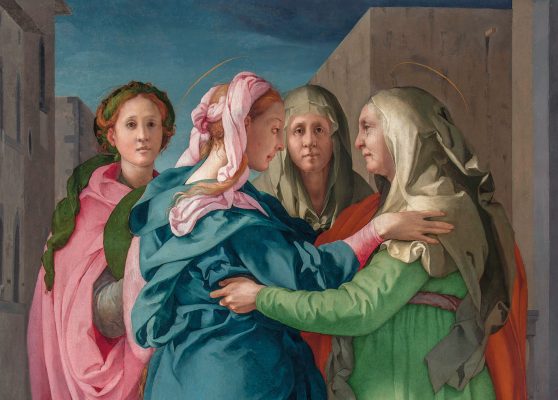
This conception reaches one of its highest points in the celebrated Visitation from the church of San Michele Arcangelo in Carmignano, a key work in the exhibition and one of the most recognisable images in Pontormo’s entire oeuvre. Mary and Elizabeth meet at the centre of the composition, while two further female figures, almost silent doubles of the protagonists, occupy the space behind them.
The embrace is not described as a simple narrative episode. The monumentality of the bodies, the breadth of the garments and the intensity of the colours transform the encounter into a suspended presence. The urban architecture recedes and seems incapable of providing the figures with a stable spatial measure. The gazes of the women in the background, directed straight towards the viewer, introduce an enigmatic stillness that contrasts with the movement of the draperies.
The modernity of the painting lies precisely in this ability to transform the Gospel episode into an experience almost outside time. The image does not abandon narrative, but concentrates it into a system of gestures, colours and presences in which the spiritual dimension is conveyed through the physical tension of the figures.
From the Supper at Emmaus to the investigations of maturity
Another fundamental work for understanding this phase is the Supper at Emmaus of 1525, now in the Uffizi Galleries. Painted after Pontormo’s stay at the Certosa del Galluzzo during the plague that struck Florence, the work demonstrates with particular clarity his ability to combine everyday observation with religious intensity. Christ occupies the centre of the composition while the disciples react to the moment of recognition; behind them, figures of Carthusian monks emerge from the shadows, portrayed with remarkable psychological acuity.
Small, tangible details, the table, the vessels and the animals, coexist with a composition strongly focused on the gesture of blessing. The sacred thus enters the sphere of everyday life without losing the subtle instability that characterises Pontormo’s visual world. Even where the scene appears more firmly constructed, the intensity of the gazes and the luminous isolation of the figures introduce a tension that transcends straightforward naturalism.
The portrait and the construction of identity
Alongside his major religious compositions, the portrait represents one of the fields in which Pontormo achieved particularly original results. His sitters often possess an extremely precise physical presence: clothing, hands, poses and indications of social status are rendered with meticulous attention. At the same time, individual identity seems to resist immediate interpretation.
External composure does not eliminate psychological tension. On the contrary, it makes it more evident. Stillness can turn into vigilance, elegance into distance, and the formal pose into a form of restrained unease. This ability to preserve both social recognisability and inner ambiguity distinguishes Pontormo’s portraiture from much of the earlier tradition and helps explain its extraordinary appeal to modern criticism.
The exhibition route
The exhibition follows a predominantly chronological structure, complemented by thematic sections that establish connections between paintings and graphic works. This approach makes it possible to observe not only the evolution of Pontormo’s style, but also the process through which he constructed his images. The aim is therefore not simply to present a succession of isolated masterpieces, but to restore the continuity of an artistic investigation pursued over more than four decades.
The exceptional nature of the exhibition largely depends on the opportunity to bring together works normally housed in collections far removed from one another. Alongside significant loans from the Uffizi Galleries, the exhibition includes works from the Galleria dell’Accademia, the Bargello Museums and the Istituto Centrale per la Grafica, as well as from major international institutions including the Louvre, the National Gallery and British Museum in London, the Metropolitan Museum of Art, the National Gallery of Art in Washington, the Art Institute of Chicago and the Getty Museum.
A monographic exhibition built through comparisons
Bringing together works from different collections makes it possible to reconstruct relationships that are difficult to perceive today. Paintings executed years apart can be observed within the same itinerary; preparatory studies can be compared with finished compositions; and solutions developed for one work can be recognised, transformed, in later creations.
This approach is particularly important in the case of Pontormo, whose artistic evolution does not follow a straightforward linear progression. Motifs already explored are reconsidered and subjected to new tensions; some inventions seem to anticipate later solutions, while others reveal unexpected returns to earlier models. Chronology therefore becomes an instrument of interpretation rather than a mere succession of dates.
Paintings and works on paper
The presence of a substantial selection of drawings represents one of the exhibition’s most significant scholarly aspects. A remarkably large corpus of Pontormo’s graphic work survives, comprising hundreds of sheets that document the central role played by drawing in his creative process. Figure studies, anatomical details, variations of poses and compositional experiments reveal an artist who repeatedly tested the possibilities offered by every solution.
The sheet becomes the place in which an image is conceived through successive revisions. A leg may change position, a torso may turn, or a gesture may be reconsidered several times before reaching its final form. Seeing these studies alongside the paintings makes it possible to understand how the apparent freedom of Pontormo’s compositions was in fact the result of an extraordinarily analytical working method.
Drawing as a laboratory of form
Pontormo’s graphic practice also helps to challenge the Romantic image of an eccentric genius guided exclusively by instinct. His experimental approach emerged from relentless discipline. The body was observed from life, analysed and reconstructed; the tension visible in his painted figures was prepared through a process in which every movement was subjected to careful scrutiny.
This aspect is particularly important for understanding Pontormo’s relationship with the Florentine culture of drawing. The artist did not break with tradition; rather, he pushed it towards unexpected consequences. Precision of analysis became the prerequisite for deformation, while knowledge of form made its transformation possible.
A comprehensive reassessment of the artist
Despite Pontormo’s central position in the history of Italian art, an exhibition of this breadth devoted entirely to his production represents an unprecedented undertaking. The project therefore also offers an opportunity to reassess the scholarly studies developed over recent decades, bringing together questions of attribution, chronology, restoration and new interpretations of individual works.
Cristina Acidini’s curatorship, together with the contribution of the scientific committee, makes it possible to place Pontormo’s investigations within the cultural context of sixteenth-century Florence, avoiding the temptation to isolate his eccentricity from the system of relationships in which it developed.
Why visit the exhibition
The importance of the exhibition lies not simply in the number or prestige of the loans. The opportunity to see together works that are normally dispersed makes it possible to approach Pontormo beyond the simplifications that long accompanied his critical reception. The image of the melancholic, solitary and eccentric artist, encouraged in part by early biographical accounts, certainly forms part of his historical reputation, but it is not sufficient to explain the complexity of his painting.
Witnessing the birth of a new visual language
Following Pontormo’s development means witnessing one of the decisive moments in European visual culture: the point at which the equilibrium achieved by the Renaissance was subjected to radical transformation. This was not a crisis understood as a decline in quality, but the emergence of new expressive possibilities. Proportion, perspective and naturalism continued to be understood and employed, yet they ceased to function as unquestionable principles.
In Pontormo’s hands, colour acquires autonomy, space can become unstable and the body may be subjected to unexpected torsions. Above all, the relationship between figures becomes a means of representing emotional states that cannot be reduced to straightforward narrative. It is in this distance between formal perfection and perceptual unease that one of the most profoundly modern aspects of his art emerges.
Seeing the creative process at close range
The dialogue between paintings and drawings also provides a rare opportunity to understand the artist’s working method in concrete terms. Pontormo’s painting can initially appear to be governed by visionary impulse. The works on paper demonstrate instead the extent to which this freedom was supported by rigorous control of the human figure and by continuous experimentation.
Observing variations of the same pose means entering the process through which the painter transformed natural observation. The real body provided the starting point, but not the final destination. Through drawing, Pontormo selected, emphasised and modified what he saw until he constructed a form capable of expressing a tension that the simple imitation of nature could never convey.
Understanding Pontormo’s modernity
The twentieth-century reception of the painter is not a marginal episode in the history of his reputation. The fascination he exerted on figures such as Pasolini and Bill Viola demonstrates how Pontormo’s language has been perceived as unexpectedly close to modern sensibility. The isolation of his figures, the suspension of time, the intensity of encounters and the ability of colour to alter visible reality are elements that can be appreciated independently of a detailed knowledge of sixteenth-century iconography.
The Visitation perhaps offers the clearest example. The subject belongs to the Christian tradition, but the way in which Pontormo arranges the figures transcends the simple illustration of the episode. The embrace becomes a structure of bodies and colours, a moment of recognition and at the same time of suspension. It is hardly surprising that this very image has attracted contemporary artists interested in duration, gesture and human relationships.