This major exhibition explores the relationship between Ovid’s poetry and the visual arts, tracing the extraordinary legacy of the Metamorphoses in Western culture. Paintings, sculptures and works from prestigious collections illustrate how the theme of transformation has transcended the centuries, becoming one of the richest and most enduring iconographic motifs in the history of art.
Among the works that have most profoundly shaped the European artistic tradition, Publius Ovidius Naso’s Metamorphoses occupies a unique position. More than a collection of mythological tales, the poem offers an ongoing reflection on transformation as the principle governing the natural world, human destiny and divine intervention. The exhibition is built around the remarkable generative power of Ovid’s text, tracing its influence on the visual arts through a journey that brings together archaeology, sculpture, painting and cultural history.
Ovid’s Metamorphoses: the poem that transformed western art
When Ovid completed the Metamorphoses, probably around AD 8, he bequeathed to Latin literature a work destined to exert an unparalleled influence on both literature and the visual arts. Comprising fifteen books and more than 250 interconnected episodes, the poem unfolds as a continuous narrative that stretches from the creation of the cosmos to the deification of Julius Caesar, bringing together myths from diverse traditions through the unifying theme of transformation.
The originality of the work lies precisely in its ability to transcend the episodic nature of mythological storytelling. Rather than presenting isolated narratives, Ovid links each episode through a sophisticated network of references, analogies and narrative connections, creating a seamless and fluid composition. Every transformation gives rise to a new story, each character introduces another episode, while change itself becomes the poem’s organising principle.
From this perspective, metamorphosis extends far beyond the realm of the miraculous. It embodies the constant transition between different states of existence, the mutability of human emotions, the fragility of identity and nature’s inexhaustible capacity for renewal. Men transformed into trees, nymphs becoming springs, and youths changed into flowers or constellations are not merely fantastical episodes, but symbolic images through which Ovid reflects on the human condition and the relationship between freedom, desire and destiny.
Ovid and the augustan age
Publius Ovidius Naso was born in Sulmo in 43 BC and educated within the cultural elite of the Augustan Age, where he distinguished himself through an elegant and innovative literary style. Unlike Virgil and Horace, he devoted his poetry to love, myth and human passions, exploring the complexities of human nature rather than celebrating imperial ideology.
In AD 8, the year in which the Metamorphoses was essentially completed, Ovid was exiled to Tomis on the Black Sea for the enigmatic reason he described as a carmen et error (“a poem and a mistake”). Far from Rome, he continued writing until his death, while his masterpiece gradually established itself as one of the most influential works in the Western literary tradition.
The poetics of transformation
Metamorphosis is the unifying principle of the entire poem. Each episode depicts a transition, often irreversible, in which the body changes form without entirely losing the memory of its former identity. This suspension between two states is one of the most distinctive features of Ovid’s imagination.
In the myth of Daphne, for example, the dramatic climax lies in the nymph’s gradual transformation into a laurel tree, while the story of Narcissus explores the question of identity through the myth of self-contemplation. In other episodes, such as those of Arachne and Baucis and Philemon, metamorphosis becomes an expression of punishment, reward or divine intervention, revealing the extraordinary symbolic richness of the poem.
From poetic narrative to visual image
The enduring influence of the Metamorphoses also stems from the vivid visual power of Ovid’s writing. His descriptions of transformation are so precise and evocative that they generate compelling mental images, providing artists with an exceptionally rich repertoire of subjects.
Ovid focuses on the very instant of change, a narrative choice that painters and sculptors have translated into works capable of conveying movement within the stillness of the image. It is precisely this dialogue between word and representation that explains the poem’s lasting impact on the history of European art.
Ovid’s poem as a key to interpreting the collection
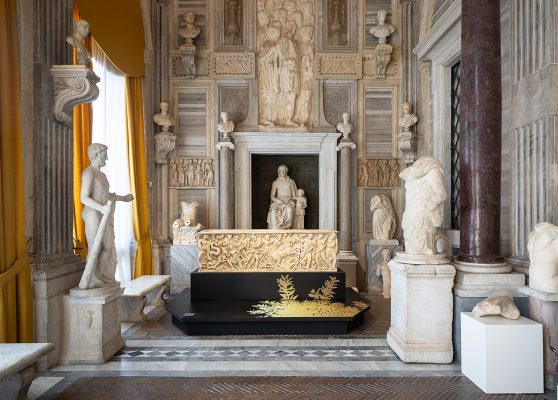
Conceived by Francesca Cappelletti and Frits Scholten as part of the collaboration between the Galleria Borghese and Amsterdam’s Rijksmuseum, the exhibition offers a fresh interpretation of art history through the lens of Ovid’s poem. The Metamorphoses serves as the guiding thread of a journey that places the exhibited works in dialogue with both the museum’s permanent collection and the historic spaces of Villa Borghese.
The choice of Scipione Borghese’s historic residence is far from incidental. The villa stands as one of the finest examples of the reception of the Classical world in seventeenth-century Rome, where collecting, architecture and mythology converge within a unified cultural vision. Deeply embedded in the museum’s identity, the theme of metamorphosis becomes the key to understanding the dialogue between the ancient and the modern, revealing how Ovidian myths have continued to inspire artists across the centuries.
Metamorphosis as a universal principle
One of the exhibition’s most compelling aspects is its expanded interpretation of the very concept of metamorphosis. It is not merely the transformation of the poem’s protagonists, but a universal principle that governs the cosmos, shapes the cycle of the seasons, transforms matter and landscapes, and regulates the perpetual cycle of life and death. Art thus becomes the privileged medium through which this continuous process can be observed and understood.
The curators extend this reflection to the creative process itself. Every work of art is born from the transformation of a material—marble, bronze, pigment or wood—into an image, just as nature in Ovid’s poem constantly assumes new forms. Artistic creation thus becomes a metamorphosis in its own right, establishing a subtle parallel between the artist’s creative act and Ovid’s poetic narrative.
A dialogue across the centuries
The exhibition deliberately avoids a strictly chronological approach. Renaissance and Baroque masterpieces are presented alongside works from antiquity and modern art, demonstrating the uninterrupted legacy of the Metamorphoses. The inclusion of artists such as Michelangelo, Correggio, Titian, Rubens, Poussin, Rodin and Brâncuși highlights the exhibition’s broad chronological scope and the continual reinvention of myth through diverse artistic languages.
The exhibition journey
The exhibition follows the narrative structure of Ovid’s poem, transforming the galleries of the villa into a journey through some of the most celebrated episodes of the Metamorphoses. Rather than presenting a simple sequence of artworks, the display creates a visual narrative in which literature, sculpture, painting and decorative arts constantly interact. More than eighty works from leading European and American museums are displayed alongside the permanent collection, enriching the historic setting while preserving its unique identity.
From primordial chaos to the birth of the world
Like Ovid’s poem itself, the exhibition begins with the creation of the cosmos. Before the appearance of gods and heroes, visitors encounter the concept of Chaos, the formless matter from which all life emerged. This opening section establishes metamorphosis not simply as a mythological event, but as the original condition of the universe. Renaissance paintings and later sculptures illustrate how successive generations of artists interpreted the theme of creation through distinct visual languages.
The great myths of transformation
As the exhibition unfolds, visitors encounter some of the poem’s most celebrated episodes. The stories of Apollo and Daphne, The Rape of Proserpina, Narcissus, Orpheus and Eurydice and many other mythical figures become the common thread linking works created across different centuries. Each section reveals how artists have chosen different moments within the same narrative: some depicting the instant before transformation, others the decisive moment of change, and still others its lasting consequences.
This dialogue highlights the remarkable interpretative freedom offered by Ovid’s text. Although inspired by the same myths, each artist creates a distinct visual language, continually reimagining the relationship between body, space and movement.
Dialogue with the permanent collection
One of the exhibition’s greatest strengths lies in the integration of loans with the museum’s own masterpieces. The celebrated sculptures by Gian Lorenzo Bernini, themselves inspired by the Metamorphoses, are not merely highlights of the display but serve as its key interpretative anchors. Visitors come to appreciate how the theme of transformation was already deeply embedded in the history of the villa and in Scipione Borghese’s collecting vision long before this exhibition was conceived.
A narrative across time
Rather than presenting the Classical tradition as a fixed legacy, the exhibition demonstrates how each era has reinterpreted Ovid according to its own cultural values. The formal balance of the Renaissance, the theatrical dynamism of the Baroque, Romantic sensibilities and the innovations of modern sculpture are all presented as stages in an ongoing process of artistic reinterpretation, confirming the enduring vitality of Ovid’s poem within European art.
Bernini and the poetics of Metamorphosis
If there is one artist who more than any other succeeded in translating the narrative power of the Metamorphoses into visual form, it is undoubtedly Gian Lorenzo Bernini. For this reason, staging the exhibition at the Galleria Borghese carries a significance that extends well beyond the museum itself. The villa houses the most celebrated group of sculptures directly inspired by Ovid’s poem, commissioned by Cardinal Scipione Borghese during Bernini’s early career. The exhibition invites visitors to reconsider these masterpieces not merely as milestones of Baroque sculpture, but as part of a broader reflection on transformation, placing them in dialogue with works from major European and American collections.
Bernini’s greatest innovation lies in his ability to capture the precise moment that Ovid describes with such dramatic intensity: the instant when one form has not yet disappeared and another has not yet fully emerged. Marble seems to abandon its mineral nature to become flesh, hair, leaves, feathers or flowing water, giving viewers the impression of witnessing an event still unfolding. This extraordinary ability to render time, as well as space, places Bernini’s sculptures among the supreme achievements of European art.
Apollo and Daphne: time carved in marble
Among the masterpieces in the permanent collection, Apollo and Daphne stands as perhaps the most accomplished sculptural interpretation of Ovid’s language. Rather than depicting either the pursuit or the completed transformation, Bernini captures the fleeting instant in which Daphne’s body gradually becomes a laurel tree. Her fingers extend into delicate branches, her feet take root in the earth, and bark slowly envelops her still-living body.
This compositional choice reveals Bernini’s profound understanding of Ovid’s poetry. Just as the poet builds dramatic tension through the gradual unfolding of the metamorphosis, Bernini translates the same narrative process into marble, encouraging viewers to move around the sculpture and experience its transformation from multiple perspectives.
The dialogue between word and matter
By placing Bernini’s sculptures alongside the works included in the exhibition, visitors gain a deeper understanding of how the Baroque did not merely illustrate myth but reinterpreted its essential meaning. Metamorphosis becomes a metaphor for the fragility of existence, the power of human passion and the instability of reality itself. Within this context, the exhibition restores Bernini’s masterpieces to their original literary framework, offering a renewed perspective on their enduring significance.
The Rape of Proserpina and the drama of transformation
The Rape of Proserpina represents another pivotal moment in the exhibition. Although it does not depict a physical metamorphosis in the strict sense, the sculpture embodies an irreversible transition—from the world of light to the depths of the Underworld. In Ovid’s account, this myth tells the story of an existential transformation that forever alters Proserpina’s destiny and the eternal cycle of the seasons.
The celebrated illusionistic rendering of Pluto’s fingers pressing into Proserpina’s flesh, the dynamic composition and the theatrical intensity of the group demonstrate Bernini’s extraordinary ability to transform marble into a seemingly living material. The sculpture conveys both the violence of the action and the psychological tension of its protagonists, while the exhibition reveals how this formal achievement is deeply rooted in Ovid’s poetics of transformation, making sculpture one of the highest expressions of the dialogue between poetry and the visual arts.
Why visit the exhibition
The exhibition’s greatest strength lies in its ability to transcend traditional disciplinary boundaries. Classical literature, archaeology, art history, collecting and museology converge in a unified project that encourages visitors to experience artistic heritage from fresh perspectives. Rather than presenting isolated masterpieces, the exhibition reveals them as chapters in a continuous history of reinterpretation and transformation spanning more than two millennia of European culture.
The international collaboration with the Rijksmuseum further highlights the scholarly significance of the project. Developed through a dialogue between Italian and Dutch specialists, the Roman presentation is not simply a reproduction of the Amsterdam exhibition but an independent curatorial project, specifically designed for the historic spaces of the Galleria Borghese, where Bernini’s masterpieces become the exhibition’s principal interpretative focus.
A journey through the european imagination
The exhibition demonstrates how the Metamorphoses became one of the most influential iconographic sources in Western civilisation. From Renaissance masters to Baroque painters and modern sculptors, Ovid’s poem has provided artists with an extraordinary range of subjects through which to explore desire, power, violence, memory, humanity’s relationship with nature and the fragility of identity.
Works by Michelangelo, Correggio, Titian, Rubens, Poussin, Rodin and Brâncuși, displayed in dialogue with the permanent collection, allow visitors to trace the evolution of these themes across the centuries, highlighting both the continuity of the Classical tradition and each period’s capacity to reinterpret it according to its own artistic vision.
The contemporary relevance of Ovid
More than two thousand years after its composition, Ovid’s poem continues to resonate with contemporary audiences. Its reflections on transformation, the instability of forms and the fluid boundaries between humanity, nature and the divine remain strikingly relevant in an age shaped by environmental concerns, questions of identity and renewed interest in humanity’s relationship with the natural world. The exhibition demonstrates that myth belongs not only to the past but also remains a powerful tool for understanding the complexities of the present.
An outstanding opportunity for art-historical insight
For scholars, art enthusiasts and visitors alike, the exhibition offers an exceptional opportunity to deepen their understanding of European artistic culture. The dialogue between rarely exhibited masterpieces, the quality of the international loans and the chance to reinterpret the Galleria Borghese’s celebrated collection through the lens of Ovid’s poem provide a richer appreciation of the enduring relationship between literature and the visual arts. The exhibition ultimately shows how every artist, engaging with Ovid’s text, created a personal metamorphosis of the image, confirming the extraordinary vitality of one of antiquity’s most influential literary masterpieces.