The figure of Saint Francis of Assisi remains one of the most profound cultural touchstones of Western civilisation. His vision of a universal fraternity between humankind, nature, and all creation has transcended the centuries, influencing not only spirituality and literature but also the visual arts. The exhibition approaches this legacy from an original perspective, choosing not to reproduce the saint’s traditional iconography but rather to explore the enduring relevance of his thought within contemporary artistic practice.
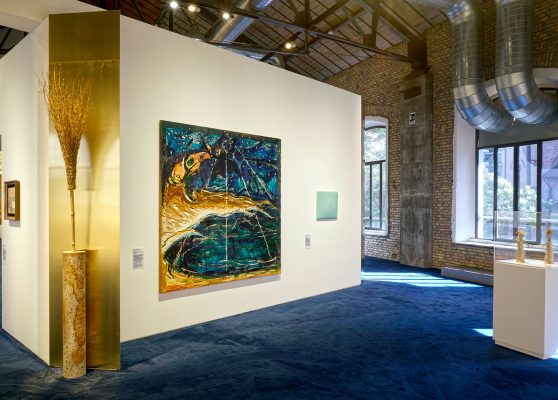
Conceived as part of the celebrations marking the eighth centenary of the death of Saint Francis of Assisi, the project establishes a dialogue between works from the second half of the twentieth century and contemporary art, taking the Canticle of the Creatures as its interpretative key. The exhibition offers a reflection on matter, the fragility of living beings, landscape, and the relationship between humanity and nature, identifying in contemporary artistic research some of the intuitions that make the Franciscan message remarkably relevant today.
Saint Francis’ thought and contemporary art
The principal originality of “Creatures, Creators. Saint Francis and Contemporary Art” lies in shifting the focus of interpretation from the saint’s iconographic representation to his worldview. For centuries, Francis has been portrayed through the most celebrated episodes of his life, from the encounter with the Wolf of Gubbio and the Sermon to the Birds to the reception of the stigmata. The exhibition instead seeks to reveal the deeper significance of these events, considering them expressions of a unique relationship between humanity and creation.
The Canticle of the Creatures as an interpretative key
The Canticle of the Creatures, one of the earliest poetic works in Italian literature, provides the theoretical foundation for the exhibition. Francis presents a vision of the world in which every element of nature shares the same inherent dignity, transcending any hierarchy between humanity and the environment.
This perspective has acquired renewed significance in the present day. Environmental issues, the relationship with the landscape, and reflections on sustainability and collective responsibility have become central concerns of contemporary artistic practice. The exhibition suggests that Franciscan thought may be understood not merely as a religious testimony but as a cultural paradigm still capable of shaping our understanding of the present.
The figure of the Parvolus
One of the exhibition’s central concepts is that of Francis as the parvolus—the little one, a creature among creatures. This idea challenges an anthropocentric view of reality and invites us to consider humanity as part of a broader balance within creation.
From an artistic perspective, this outlook translates into an interest in simple materials, processes of transformation, natural elements, and creative practices that privilege dialogue with both landscape and memory. Fragility, rather than being perceived as a limitation, becomes a condition of openness and connection.
The exhibition path
The exhibition brings together works from the museum’s collection alongside historical pieces, loans, and new commissions created specifically for the project. Rather than following a chronological order, the display establishes an intricate network of relationships between artists and generations, demonstrating how Franciscan thought continues to inspire contemporary visual culture.
The exhibition does not seek to illustrate Saint Francis through traditional religious imagery. Instead, it identifies within the artworks several key themes of his message: the relationship with creation, the value of poverty understood as essentiality, respect for all forms of life, the fragility of the human condition, and the possibility of a harmonious relationship between humanity and nature.
Post-War italian art
A substantial section of the exhibition is devoted to leading figures of post-war Italian art whose research developed a privileged relationship with matter, landscape, and the spiritual dimension of existence. Although belonging to different artistic movements, these artists share a profound attention to the physical world and to the processes of transformation within nature, creating meaningful connections with Franciscan sensibility.
Matter and spirituality
The works of Alberto Burri, Pier Paolo Calzolari, and Ennio Morlotti represent some of the exhibition’s most significant moments. For these artists, matter is not merely a means of expression but the very protagonist of the artwork, acquiring a symbolic value that evokes the continuous transformation of life itself.
Burri’s use of sacks, wood, burnt plastics, and Cretti embodies an artistic vision in which wounds and regeneration coexist, transforming humble everyday materials into images of extraordinary poetic intensity and establishing a compelling parallel with the Franciscan idea of the dignity inherent in every aspect of creation.
Pier Paolo Calzolari’s works introduce a suspended dimension in which natural elements and unconventional materials create environments of profound contemplative power. Ice, salt, lead, and organic surfaces generate a poetics of precariousness that encourages reflection on the transient nature of existence and the perpetual metamorphosis of matter.
In Ennio Morlotti’s painting, the landscape gradually dissolves into a network of signs and colours that conveys the vital energy of nature. Representation loses its descriptive function to become a direct experience of the natural world, understood as a living organism in constant evolution.
A similar search for essentiality characterises the work of Giorgio Morandi. His celebrated still lifes and landscapes reduced to their most fundamental elements create spaces of silence and meditation in which the simplest objects acquire an almost sacred presence. Their formal restraint and subtle variations of light and colour evoke a contemplative dimension that finds remarkable affinities with the spirituality of Saint Francis.
Nature, sign, and memory
A second core section of the exhibition brings together artists who have explored nature through profoundly different artistic languages while sharing a common interest in the relationship between individual experience and collective memory.
The works of Stefano Arienti investigate the value of transformation and the layering of matter by reworking existing images and materials through minimal interventions that alter our perception of reality.
Bruna Esposito‘s artistic research introduces natural elements, atmospheric phenomena, and everyday materials into installations that reflect on energy, time, and sustainability. Her works establish a direct dialogue with the forces of nature, inviting viewers to consider the landscape as a space of balance and shared responsibility.
Particularly significant is the presence of Maria Lai, whose artistic production represents one of the most original explorations of the relationship between community, memory, and territory. Threads, woven structures, stitched books, and environmental interventions transform artistic practice into an act of connection, restoring central importance to popular traditions.
The works of Mario Schifano further expand the dialogue through a personal reinterpretation of the contemporary landscape. Nature, filtered through the culture of images and mass media, retains a powerful symbolic charge while revealing the complex relationship between the natural environment and technological civilisation.
Antonio Del Donno likewise addresses the themes of symbol and memory, recovering archetypal signs and essential materials that evoke a universal and ritual dimension. His works seem to question the deeper meaning of forms and cultural traditions.
With Paolo Canevari, the exhibition ultimately opens onto a reflection on the relationship between nature and contemporary civilisation. Through the use of industrial materials and everyday objects, the artist creates images that challenge the balance between technological development, the environment, and collective responsibility.
Taken together, these artistic experiences demonstrate that the landscape is not simply a subject to be represented but a space of relationships, memories, and continual transformations. Artistic language becomes a means of exploring the relationship between culture and nature, individual and community, offering multiple interpretations that find a common ground in Franciscan thought.
The new Generations of artists
Alongside the masters of post-war Italian art, the exhibition presents a significant selection of contemporary artists invited to engage with the legacy of Saint Francis through updated languages and personal perspectives. The works of Jacopo Benassi, Chiara Calore, Aron Demetz, Fulvio Di Piazza, Marco Cingolani, Andrea Mastrovito, Alessandro Pessoli, and Nicola Samorì testify to the vitality of artistic research addressing themes such as bodily vulnerability, the metamorphosis of living beings, the relationship between humanity and the environment, and the significance of cultural memory.
Particular importance is given to the new commissions created specifically for the exhibition. These works do not narratively illustrate Franciscan thought but reinterpret its essential intuitions, transforming them into images capable of engaging with contemporary issues.
New interpretations of the living world
The human figure, the animal body, landscape, and metamorphosis are among the principal iconographic themes of the exhibition. The emphasis on the vulnerability of living beings and the processes of transformation reveals the continuity between the Franciscan message and some of the most significant concerns of contemporary art.
The newly commissioned works are especially noteworthy, reflecting the curatorial intention not merely to revisit history but to stimulate new artistic productions capable of engaging directly with the exhibition’s central themes.
Beatrice Buscaroli’s curatorial project
The curatorial approach of Beatrice Buscaroli is distinguished by its emphasis on dialogue between artworks and ideas rather than a simple chronological sequence of artists. The exhibition creates a network of associations in which materials, forms, and images become instruments for reflecting on the relationship between the sacred and the contemporary.
An exhibition beyond religious iconography
The decision to avoid a direct representation of Saint Francis is one of the project’s most compelling aspects. The saint does not appear as a figurative protagonist but as a generative principle of thought, capable of connecting widely different artistic experiences.
From this perspective, the exhibition addresses themes such as poverty, respect for creation, the fragility of existence, the dignity of matter, and responsibility towards the natural world, demonstrating how contemporary art can engage with spiritual questions without sacrificing its critical autonomy.
Art, ethics, and contemporary society
The project also highlights the role of cultural institutions in fostering dialogue between historical heritage and contemporary sensibilities. Francis is interpreted as a shared cultural legacy capable of providing valuable insights into the major issues of our time.
In this sense, “Creatures, Creators. Saint Francis and Contemporary Art” proposes an exhibition model in which art history, philosophy, spirituality, and cultural ecology converge in an interdisciplinary interpretation of the contemporary world.
Why visit the exhibition
The exhibition offers an important opportunity to understand some of the principal directions of Italian art over recent decades through an original interpretative perspective. The juxtaposition of historical masters and contemporary artists reveals both continuities and differences in the representation of nature, matter, and the relationship between individuals and the collective.
From an art historical perspective, Saint Francis’ message is liberated from an exclusively religious dimension and interpreted as a system of values capable of crossing the artistic languages of the twentieth and twenty-first centuries.
Through the dialogue between matter and symbol, memory and landscape, figure and metamorphosis, the exhibition presents a nuanced reflection on the relationship between art and reality, demonstrating how Franciscan thought continues to provide fertile ground for contemporary artistic research and a privileged lens through which to question the present.