The event is conceived as an exhibition project of high scientific profile, aiming to reconstruct—with philological rigor and interpretative depth—the genesis of the plastic thinking of one of the leading figures of modern sculpture. The exhibition focuses not only on the most well-known works, but above all on the cultural and visual matrices that guided his research toward a progressive formal essentiality.
Through an intense dialogue between archaic art, classical tradition, and modern experimentation, the exhibition highlights how Brâncuși developed a language capable of overcoming naturalistic representation in order to reach a universal dimension. From this perspective, the idea of infinity emerges as a generative principle of form, translating into structures that evoke continuity, rhythm, and transcendence.
The birth of an absolute language between the archaic and the classical
The theoretical core of the exhibition develops around the investigation of the archaic and classical roots of the language of Constantin Brâncuși, interpreted as the result of a complex cultural stratification. The artist does not merely reject nineteenth-century academicism, but constructs a formal system grounded in a profound dialogue with past civilizations. In this sense, the modernity of his work does not arise from a radical break, but from a refined operation of synthesis, in which elements from different historical and geographical contexts are reworked into a new linguistic unity.
The memory of archaic forms
One of the most relevant aspects highlighted by the exhibition is the relationship with archaic art, understood not as an iconographic repertoire to be cited, but as a system of visual thought based on essentiality. Brâncuși’s works show a surprising affinity with Cycladic sculpture, African productions, and the artistic expressions of primordial cultures, revealing a shared tension toward the reduction of form.
This relationship does not translate into a simple stylistic influence, but into a true structural consonance: as in archaic works, in Brâncuși’s sculpture form tends to free itself from contingency in order to assume a universal value. The exhibition emphasizes how this process is the result of a conscious reflection, leading the artist to identify in primitive forms an alternative model to Western naturalistic tradition.
The archetype as a structure of form
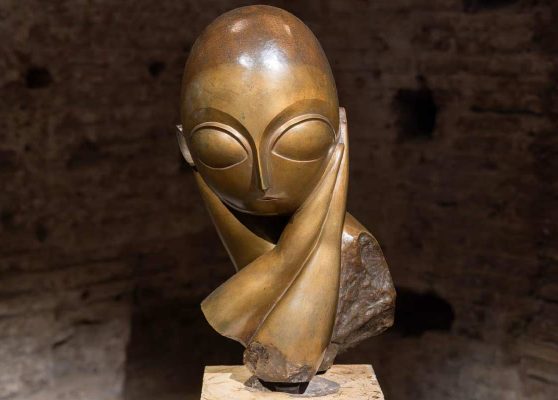
The notion of archetype plays a central role in Brâncuși’s research. His sculptures do not represent objects or recognizable figures in a strict sense, but evoke primary images belonging to a collective memory. The reduction to pure volumes and the simplification of lines eliminate every superfluous element, focusing attention on the essence of form.
This process implies a radical transformation of sculptural language: form is no longer the result of direct observation of reality, but the outcome of a mental construction aimed at grasping the universal idea of things. In this sense, the archetype becomes a generative structure, capable of organizing matter according to principles of balance and necessity.
The dialogue with the classical tradition
Alongside the archaic dimension, the exhibition highlights the confrontation with the classical world, which represents an essential reference for Brâncuși, albeit reinterpreted in a modern key. The artist looks to Greek sculpture not so much for its formal perfection, but for its ability to express an idea of harmony that transcends sensory data.
The classical tradition is thus reinterpreted through a process of progressive abstraction, in which the principles of proportion and balance are maintained, but freed from figurative representation. This dialogue allows Brâncuși to construct a language that combines rigor and freedom, order and innovation.
The synthesis between ideal and abstraction
The tension between classical ideal and modern abstraction constitutes one of the most interesting elements of Brâncuși’s research. His works do not renounce the harmonic dimension, but translate it into essential forms that escape any direct reference to reality.
In this sense, beauty is no longer linked to the representation of the human body, but becomes an intrinsic quality of form, determined by the relationship between its parts. Sculpture thus becomes an autonomous object, capable of expressing universal values through a rigorously controlled structure.
Infinity as a formal principle
The concept of infinity runs throughout the entire exhibition, emerging as a fundamental interpretative key to understanding Brâncuși’s research. Infinity is not understood in a purely philosophical sense, but as an operative principle guiding the construction of forms.
The exhibited works show how the artist uses repetition, modularity, and verticality to suggest an idea of endless continuity. Sculpture thus becomes a device capable of projecting itself beyond its physical limits, establishing a dialogue with the surrounding space.
Seriality and vertical tension
Seriality does not represent a simple repetition of a formal motif, but a method of investigation that allows the exploration of the potential of form. Each variation introduces a new interpretative possibility, contributing to the construction of an open system.
The vertical tension, often present in Brâncuși’s works, reinforces this idea of infinity, suggesting an ascending movement that surpasses the earthly dimension. In this way, sculpture becomes a bridge between matter and transcendence.
Constantin Brâncuși: a key figure in modern sculpture
Constantin Brâncuși occupies a pivotal position in the history of twentieth-century art, acting as a link between nineteenth-century sculptural tradition and the radical experiments of modernity. His research marks a decisive shift: sculpture is no longer understood as a representation of reality, but as an autonomous construction of essential forms capable of expressing universal content.
His contribution takes place within a historical context marked by profound cultural transformations, in which art is called upon to redefine its languages in relation to the changes of contemporary society. In this context, the Romanian artist develops a reflection that goes beyond both naturalism and purely decorative tendencies, placing the search for essence at the center of the creative process.
His work is distinguished by a constant tension toward simplification, understood not as an impoverishing reduction, but as a cognitive tool. Through rigorous work on form, Brâncuși comes to conceive sculpture as a self-sufficient entity, capable of establishing a direct dialogue with space and with the viewer.
A silent revolution
The transformation carried out by Brâncuși can be defined as a silent revolution, as it lacks sensational manifestations yet is deeply incisive at the linguistic level. Unlike other protagonists of the avant-garde, who express themselves through explicit ruptures and provocative gestures, Brâncuși constructs his path through a gradual redefinition of the very foundations of sculpture.
This revolution manifests itself in the progressive abandonment of every superfluous reference to visible reality, focusing instead on forms that tend toward the absolute. The artist does not destroy tradition, but critically traverses it, identifying within it elements that can be transformed and renewed.
The radical nature of his research lies precisely in this ability to carry out a profound transformation without resorting to explicit strategies of rupture. His works appear essential, almost inevitable, yet they are the result of a long and complex process based on continuous subtraction and refinement.
The centrality of the creative process
At the core of Brâncuși’s practice lies the creative process, understood as a path of progressive approximation to the essence of form. Each work does not represent a definitive endpoint, but a stage within an ongoing research.
The artist works in series, revisiting and reworking the same themes in successive variations, in a process aimed at exploring all the possibilities offered by a given formal configuration. This method highlights a conception of sculpture as a field of investigation, in which each solution remains open to further developments.
Repetition is therefore not a sign of staticity, but a dynamic tool through which form is continuously tested, refined, and brought toward a condition of ideal balance. Each work must be read as part of a broader trajectory, in which form is constantly re-elaborated. This process of refinement represents one of the most innovative aspects of his research.
Between spirituality and form
One of the deepest aspects of Brâncuși’s research is the connection between spirituality and form, which constitutes a key element in understanding the meaning of his work. Sculpture is not for him merely an aesthetic object, but a means through which to explore dimensions that transcend sensory reality.
This tension toward the transcendent translates into a search for pure forms capable of evoking meanings that go beyond their material presence. His works do not represent the visible world, but aim to express universal principles linked to the human condition and to the perception of time and space.
The spiritual dimension of his sculpture does not manifest itself through explicit iconographies, but through the construction of forms that suggest a higher order. In this sense, his work approaches an almost metaphysical conception of form, understood as the manifestation of an invisible principle.
The transcendence of matter
The relationship with matter assumes a fundamental meaning in this context. Brâncuși does not simply shape material, but transforms it in such a way as to transcend its physical dimension. The polished surface, the purity of lines, and the balance of proportions contribute to giving the works a quality that seems to go beyond their concrete nature.
Matter thus becomes a vehicle for a tension toward the immaterial, in which sculpture is configured as a meeting point between the visible and the invisible. This process implies a conception of artistic practice as a meditative act, in which every gesture is oriented toward the search for a higher harmony.
Light, reflecting on surfaces, amplifies this dimension, transforming the work into an object that continuously changes in relation to space and the viewer’s gaze.
The legacy in contemporary sculpture
The influence of Constantin Brâncuși on contemporary sculpture is vast and multifaceted, extending far beyond the historical context in which the artist operated. His research helped redefine the very concept of sculpture, opening the way to new modes of relationship between form, space, and perception.
Many developments in the art of the second half of the twentieth century find in his work a point of origin, particularly with regard to attention to spatial dimension and to the viewer’s perception of the artwork. Sculpture is no longer conceived as an isolated object, but as an element within a system of relationships involving environment and viewer.
Formal reduction, the centrality of process, and attention to matter are aspects that reappear in numerous later artistic experiences, testifying to the depth and endurance of Brâncuși’s legacy.
A model for the avant-garde
Brâncuși’s research represented a fundamental point of reference for the historical avant-gardes and for many twentieth-century artists, who recognized in his work one of the matrices of modern sculpture. His approach to form, based on synthesis and essentiality, deeply influenced movements such as minimalism and abstract sculpture.
His ability to conceive sculpture as an autonomous form, freed from representation, opened new expressive possibilities, allowing artists to explore previously uncharted territories. In this sense, Brâncuși can be considered not only an innovator, but also a starting point for many subsequent explorations.
His legacy does not consist merely of a set of formal solutions, but takes shape as a working method grounded in the search for the essential and in the belief that form can convey universal meanings. This approach continues to exert a strong influence, confirming the relevance of his thought in the contemporary art landscape.
Why visit the exhibition
The exhibition represents a significant opportunity to deepen one’s knowledge of Constantin Brâncuși through a rigorous and articulated critical path. It allows for an understanding of the complexity of his research by relating works and cultural contexts.
The exhibition also takes shape as a highly intense visual experience, in which the arrangement of the works and the quality of the display enhance the perceptual dimension of sculpture. The interaction between the sculptures and the exhibition space allows for a full grasp of the complexity of Brâncuși’s language, highlighting the relationship between form, light, and environment.
Understanding the origins of modernity
Visiting the exhibition means engaging with one of the crucial moments in art history, in which sculpture undergoes a radical transformation. The itinerary offers an in-depth view of the dynamics that led to the birth of a new artistic language. The curatorial approach encourages a conscious reading, providing interpretative tools that help understand the relationships between the works and their cultural context.