“Mario Schifano” takes shape as a large-scale and structured event, capable of investigating the complexity of one of the leading figures of Italian art in the second half of the twentieth century. The exhibition does not merely present an anthology of works, but proposes a critical path that highlights the Roman beginnings, the progressive contamination between photography and painting and the significant experience of experimental cinema. Through over one hundred works, the exhibition clarifies the artist’s central role in redefining pictorial language in relation to media modernity.
Painting and image in Rome in the second half of the twentieth century
The exhibition is a large-scale curatorial project dedicated to one of the most significant artists, a protagonist of Italian Pop Art and contemporary painting. The retrospective aims to offer a multifaceted reading of his production, which spanned painting, photography and image culture in Rome during the second half of the twentieth century, a historical moment marked by the radical transformation of visual languages.
Roman beginnings of the 1950s and 1960s
The Roman beginnings of Mario Schifano constitute a fundamental chapter for understanding the genesis of his language. Having moved to the capital at a very young age, the artist came into contact with a vibrant cultural environment shaped by tensions between the legacy of Informal art and the first impulses of renewal that would lead to the season of the so-called School of Piazza del Popolo.
Rome, in those years, was a crossroads for artists, intellectuals, filmmakers and writers. Private galleries and cafés in the historic center became places of debate and experimentation. In this context, Schifano developed a sensitivity attentive to the transformations of visual culture, showing from his earliest works a desire to move beyond both naturalism and the dominant lyrical abstraction.
From matter to the zeroing of the image
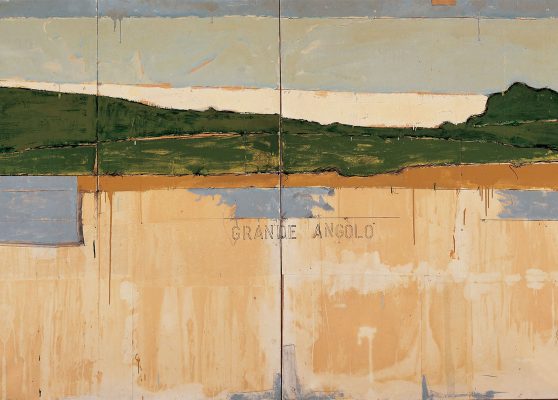
The early works reveal an interest in the surface as an autonomous field of investigation. The pictorial matter is treated directly, sometimes roughly, with particular attention to the physicality of the support. However, it is with the celebrated monochromes that Schifano performs a radical gesture: reducing the image to a pure field of color.
These works, created on canvas-backed paper using industrial enamels, represent a moment of symbolic zeroing. By eliminating figuration, the artist seems to restart from a zero degree of painting. Yet this reduction does not coincide with expressive impoverishment: on the contrary, the color vibrates across the surface, retaining the trace of the gesture and establishing a silent dialogue with the architectural space that hosts it.
Confrontation with mass culture
Already in his Roman beginnings, Schifano’s interest in the signs of urban modernity becomes evident: writings, brands, road signs. The artist understood that the new iconography of the present was no longer mythological or historical, but produced by the consumer society. By incorporating these elements into painting, he inaugurated a reflection destined to shape his entire career.
Between photography and painting: a structural dialogue
Photographic image as matrix
The relationship between photography and painting occupies a central position in Schifano’s research and receives extensive treatment in the exhibition. From the mid-1960s onward, the artist used photographs taken directly or sourced from newspapers and television as the basis for his paintings. The photographic image becomes a matrix to be reworked, not a model to be faithfully reproduced.
The canvas thus becomes a space of translation: the photographic data are enlarged, grainy, chromatically altered. Painting intervenes to underline the distance between reality and representation, between document and interpretation. In this passage one can grasp Schifano’s intention to question the very nature of the technical image.
Surface as a place of overlapping
In works where photography and painting overlap, the surface appears stratified. Transparencies, glazes and graphic signs interrupt the continuity of the image, emphasizing its artificial construction. The artist does not conceal the process, but makes it an integral part of the work.
This practice anticipates reflections that would become central in contemporary visual culture: the manipulability of the image, its accelerated circulation, the loss of a stable referent. Schifano demonstrates how painting can still perform a critical function, transforming photographic appropriation into an occasion for analysis and distancing.
The “TV Landscapes” as linguistic synthesis
The so-called “TV Landscapes” represent one of the most well-known outcomes of this dialogue. By photographing the television screen and subsequently intervening on the canvas, Schifano translates the television flow into a pictorial image. The result is a fragmentary vision, often crossed by signs that disturb its legibility.
In these works, television is not merely an iconographic subject, but a conceptual device: it embodies the new perceptual condition of contemporary humanity, immersed in a continuous flow of images.
Experimental cinema and the moving image
Season of experimental films
A substantial focus is devoted to the production of experimental cinema, an integral part of Schifano’s poetics. Between the late 1960s and the 1970s, the artist created films that reflect the same tension toward fragmentation and linguistic contamination present in his painting.
These works are characterized by rapid editing, the absence of linear narrative, and the free use of color and superimposition. Cinema becomes a laboratory in which to experiment with new modes of perception, questioning the traditional distinction between visual arts and temporal arts.
Moving image as an extension of painting
In Schifano’s filmic experience, the moving image does not replace painting, but constitutes its extension. The pictorial gesture translates into visual sequences that retain a strong poetic component. Even within the cinematic medium, the artist preserves a lyrical and visionary attitude, avoiding both documentary realism and spectacularization.
The exhibition presents film and documentary materials that allow visitors to understand the continuity between canvas and film, between static surface and temporal flow. In this way, it becomes clear that Schifano’s work cannot be reduced to a single disciplinary category, but must be read as a complex investigation of the image in modernity.
Exhibition path: rotunda and Piano Nobile
A Coherent Architectural Itinerary
The installation in the rotunda and in the seven large rooms on the piano nobile allows for an organic distribution of the works, respecting both chronology and thematic articulations. The rotunda introduces visitors to the immersive dimension of the exhibition, while the subsequent rooms develop the main nuclei of Schifano’s research.
The monumentality of the space enhances the large-format works and allows for direct engagement with the physicality of painting. At the same time, the sections dedicated to cinema and audiovisual materials are placed in environments suitable for collective viewing, reinforcing the idea of a path that traverses different media.
In this spatial articulation, the exhibition “Mario Schifano” offers not only a historical reconstruction, but a critical experience that invites reflection on the enduring relevance of his work within contemporary image culture.
The project
The exhibition is promoted by the Department of Culture of Roma Capitale and Azienda Speciale Palaexpo, which oversee its institutional and cultural direction. The exhibition project is produced and organized by Azienda Speciale Palaexpo, in collaboration with Intesa Sanpaolo and Gallerie d’Italia, strategic partners contributing to the realization and enhancement of the initiative. The Main Partner of the exhibition is ENI, whose support strengthens the project’s national and international scope. The exhibition also benefits from the support of Fondazione Silvano Toti, which contributes to the promotion and development of the cultural activities connected to the show.