The exhibition brings together more than two hundred works, including paintings, works on paper, archival materials, and documents, offering a comprehensive critical survey of over four decades of artistic experimentation. The project highlights the complexity of a practice that evolved from figuration and applied arts toward a refined and meditative form of abstraction, where line, rhythm, and spatial tension become the core elements of a highly personal visual language. The exhibition also contributes significantly to the reassessment of women artists within the broader narrative of modern art.
Bice Lazzari: biography and formation
Venetian years and early training
Born in Venice in 1900, Bice Lazzari developed her artistic identity within a cultural environment deeply rooted in tradition yet increasingly receptive to modern experimentation. Initially trained in music, an education that would later influence the rhythmic structure of her compositions, she enrolled at the Academy of Fine Arts in Venice. Her early works are grounded in figuration, revealing a careful attention to compositional balance and structural clarity.
Alongside painting, Lazzari devoted considerable energy to applied arts and decorative design during the 1920s and 1930s. Far from being a marginal activity, this engagement provided a crucial laboratory for her understanding of modular structures, surface articulation, and the dialogue between form and space. Even in these early works, one perceives a tendency toward simplification and a gradual reduction of descriptive elements, anticipating her later abstract developments.
The move to Rome and the encounter with modernity
In 1935 Lazzari moved to Rome, a decisive turning point in her career. The capital offered a complex and intellectually vibrant context, shaped by rationalist architecture and increasingly open to abstract tendencies. Her interaction with architects, designers, and artists encouraged a deeper exploration of structural principles and formal autonomy.
During and after the Second World War, her painting progressively detached itself from representation. The linear element, initially a descriptive device, became an autonomous structural force. Line transformed into rhythm, measure, and spatial articulation. This transition did not occur abruptly; rather, it was the result of a gradual and coherent evolution grounded in disciplined reflection.
Maturity and critical recognition
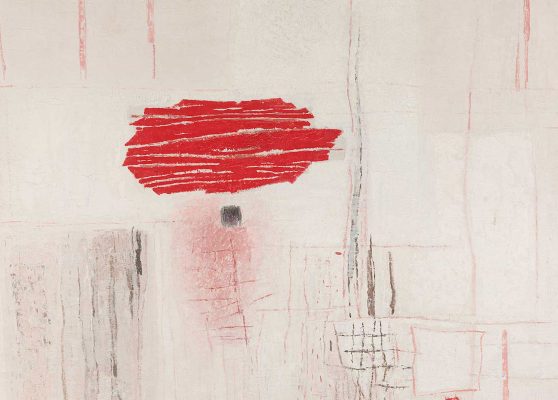
By the 1950s and 1960s, Lazzari had fully articulated her abstract language. Her works from this period often feature monochromatic fields traversed by sequences of finely calibrated lines, generating subtle optical vibrations and controlled rhythmic tensions. The reduction of means does not imply austerity; instead, it intensifies formal concentration and expressive precision.
Although critical recognition steadily increased, Lazzari’s position remained somewhat peripheral within dominant art historical narratives, frequently centered on male protagonists. This retrospective enables a renewed assessment of her role within twentieth-century Italian art, emphasizing both her originality and her dialogue with international developments.
Theme of the exhibition
The notion of “Language” as interpretative framework
The title suggests a perspective that transcends chronological succession. “Languages” refers to a plurality of formal codes and expressive strategies through which Lazzari engaged with the transformations of twentieth-century art. Rather than adhering passively to prevailing trends, she maintained a critical dialogue with abstraction, Informal painting, and later minimalist investigations.
In Lazzari’s practice, language becomes a meditation on the very nature of painting: the surface as a field of tension, the sign as a temporal trace, the line as generative structure. Each phase of her production corresponds to a distinct modulation of these elements, continuously redefined through disciplined inquiry.
Abstraction, rhythm, and structure
The exhibition foregrounds Lazzari’s contribution to Italian abstraction. Her works resist impulsive gesturalism, instead articulating a measured and almost musical construction. Repetition and variation function as compositional principles, creating rhythmic sequences that unfold across the pictorial plane.
In many works from the 1960s and 1970s, the surface is traversed by parallel lines or delicate graphic textures that produce subtle vibratory effects. The chromatic palette is often restrained, whites, greys, blacks, and deep reds, reinforcing a contemplative spatial dimension. Lazzari’s abstraction is neither purely analytical nor emotionally detached; it preserves a lyrical quality embedded within its formal rigor.
An independent position within the twentieth century
The exhibition makes clear Lazzari’s independent stance in relation to contemporary movements. While her research resonates with aspects of European Informal art and minimalist tendencies, she maintained a deliberate distance from doctrinal affiliations. Her practice emerges as a sustained personal inquiry grounded in discipline and introspection.
The thematic focus thus positions Lazzari not merely as a witness to her era, but as an active interpreter of its artistic languages. The plurality of her approaches reflects a continuous redefinition of artistic identity rather than stylistic fragmentation.
Exhibition path
From figuration to formal synthesis
The exhibition opens with early works that document her figurative phase. Landscapes, still lifes, and decorative compositions reveal an interest in structural balance and the relationship between filled and empty spaces. These works already suggest a movement toward simplification and essential form.
This section clarifies that abstraction was not a rupture but the culmination of a gradual transformation. Figuration progressively dissolves, giving way to increasingly essential structures.
The postwar years and the emergence of abstraction
The central section focuses on the postwar period, when Lazzari more decisively articulated her abstract identity. The line becomes the fundamental element of her language, no longer descriptive, but structural and autonomous.
Sign and surface
In numerous works on canvas and paper, sequences of lines organize the pictorial space into fields of controlled vibration. The painted surface becomes an active site of tension, rather than a neutral support. The economy of means intensifies the viewer’s attention to the relationship between sign and ground.
Materials and experimentation
Alongside paintings, works on paper reveal sustained technical experimentation. Pencil, ink, and tempera are employed with precision, each material selected for its specific expressive potential. Despite variations in medium, a coherent formal discipline unifies the production.
Mature phase: minimalism and lyrical intensity
The final section is devoted to the mature works, where formal reduction reaches its highest level of synthesis. Thin lines traverse monochromatic expanses, creating compositions that evoke meditative introspection.
Line as writing
Here, line assumes the value of a personal script. It neither describes nor represents, but records an inner movement. Repetition becomes an investigative method, while subtle variation introduces dynamic tension within apparent stillness.
Space as mental experience
Pictorial space is conceived not as illusionistic depth but as a mental field. The absence of traditional perspective concentrates attention on the surface, inviting slow and analytical viewing. Lazzari’s paintings demand time, time for observation and for perceiving the smallest differences.
Why visit the exhibition
Critical reappraisal of italian modern Art
This exhibition offers an essential opportunity to reconsider the development of modern and contemporary art in Italy through the lens of an artist who pursued her research with coherence and independence. The reconstruction of her trajectory enriches the understanding of Italian abstraction and contributes to a broader reassessment of women’s contributions to twentieth-century art history.
Experience of discipline and contemplation
Visiting the exhibiton means engaging with a conception of painting grounded in rigor, discipline, and introspection. The works resist spectacle and instead foster attentive and reflective viewing, encouraging meditation on the meaning of sign and form.
Enduring relevance of a personal inquiry
In a century marked by rapid shifts and successive avant-gardes, Lazzari chose a path of concentration and subtraction. This sustained commitment to essential form grants her work a striking contemporary resonance. Within the institutional framework of the National Gallery of Modern and Contemporary Art, the retrospective assumes particular significance, contributing to the redefinition of the canon of twentieth-century Italian art and affirming the enduring vitality of abstract languages.