Conceived as both an artistic and civic gesture, the exhibition reaffirms a commitment to restoring to the city a space devoted to art, fashion, and culture as tools for dialogue and social growth. Beauty is presented not as a static ideal, but as an active force capable of generating meaning and transformation. Through the eyes of Joana Vasconcelos the exhibition space becomes a site where aesthetic experience meets ethical reflection and where cultural production engages with contemporary complexities.
At its core, Venus affirms that beauty must be shared and continually redefined. Artistic creation and haute couture are understood as complementary languages shaping collective imagination. Through myth, contemporary art, and participatory practices, the exhibition reflects on the enduring cultural and social relevance of beauty.
The conceptual framework of Venus
The exhibition takes its title from Venus, a figure that has traversed centuries of Western culture as a symbol of beauty, desire, and generative power. In this context, Venus is neither a nostalgic citation nor a purely iconographic reference, but an operative concept, an archetype through which to interrogate the present. The mythological dimension is reactivated and reinterpreted, opening up new meanings that resonate with contemporary concerns related to identity, resilience, and collective responsibility.
Beauty as a transformative force
In Venus, beauty is framed as a dynamic principle capable of producing harmony and, by extension, envisioning possibilities of social balance and justice. This idea, explicitly articulated by Joana Vasconcelos, underpins the entire project. Beauty is not detached from reality; rather, it is deeply entangled with it, functioning as a catalyst for awareness and change. The exhibition proposes beauty as an ethical and political dimension, one that can counter fragmentation and foster solidarity in a world marked by increasing social fractures.
Myth, abstraction, and contemporary relevance
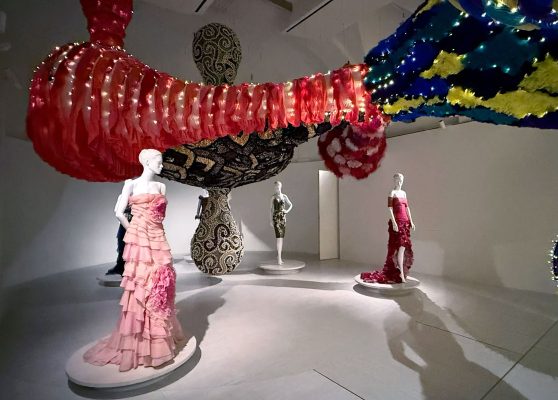
Through abstraction, Vasconcelos revisits garments, forms, and textile surfaces associated with the heritage of Valentino Garavani, generating a visual language that does not imitate haute couture but engages in a profound dialogue with it. The resulting works evoke the mythological figure of a Valkyrie-like Venus, an abstract heroine that embodies strength, protection, and resilience. This reinterpretation situates Venus firmly within the present, transforming her into an emblem of contemporary vitality and resistance.
Joana Vasconcelos and the dialogue with haute couture
Central to the exhibition is the presence of Joana Vasconcelos, whose practice is renowned for its ability to merge monumental scale with intricate craftsmanship, and conceptual rigor with emotional resonance. In Venus, her work enters into a direct and meaningful exchange with the legacy of Valentino Garavani, establishing a dialogue that unfolds progressively throughout the exhibition and culminates in a suspended, almost contemplative final convergence.
Valkyrie Venus
The monumental installation presented by Vasconcelos constitutes the conceptual and visual fulcrum of the exhibition. Composed of thousands of decorative elements, the work gives form to a contemporary and abstract heroine, an embodiment of power, protection, and endurance. The figure of Venus emerges not as an idealized body, but as a collective presence, shaped by the accumulation of gestures, materials, and human contributions.
The work Venus, conceived by the artist and realized through the contribution of thousands of hands and ten distinguished institutional partners, functions simultaneously as an artistic and social device. More than one hundred students from Art and Fashion Academies took part in its creation, alongside local communities and civic organizations, transforming the making of the artwork into a shared experience of learning and co-creation.
Craftsmanship and symbolic density
The work’s surface, dense with textile modules and ornamental components, reflects a profound respect for craftsmanship as a bearer of knowledge and memory. By engaging with the language of haute couture, understood as a discipline of majestic beauty and refined, almost hieratic excellence, Vasconcelos constructs a bridge between artistic abstraction and sartorial intelligence. The result is a powerful synthesis in which material complexity becomes a vehicle for symbolic depth.
Exhibition path of “Venus”
The exhibition path of “Venus” is conceived as a non-linear journey, structured through thematic resonances rather than chronological sequences. Emblematic works by Joana Vasconcelos are juxtaposed with newly conceived site-specific installations inspired by the aesthetic and material universe of Valentino Garavani. This curatorial approach encourages visitors to navigate the space intuitively, engaging with the works through association, contrast, and reflection.
Within this dialogue, the legacy of Valentino Garavani and Giancarlo Giammetti emerges as a foundational presence. More than a fashion house, their shared vision represents a model of creative and entrepreneurial partnership that has shaped contemporary haute couture. The exhibition pays tribute to their longstanding collaboration, highlighting how artistic sensibility and managerial foresight converged to construct a global cultural phenomenon rooted in craftsmanship, discipline, and aesthetic coherence.
The collaboration between Valentino Garavani and Giancarlo Giammetti
At the heart of this narrative lies the extraordinary partnership between Valentino Garavani and Giancarlo Giammetti. Since the founding of the Maison in Rome in 1960, their collaboration has embodied a rare balance between artistic inspiration and strategic vision. Valentino’s pursuit of formal perfection, chromatic harmony, and timeless elegance found in Giammetti a complementary force capable of translating creativity into institutional structure and international expansion.
The exhibition explores this dual authorship not only through archival materials, sketches, garments, and visual documentation, but also by evoking the intangible dimension of their dialogue: a shared intuition of beauty as discipline and as emotional intensity. Their relationship demonstrates how haute couture can transcend fashion to become a cultural language, capable of shaping collective imagination and redefining standards of refinement.
Participatory and collective project
One of the defining aspects of Venus is its nature as an ambitious participatory art project. The monumental work at the heart of the exhibition was conceived by the artist and realized through the collaboration of thousands of hands, transforming the act of making into a shared experience. Over 756 hours of workshops and the involvement of more than 200 participants of different ages and backgrounds testify to the project’s extensive social reach.
Community, education, and social inclusion
The realization of the work involved students of art and fashion academies, patients and families from healthcare institutions, women from shelters supporting refugees and victims of violence, and inmates from correctional facilities. More than 200 kilograms of crocheted modules were produced across the city and sent to the artist’s studio in Lisbon, converging into a single collective gesture. This process foregrounds the transmission of skills and traditions as instruments of empowerment, care, and shared resilience.
In this context, the values historically associated with the Maison founded by Valentino Garavani and Giancarlo Giammetti—attention to craftsmanship, respect for manual knowledge, and intergenerational dialogue—resonate with the participatory dimension of the project. The exhibition thus establishes a bridge between haute couture and collective practice, between excellence and inclusivity, reaffirming beauty as a shared and transformative force.
Why visiting Venus matters
To visit Venus is to engage with a vision of art and fashion that transcends aesthetic contemplation and embraces social responsibility. The exhibition offers a rare opportunity to witness how beauty can operate as a connective force, capable of generating dialogue between disciplines, communities, and individual experiences.
By foregrounding participation, craftsmanship, and cultural memory, Venus articulates a model of artistic practice rooted in solidarity and collective imagination. This collective dimension does not remain confined within the exhibition space; rather, it extends into the urban fabric, establishing a direct dialogue with some of the most emblematic sites of the capital.
Diffused Installations
Piazza Mignanelli – I’ll Be Your Mirror
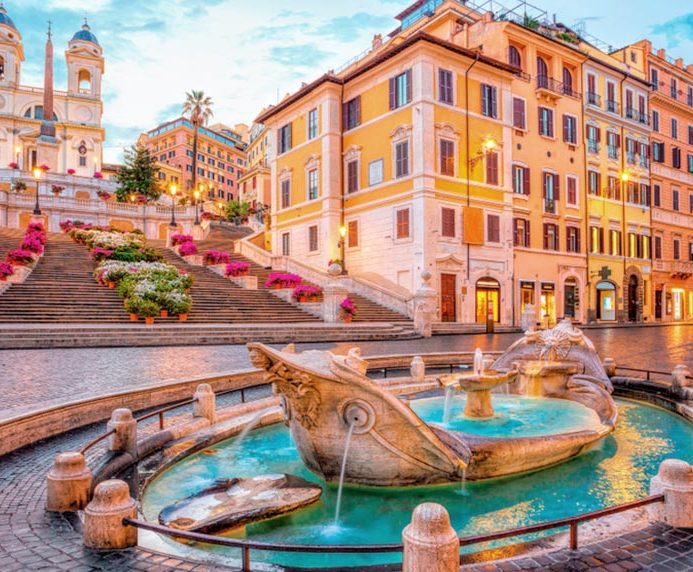
In Piazza Mignanelli, a historic urban space at the foot of Trinità dei Monti and home to the Valentino Maison, the installation I’ll Be Your Mirror engages with the public and monumental dimension of Baroque Rome. The work acts as a symbolic reflective surface, inviting viewers to recognize themselves within the collective space and to question the relationship between individual identity and shared imagination.
The choice of this location is significant: here, the history of Roman haute couture meets the artistic memory of the city, creating a dialogue between tradition and contemporary experimentation.
Terrazza del Pincio – Solitaire
At the Terrazza del Pincio, one of the most celebrated panoramic viewpoints overlooking the city, the installation Solitaire introduces a sculptural presence that dialogues with the urban landscape and the contemplative nature of the belvedere.
Here, the artwork confronts the horizon and the Romantic tradition of gazing upon the Eternal City, transforming the act of observation into a meditation on beauty as both shared and intimate experience. The intervention temporarily reshapes the perception of the panorama, inserting a contemporary element into a historically layered setting.
Ara Pacis – Drag Race
At the Ara Pacis, the Augustan monument symbolizing peace and imperial foundation, the installation Drag Race introduces a dynamic and ironic intervention that contrasts with the solemnity of the ancient structure and the contemporary minimalism of the museum designed by Richard Meier.
The work activates a dialogue between antiquity and contemporaneity, between historical monumentality and current artistic languages, reaffirming Rome’s vocation as a site of continuous overlap and transformation. In this context, beauty is not a static celebration of the past, but a living process capable of rewriting the meaning of places through new narratives.
Beauty as a shared cultural practice
Through these diffused installations, Venus emerges not merely as an exhibition, but as a true urban geography of beauty. The project extends beyond museum walls, engaging squares, panoramic terraces, and monumental complexes in a path that intertwines contemporary art, haute couture, and public space.
The city thus becomes an integral part of the exhibition device: not simply a backdrop, but an active interlocutor. Each intervention temporarily redefines the perception of its surroundings, inviting citizens and visitors alike to experience Rome as an open laboratory where historical memory and contemporary research coexist in productive tension.