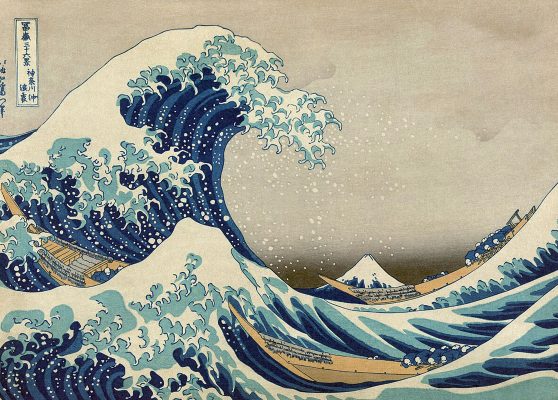
“Hokusai – The Great Master of Japanese Art” stands as one of the most significant exhibitions in Rome devoted to Japanese art, offering a rigorous and articulated exploration of the work of Katsushika Hokusai (1760–1849). Conceived as a scholarly yet accessible project, the exhibition examines the artist’s long and restless career, highlighting his capacity to transform traditional iconography into a dynamic and innovative visual language.
Through a carefully structured curatorial approach, the exhibition situates Hokusai within the cultural and intellectual framework of Edo-period Japan, while simultaneously addressing his extraordinary influence on the development of modern Western art. The project unfolds as a visual and conceptual journey, inviting visitors to engage with themes such as nature, landscape, everyday life, and the relationship between human experience and the forces of the natural world. Without resorting to celebratory rhetoric, the exhibition foregrounds the complexity of Hokusai’s vision, underscoring his role as a pivotal figure in the global history of art.
Exhibition theme: Hokusai and the world of Ukiyo-e
At the core of the exhibition lies an in-depth investigation of ukiyo-e, the artistic genre that flourished in Japan between the seventeenth and nineteenth centuries and within which Hokusai developed his distinctive voice. Literally translated as “pictures of the floating world,” ukiyo-e encompassed scenes of urban life, landscapes, actors, courtesans, and popular culture, reflecting the tastes and aspirations of a rapidly evolving society. Hokusai’s contribution to this tradition was both radical and transformative: while fully conversant with its conventions, he consistently expanded its thematic and formal boundaries.
Beyond convention: innovation within tradition
Hokusai’s work demonstrates an acute awareness of the visual heritage of Japanese painting and printmaking, yet it is marked by an unrelenting drive toward experimentation. His compositions often display daring perspectives, asymmetrical structures, and a sophisticated use of line that departs from established norms. The exhibition emphasizes how Hokusai redefined the possibilities of the woodblock print, elevating it from a popular medium to a vehicle for profound artistic expression.
Figures of Ukiyo-e: the human presence in the floating world
Within the visual universe of ukiyo-e, the representation of human figures occupies a central and multifaceted role. Far from functioning as mere narrative accessories, figures in ukiyo-e prints articulate a complex reflection on identity, social roles, and the transient nature of existence in Edo-period Japan. Hokusai approaches the human figure not as an idealized form, but as a living presence embedded in daily gestures, labor, leisure, and ritual, revealing a profound sensitivity to the rhythms of ordinary life.
Everyday life and social typologies
Artisans, fishermen, travelers, women engaged in domestic activities, and performers populate Hokusai’s prints with a remarkable sense of immediacy. These figures are defined less by individual portraiture than by their typological clarity, embodying recognizable roles within the urban and rural fabric of Japanese society. Through economy of line and expressive posture, Hokusai conveys movement, effort, and emotion, transforming fleeting moments into enduring visual statements.
The body in motion and the dynamics of gesture
A distinctive feature of Hokusai’s figural language is the emphasis on bodily movement. Figures bend, strain, walk, carry, and work, often interacting directly with natural forces or architectural spaces. This dynamic treatment underscores the physicality of human existence and situates the body as a mediator between the individual and the surrounding world. Gesture becomes a primary expressive tool, capable of suggesting narrative, labor, or contemplation without recourse to explicit storytelling.
Human figures and the ephemeral nature of the Ukiyo
In keeping with the philosophical underpinnings of the ukiyo, or “floating world,” human figures are frequently depicted as transient presences, absorbed in actions that underscore the impermanence of experience. Whether engaged in pleasure, work, or travel, they appear subject to time, change, and contingency. Hokusai’s treatment of the figure thus resonates with broader cultural reflections on impermanence, aligning visual form with ethical and existential awareness.
Nature as a central motif
A recurring theme throughout the exhibition is nature, conceived not merely as a backdrop but as an active and often dominant presence. Mountains, rivers, waves, and atmospheric phenomena become protagonists in Hokusai’s imagery, embodying both the beauty and the unpredictability of the natural world. This approach reflects broader philosophical and spiritual currents in Japanese culture, including Shinto and Buddhist conceptions of humanity’s place within a larger cosmic order.
Mount Fuji as symbol and structure
Particular attention is devoted to Mount Fuji, a subject that occupies a central position in Hokusai’s oeuvre. Through repeated variations, the mountain is transformed into a unifying axis around which issues of permanence, change, and perception are articulated. The exhibition contextualizes these works within the religious and cultural significance of Fuji, while also examining their formal innovations and compositional clarity.
Katsushika Hokusai: life, identity, and artistic evolution
Understanding Hokusai’s art requires an appreciation of his complex biography and his constantly shifting artistic identity. Over the course of his long career, he adopted numerous names, each marking a new phase in his creative development. This practice, far from being anecdotal, reflects a deeper conception of artistic life as a process of continual renewal.
A restless career
Born in Edo (modern-day Tokyo), Hokusai was active for more than seven decades, producing an extraordinary body of work that spans illustrated books, single-sheet prints, drawings, and paintings. The exhibition traces this evolution chronologically, allowing visitors to perceive both continuity and transformation in his artistic language. Early works reveal his engagement with popular subjects, while later productions demonstrate an increasing focus on landscape, abstraction, and formal synthesis.
The artist as observer of the world
Hokusai’s acute observational skills are evident in his depictions of everyday life, where gestures, postures, and activities are rendered with economy and precision. The exhibition highlights how these scenes, while rooted in the specific context of Edo-period society, possess a universal resonance that transcends time and geography.
Drawing as foundation
A dedicated section explores Hokusai’s practice of drawing, which underpins all aspects of his production. Sketchbooks and preparatory studies reveal his methodical approach to form and movement, as well as his ability to distill complex scenes into essential visual elements. These materials offer rare insight into the intellectual discipline that sustained his prolific output.
Exhibition path
The exhibition path is structured as a thematic and chronological journey, designed to guide visitors through the principal phases of the artist’s career while emphasizing key conceptual issues. The layout encourages close visual engagement, fostering an understanding of Hokusai’s technical mastery and compositional intelligence.
From urban scenes to expansive landscapes
The opening sections focus on Hokusai’s engagement with the vibrant urban culture of Edo, presenting works that depict artisans, performers, and scenes of daily activity. Gradually, the narrative shifts toward landscape, where the artist’s vision attains a new level of ambition and universality. This transition is presented not as a rupture, but as a logical extension of his interest in rhythm, movement, and spatial organization.
The language of the Woodblock Print
A significant portion of the exhibition is dedicated to the technical aspects of woodblock printing. Through selected works, visitors are invited to consider the collaborative nature of the process, involving designers, carvers, and printers. The exhibition underscores how Hokusai exploited the expressive potential of line, color, and texture, achieving effects of remarkable clarity and dynamism.
Color, line, and perspective
Detailed analysis of selected prints reveals Hokusai’s innovative use of imported pigments, such as Prussian blue, and his engagement with Western principles of perspective. These elements are examined not as isolated curiosities, but as integral components of a broader visual strategy that sought to expand the expressive range of Japanese art.
Why visit the exhibition
Visiting the exbition offers a rare opportunity to encounter an artist whose work reshaped the visual imagination of multiple cultures. The exhibition provides not only an introduction for those new to Japanese art, but also a nuanced and critical perspective for specialists and informed audiences.
Hokusai and the birth of a global visual culture
The exhibition addresses Hokusai’s profound influence on Western artists of the nineteenth and twentieth centuries, from Impressionism to modern graphic design. By situating his work within a transnational framework, the project illuminates the mechanisms of artistic exchange and the emergence of a truly global visual culture.
An intellectual and aesthetic experience
Beyond its historical significance, the exhibition invites reflection on enduring questions related to perception, nature, and creativity. Hokusai’s ability to combine formal rigor with imaginative freedom speaks to contemporary concerns, making the exhibition both timely and intellectually stimulating.