Jack Vettriano in Rome: painting between narrative and vision
“Jack Vettriano in Rome” is an exhibition project that invites viewers to engage with an artist who has been able, with rare clarity, to occupy the boundary between popular acclaim and institutional legitimacy. Vettriano has often been interpreted through reductive categories: on the one hand, the immediate seduction of “narrative” images; on the other, the accusation of an aesthetic considered too accessible, at times mistaken for superficiality. For this very reason, an exhibition set in Rome, and embedded within the historical and urban fabric of Trastevere, can function as a critical device: not to “absolve” or “condemn”, but to reveal the internal structure of a painting that operates through desire, memory, and the theatre of relationships.
Vettriano’s scenes are constructed as fragments: they do not tell everything, but rather suggest. The narrative is never explicit; instead, it is entrusted to the posture of bodies, the distance between figures, the light that cuts through space, and above all to atmosphere. Here lies one of the reasons for the persistence of his imagery: painting acts as a projection machine, in which the viewer completes what is absent, filling the gaps with experience and desire.
Biography and training: from the self-taught Jack Hoggan to Vettriano
Working-class origins and early labour
The biographical trajectory of Vettriano, born Jack Hoggan in 1951 in the Scottish county of Fife, within a family context linked to the mining industry, is not a merely ornamental detail: it is a key to interpreting his position within the art system. The artist left school at an early age and began working young, moving toward a technical role in the mining environment. The distance from an academic training—often cited by critics as a limitation—also constitutes the premise of his autonomy outside institutional frameworks, allowing him to develop a direct relationship with models drawn from visual culture.
Watercolours and solitary apprenticeship
The turning point comes in adulthood, when a set of paints (watercolours and painting materials) introduces him to a practice that gradually becomes essential. Vettriano begins as a self-taught artist, in his spare time, copying and studying: an ancient, workshop-based method in which imitation is not servile but formative. During this phase, the artist looks to different traditions: from the old masters to the experiences of Impressionism, through to suggestions from Surrealism and a Scottish tradition attentive to narrative and atmosphere. Here, self-taught practice does not coincide with improvisation; it coincides with the discipline of learning through stratification, selecting references and constructing a personal grammar.
The first public recognition: Royal Scottish Academy
The transition from the private to the public sphere is concentrated in an episode that, in its essential nature, proves revealing: participation in the annual exhibition of the Royal Scottish Academy in Edinburgh, where the exhibited works were quickly purchased, opening a circuit of galleries and media attention. This event does not merely mark an initial “success”; it marks the entry of an already highly recognisable figurative language into a professional context that would compel the artist to confront market expectations and critical inertia.
The artistic name and Italian genealogy
It is at this moment that the artist adopts the name Vettriano, derived from his mother’s surname (reported in some sources as Vettraino/Vettriano), linking his identity to a genealogy that includes Italian origins: his mother descended from a family with roots in southern Lazio. For an exhibition in Rome, this element should not be understood as a mere curiosity, but as an indication of a composite European identity, in which belonging is stratification rather than label. Vettriano, in other words, is not only “Scottish”: he is an artist who embodies a modernity shaped by passages, adoptions, and reinventions.
Sentimental noir, eros, and romanticism
Painting as a film still: direction, light, waiting
The most evident quality of Vettriano’s painting is its cinematic structure. This is not a superficial reference: the scene is often conceived as a framed shot, with a precise emotional focus and a surrounding aura of ambiguity. Light—almost always artificial or sharply defined—functions as direction: it isolates faces, accentuates the texture of fabrics, separates bodies and objects, creating a hierarchy of vision. In many works, what matters is not the action, but the moment before or after: the instant in which everything can still happen. Here painting ceases to be descriptive and becomes suspense.
Eros as a narrative device
Eros does not coincide with the exhibition of the body; it coincides with the construction of tension. Sensuality emerges through details: a bare shoulder, a glove, a cigarette, a heel; and above all through the gap between proximity and distance. Attraction between figures is often evident, yet communication remains fragile: gestures are interrupted, gazes brush past without meeting. This ambivalence produces a distinctly modern dimension: intimacy as theatre, desire as enigma, love as promise and unease.
Restless romanticism and bourgeois theatre
The settings—hotel rooms, exclusive clubs, ballrooms, night interiors—are not simple backdrops. They are “sets” that carry a social code: elegance, control, appearance. It is within this code that unease insinuates itself. Vettriano does not merely paint couples; he paints relationships in which attraction is always traversed by an element of risk, secrecy, or loss. The bourgeoisie here is not a sociological theme but an atmosphere: a mental space in which form both protects and imprisons.
Solitude and modernity
One of the most persistent motifs in Vettriano’s work is solitude. Even when the scene is populated, each figure appears separate, as if existing within a psychic bubble. This quality is achieved through compositions that emphasise voids, distances, and margins: often the painting suggests an “off-screen” space that weighs as heavily as what is represented. In this sense, Vettriano indirectly dialogues with a line of figurative modernity attentive to urban alienation and incomunicability—not through learned quotation, but through affinity of emotional climate.
The beach as a stage
The coastal landscape—wind, rain, low sky—recurs as one of the artist’s major “symbolic spaces”. The beach is the place of exposure: bodies are visible, vulnerable; and at the same time it is the place of distance, because the horizon withdraws, dilutes, destabilises. In these scenes, elegance does not erase the natural element; it passes through it. It is here that melancholy becomes form.
The exhibition itinerary
The exhibition itinerary unfolds through a selection of over eighty works, offering visitors the opportunity to explore the work of one of the most commercially successful and widely reproduced figurative artists of the contemporary era. The exhibition does not merely present an anthology of well-known images, but constructs an articulated interpretative framework capable of conveying the complexity of a pictorial language grounded in atmosphere, narrative, and emotional tension.
Alongside ten oil paintings, representing the most recognisable core of Vettriano’s production, the exhibition includes works on museum-quality paper in unique, certified editions, created specifically for the Roman presentation. These works allow close observation of the compositional structure of the images: the role of drawing, the construction of bodies, and the use of light as a dramaturgical element. Paper thus becomes a space of concentration, in which painting reveals itself as process rather than purely as iconic result.
Photography and self-representation
A significant contribution to the interpretation of the work is offered by the photographic series taken in the artist’s studio by Francesco Guidicini, official portrait photographer of the Sunday Times. These images, far removed from a purely documentary function, introduce a reflection on the construction of the artist’s public image and on the relationship between painting, photography, and media.
The dialogue between paintings and photographs highlights a constant in Vettriano’s poetics: an awareness of the scene. Just as his paintings appear constructed as suspended film stills, the artist’s studio also emerges as a place of staging, in which the boundary between intimacy and representation remains deliberately ambiguous.
The voice of Vettriano: memory and stylistic awareness
The exhibition is enriched by a video in which Jack Vettriano recounts his artistic trajectory, focusing on the evolution of his pictorial language and on his relationship with the public and critics. The inclusion of this audiovisual material is not celebratory, but interpretative: it allows the artist’s self-narration to be set in dialogue with the exhibited works, highlighting continuities and tensions between intention, practice, and reception.
In this context, Vettriano’s painting emerges as a language constructed over time, founded on a conscious repetition of themes and atmospheres, in which eros, solitude, and desire become structural elements of a coherent vision.
Icons and counter-shots: reading beyond the “famous” image
Every exhibition on Vettriano must manage a specific risk: the reduction of his work to a catalogue of iconic images. The challenge lies in revealing what, beneath the icon, persists as structure: the conscious repetition of motifs, the grammar of light, the ability to compress a narrative into a single gesture. The installation at Palazzo Velli can thus valorise the “counter-shot”: lesser-known or more intimate works that allow an understanding of the breadth of his register, from openly theatrical scenes to those restrained, almost suspended in silence.
Light and surface
Vettriano’s painting is not only narrative construction; it is work on surface. Fabrics, skin, metal objects, reflections, shadows: everything contributes to a visual quality aimed at immediate legibility, without renouncing internal tension. The material is controlled, often smooth, but light renders it vibrant; and this vibration is what transforms a scene into a state of mind. Vettriano’s “realism” is, in fact, a realism of atmosphere: true not because it “resembles” reality, but because it produces an effect of psychological truth.
Palazzo Velli: a historic container for a modern imaginary
Placing Vettriano within a historic palace in the heart of Rome means bringing two temporalities into dialogue: on the one hand, the density of the site; on the other, the modern (and modernist) imaginary of an artist who has constructed scenes reminiscent of the “mid-twentieth century” as if they were contemporary myths. The resulting friction is productive: historic architecture does not domesticate the works, but amplifies their scenic character. In this dialogue, the exhibition also invites reflection on the very nature of figurative painting today: why, in an age of digital images and speed, does such a narrative form of painting continue to exert attraction?
The case of “The Singing Butler”
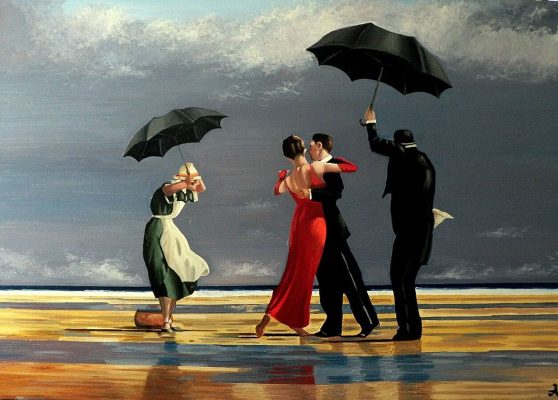
Among the best-known works associated with Vettriano, “The Singing Butler” (1992) represents a point of symbolic condensation: an elegantly dressed couple dances on a windy beach, while a butler and a maid hold umbrellas. It is an image that operates through contrast and desire: lightness and adverse weather, romanticism and precariousness, theatricality and melancholy. In 2004, the painting set an auction record with a sale price of £744,800, becoming emblematic of how the popularity of an image can translate into economic value and, at the same time, shared memory.
Music, imagination, popular culture
A true interpretative mythology has developed around this work: Vettriano himself fostered the idea of an implicit soundtrack, a song that renders the scene even more cinematic and nostalgic: Fly Me to the Moon. Here, the pop element does not impoverish the painting; rather, it situates it within a network of accessible references, where the viewer’s imagination—musical, cinematic, personal—completes the image. The strength of the icon lies precisely in its openness: it is a “finished” image and, at the same time, infinitely continuable.
Honours, institutions, and media: the OBE
Vettriano’s trajectory demonstrates that recognition is never univocal. While part of the critical establishment maintained distance, the artist received significant institutional and media acknowledgements, including the honour of Officer of the Order of the British Empire (OBE) for services to the visual arts, awarded in the early 2000s. The OBE does not “resolve” the critical debate, but signals the public relevance of his work and his ability to engage a broad, cross-generational, and transnational imaginary.
The end of a trajectory: 1951–2025
The Roman exhibition takes place after the artist’s death, which occurred in March 2025 in Nice. This fact should not be read in commemorative terms, but as the closure of a historical arc: Vettriano now belongs to a completed season, and precisely for this reason his work can be assessed with greater clarity, beyond the contingencies of fashions and polarised judgments. In an era oscillating between hyper-conceptualism and returns to figuration, his painting remains a document of collective desires: for elegance, romance, and unease.
Why visit the exhibition
An exemplary case of contemporary figuration
Visiting the exhibition means encountering an exemplary case: an artist who, without academic training, constructed a language of extraordinary recognisability. It offers the opportunity to observe closely the coherence of this grammar—light, posture, atmosphere, set, elegance as mask, desire as tension—and above all to verify how figuration can still function today as a complex language, capable of addressing psychology and society without resorting to programmatic statements.
Beyond “kitsch” and beyond “cult”
Vettriano is often trapped between two opposing simplifications: dismissal as a “painter of easy appeal” and uncritical celebration as a popular icon. A well-conceived exhibition can help escape both traps. The point is not to decide whether Vettriano is “kitsch” or “cult”; rather, it is to understand which visual mechanisms he activates, which desires he intercepts, and which idea of modernity he stages. In this sense, the exhibition becomes a laboratory for reading contemporary imagery: how is an icon born? how can a motif be repeated without being exhausted? how does painting dialogue with cinema, advertising, photography, and collective memory?
The viewer as co-author
Vettriano’s painting requires an active viewer. Each scene is a fragment: beginning and end remain off-screen. This “unsaid” element is the true strength of his language: it does not impose a meaning, but constructs an emotional context in which each viewer recognises something—a memory, a desire, a fear. It is here that Vettriano, beyond questions of taste, demonstrates a rare quality: the ability to make painting an experience of projection, in which the image does not exhaust itself, but continues.
Rome as a critical frame: the present within history
Finally, the Roman venue holds a specific value. Rome is a city in which history is not background but substance; for this very reason, the encounter with such a “modern” imaginary—ballrooms, nights, hotels, beaches—produces a fertile short circuit. The exhibition invites reflection on a broader question: what do we seek in images today? Perhaps not only formal innovation, but also a narrative in which desires and contradictions can be recognised. Vettriano, with his atmospheric painting, stages precisely this: the persistence of romance and the shadow that accompanies it.
Curatorship
Chiara Campagnoli, Deborah Petroni, and Rubens Fogacci of Pallavicini s.r.l. organised the exhibition in collaboration with Jack Vettriano Publishing. The exhibition is curated by Dr Francesca Bogliolo. The curatorial project adopts a rigorous approach, avoiding both uncritical celebration and the reduction of the artist to a purely market-driven phenomenon.
The curatorship privileges a thematic reading, highlighting the internal coherence of Vettriano’s work and his ability to construct narrative images that interrogate the viewer. The patronage of Palazzo Velli strengthens the dialogue between the exhibition and its historical-architectural context, transforming the exhibition space into an active element of the visual narrative, capable of amplifying the theatrical and psychological dimension of the painting.